
Research Paper

Journal of the Korean Society of Mineral and Energy Resources Engineers. 31 October 2026. 843-868
https://doi.org/10.32390/ksmer.2026.63.5.843

ABSTRACT


MAIN

  • 서 론

  • 이론적·제도적 배경

  •   광산 평가, 행정보고 및 공개보고의 개념

  •   광물 매장량과 가채매장량의 정의 및 전환

  •   CRIRSCO 정합체계와 국가 공개보고 코드

  •   국가보고기구와 책임전문가

  •   국내 광산 평가 관련 제도의 목적과 구조

  • 연구방법

  •   분석자료

  •   비교항목 설정 및 조항 분류

  •   국내외 차이 분석

  •   분석 검증절차와 한계

  • 연구결과

  •   국제 공개보고 체계의 공통기능

  •   국내 현행제도의 구조와 특성

  •   국제기준과 국내 현행제도의 차이

  •   국내 제도 보완 가능 항목과 국가 코드 구축 필요 항목

  • CRIRSCO 정합형 국가 코드 개발을 위한 시사점

  •   국내 현행 제도의 의의 및 국제 공개 보고 기능 차이

  •   국내 공개보고 코드 개발의 필요성

  • 결 론

서 론

광물 매장량(mineral resources)과 광물 가채매장량(mineral reserves)에 관한 정보는 광산 개발단계의 의사결정, 프로젝트 금융, 투자 판단 및 기업가치 평가의 기초가 된다. 광산 프로젝트는 탐사에서 기술연구, 건설 및 조업으로 이어지는 장기간의 개발과정을 거치며, 각 단계에서 제시되는 수량·품위와 경제성 정보는 서로 다른 시점과 가정에 기초한다. 따라서 정보이용자가 그 의미와 불확실성을 해석할 수 있도록 공통 정의, 책임주체, 검증절차 및 공개범위를 규정하는 체계가 필요하다(Rendu and Miskelly, 2001; Camisani-Calzolari, 2004; Burnett et al., 2026).

이러한 필요에 대응하여 주요 광업국은 전문단체 규범, 거래소 규칙 또는 증권규정을 통해 광물 프로젝트의 공개보고를 제도화해 왔다. CRIRSCO는 국가·지역별 기준의 공통 정의와 최소요건을 조화시키는 International Reporting Template(IRT)을 제공하며, 각 관할권은 자국의 법률·시장·전문직 구조에 맞는 공개보고 코드를 운영한다(CRIRSCO, 2024; Sides and Allington, 2024). Burnett et al.(2026)은 국가별 공개보고 제도 비교를 통해 CRIRSCO 계열 기준이 높은 수준의 정의·분류 정합성을 공유하는 한편, 책임전문가의 인정방식, 보고형식 및 집행구조에서 관할권별 차이를 보인다고 분석하였다. 따라서 국제 공개보고 기준은 동일한 추정기법을 강제하는 계산표준이라기보다, 정보의 의미와 책임·검증·공개를 표준화하는 규범으로 이해할 필요가 있다.

국내의 광산 평가 관련 현행제도는 「광업법」과 하위법령, 광업업무처리지침 및 채굴권허가를 위한 광량산출기준 등을 중심으로 광업권·채굴권 설정, 채굴계획 인가, 생산보고와 행정감독을 지원한다(MOTIE, 2022a, 2022b). 반면 국제 공개보고 기준은 투자자와 그 조언자를 위한 과학적·기술적 정보의 공개를 목적으로 한다. 두 제도군은 정보이용자와 목적이 다르므로 명칭이나 등급의 단순 대응보다 각 체계가 수행하는 기능을 기준으로 비교할 필요가 있다.

국내 선행연구는 국내 광량 평가기준과 국제 분류체계의 차이를 검토하고 용어·분류의 정합 필요성을 제시하였다(Choi et al., 2019; Kim et al., 2020). 국외 선행연구는 CRIRSCO 계열 코드의 형성, 적용범위, 공통 정의, 책임전문가 및 보고요건을 폭넓게 비교하였다(Camisani-Calzolari, 2004; Burnett et al., 2026). 그러나 국내 광업행정의 고유 목적을 기준점으로 삼아 국제 공개보고의 공통기능을 기능별로 대응시키고, 그 결과 도출된 차이를 기존 제도의 보완과 별도 국가 공개보고 코드·운영체계의 필요성으로 구분한 연구는 제한적이다.

본 연구는 주요 국제 공개보고 체계에서 공통적으로 요구되는 기능을 도출하고, 이를 국내 현행 광업행정 제도와 비교하여 기능의 포함 수준과 제도적 차이를 분석하는 것을 목적으로 한다. 또한 확인된 차이를 기존 법령·지침·서식의 보완으로 대응할 수 있는 사항과 별도의 국가 공개보고 코드 또는 운영체계가 필요한 사항으로 구분하고, 이를 바탕으로 대한민국의 CRIRSCO 정합형 국가 공개보고 코드 개발에 필요한 핵심 구성요소와 우선 검토영역을 제시하고자 한다. 본 연구의 연구질문은 다음과 같다.

• RQ1. 본 연구에서 분석한 주요 국제 공개보고 체계에서 공통적으로 확인되는 핵심 기능은 무엇인가?

• RQ2. 국내 현행 광업행정 제도는 이러한 공개보고 기능을 어느 수준까지 포함하고 있으며, 주요 차이는 어떠한 제도영역에서 나타나는가?

• RQ3. 확인된 차이 중 기존 법령·지침·서식의 보완 또는 관계제도 연계로 대응할 수 있는 사항과 별도의 국가 공개보고 코드 및 운영체계가 필요한 사항은 무엇인가?

• RQ4. 대한민국의 CRIRSCO 정합형 국가 공개보고 코드에 우선적으로 포함되어야 할 핵심 구성요소는 무엇인가?

이론적·제도적 배경

광산 평가, 행정보고 및 공개보고의 개념

광산 평가는 지질자료를 이용한 부존량 추정에서 시작하여, 채광·선광·인프라·시장·환경·사회·인허가 조건을 검토하고 경제적 채굴 가능성을 판단하는 단계적 활동이다. 이 과정에서 생산된 정보가 어떤 이용자에게 어떤 책임구조로 전달되는지에 따라 행정보고와 공개보고가 구분된다. 행정보고는 행정기관의 인허가·감독 판단을 위해 법령이 정한 서식과 절차에 따라 제출되는 정보이고, 공개보고(public reporting)는 투자자와 그 조언자가 광물 프로젝트를 평가하도록 대중에게 제공되는 과학적·기술적 정보로서 연차보고서, 공시문서, 투자설명서, 웹사이트 게시물 등 대중이 접근할 수 있는 모든 형태를 포괄한다(CRIRSCO, 2024). 공개보고 체계는 1960년대 말 호주의 Poseidon 니켈 버블과 1990년대 캐나다 Bre-X 사건 등 부실보고가 투자자 피해로 이어진 역사적 계기를 통해 전문단체와 증권거래소가 협력하여 제도화되었다(Camisani-Calzolari, 2004; Burnett et al., 2026). 두 보고는 기초자료를 공유할 수 있지만 정보이용자, 목적, 책임, 검증구조 및 공개범위가 다르다(Table 1). 본 연구에서는 이 구분을 분석 전반의 전제로 삼았다.

Table 1.

Functional distinction between administrative and public reporting

Aspect Administrative reporting Public reporting
Primary information users Administrative agencies and permitting and supervisory officials Investors, financial institutions, market participants and their advisers
Primary purpose Mining and extraction rights, mining-plan authorisation, production and administrative supervision Disclosure of material scientific and technical information on mineral projects and investor protection
Key outputs Statutory and administrative forms, calculation sheets, drawings, permitting materials Public reports, technical reports, checklists, expert certificates
Responsibility structure Centred on applicants and operators and administrative review Centred on responsible experts’ qualification, signature and consent, professional bodies and market discipline
Verification Administrative review; checking of documents and assay results QA/QC, site visits, verification of primary data, independent review and disclosure of material information
Mutual relation Continues to perform administrative functions Performs a separate function for external information users without replacing the administrative system

광물 매장량과 가채매장량의 정의 및 전환

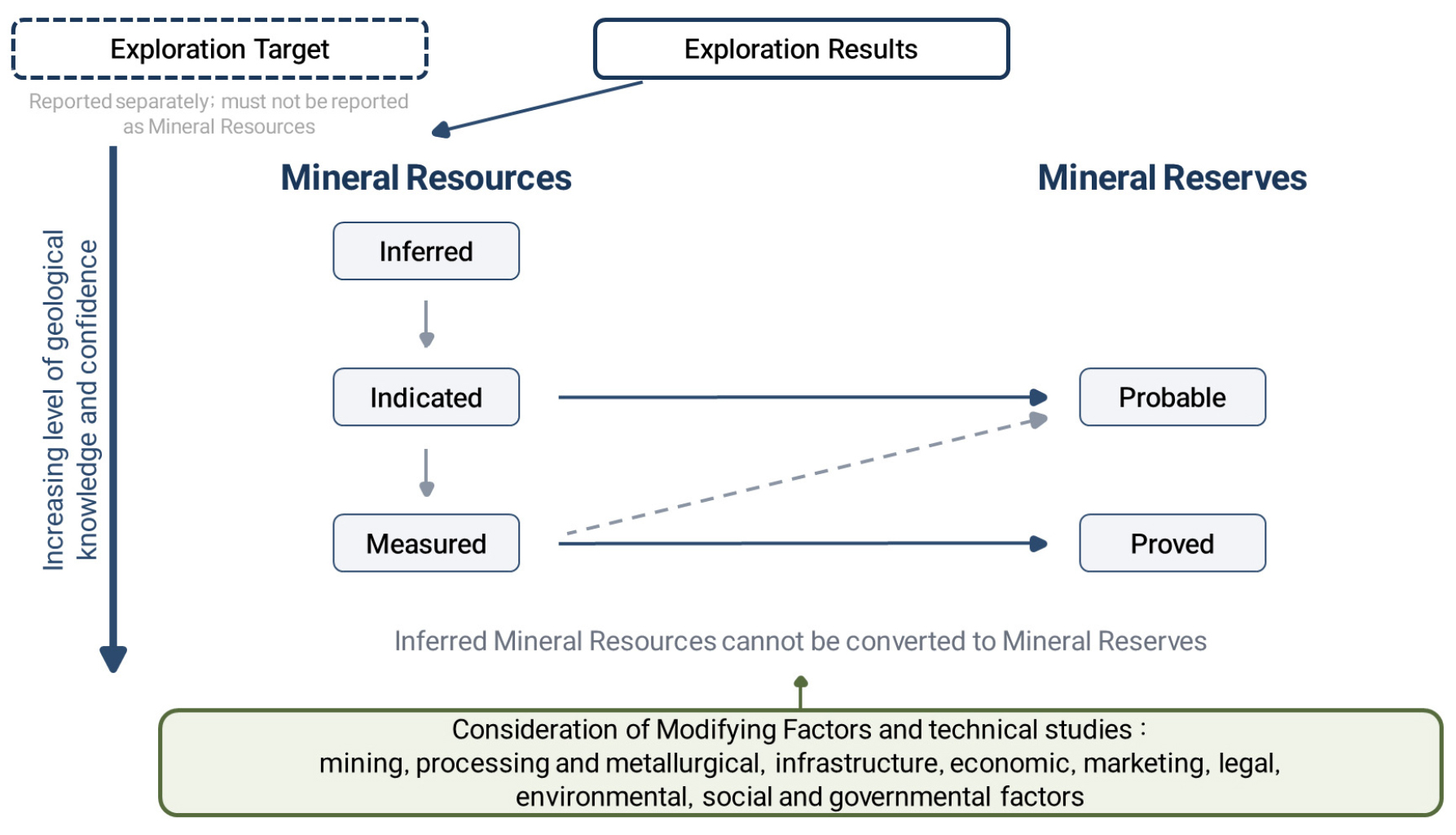
국제 공개보고 체계에서 탐사결과(exploration results)는 탐사활동에서 얻은 자료와 해석을 의미하고, 탐사목표(exploration target)는 잠재적 수량과 품위를 개략적으로 표현한 탐사개념으로서 광물 매장량과 혼동되지 않도록 제한된 방식으로 보고된다(CRIRSCO, 2024). 광물 매장량은 경제적 추출에 대한 합리적 전망(reasonable prospects for(eventual) economic extraction, RPEE(E))이 있는 광화물질의 수량과 품위이며, 지질학적 신뢰도가 증가하는 순서에 따라 예상(Inferred), 추정(Indicated), 확정(Measured)으로 분류된다. RPEE(E)는 광물 매장량 선언 이전에 충족되어야 하는 경제성 요건으로서 CRIRSCO 계열 코드의 핵심 요소로 논의되어 왔다(Lock, 2020). 광물 가채매장량은 Indicated 또는 Measured 등급의 매장량 중 전환요인(modifying factors)과 기술연구를 통해 경제적으로 채굴 가능한 것으로 입증된 부분이며, 추정(Probable)과 확정(Proved)으로 분류된다. JORC Code는 가채매장량을 나타내는 영문 표현으로 Mineral Reserves 대신 Ore Reserves를 사용한다(JORC, 2012). 본 논문은 국내 광업계의 용례와 Kim et al.(2020)의 국문 용례를 따라 Mineral Resources를 ‘광물 매장량’, Mineral Reserves를 ‘광물 가채매장량’으로 표기하되, 국내 행정분류인 확정광량·추정광량과는 명시적으로 구분한다.

광물 매장량에서 광물 가채매장량으로의 전환에는 채광, 선광·야금, 인프라, 경제성, 시장, 법률, 환경, 사회 및 정부 요인 등 전환요인이 적용되며, 전환을 뒷받침하는 기술연구는 정밀도에 따라 예비타당성조사(pre-feasibility study, PFS), 타당성조사(feasibility study, FS)로 구분된다(CRIRSCO, 2024). Fig. 1은 이 공통 구조를 설명한다.
https://cdn.apub.kr/journalsite/sites/ksmer/2026-063-05/N0330630521/images/ksmer_63_05_21_F1.jpg
Fig. 1.

Classification structure for mineral resources and mineral reserves under the international reporting standards.

CRIRSCO 정합체계와 국가 공개보고 코드

CRIRSCO는 국가·지역별 광물 매장량·광물 가채매장량 공개보고 기준의 국제적 정합성을 촉진하기 위한 자발적 국제 협의체로서, International Reporting Template (IRT)을 통해 공통 정의, 기본원칙 및 최소 공개요건을 제시한다(CRIRSCO, 2019a; CRIRSCO, 2024). 다만 IRT는 개별 국가에서 직접 적용·집행되는 법령이나 규정이 아니라, 국가·지역 코드의 개발과 개정을 위한 국제적 기준틀이다. 따라서 각 관할권에 별도의 국가·지역 코드가 마련되어 있는 경우에는 해당 코드가 우선 적용된다. 본 연구는 이러한 위계를 분석설계에도 반영하여, IRT를 공통 정의와 최소요건을 제시하는 참조층으로, JORC, NI 43-101·CIM, SAMREC, PERC 및 S-K 1300을 각 관할권의 구현층으로 구분하여 취급하였다. 이러한 점에서 CRIRSCO 체계는 IRT만으로 작동하는 것이 아니라, IRT와 정합성을 갖춘 국가·지역 코드, 이를 제정·유지·개정하는 국가보고기구, 책임전문가와 전문단체, 그리고 거래소·증권규제기관 등 관련 제도의 연계를 통해 실질적으로 운영된다.

국가 공개보고 코드는 IRT를 자국 언어로 단순히 번역한 문서가 아니다. 각 관할권은 IRT의 공통 정의, 기본원칙 및 최소요건을 유지하면서도 자국의 법률체계, 언어와 용어, 전문자격제도, 거래소·증권규제 및 광업행정 구조를 고려하여 코드의 적용대상, 보고범위, 책임구조 및 집행방식을 구체화한다(Sides and Allington, 2024; Burnett et al., 2026). 이에 따라 전문단체가 제정한 코드가 거래소 상장규정에 편입되는 방식, 증권규정이 전문기관의 정의와 기준을 법적으로 인용·편입하는 방식, 특정 거래소나 규제기관에 직접 귀속되지 않는 자율 전문표준 방식 등 다양한 제도유형이 병존한다. 이러한 차이는 공통기준의 부재를 의미하는 것이 아니라, 동일한 공개보고 기능을 각국의 제도환경에 맞게 구현하는 방식의 차이로 이해할 수 있다.

국가 코드의 개발과 CRIRSCO 가입은 서로 연계되어 있지만 구분되는 절차이다. 국내에서 CRIRSCO 정합형 국가 코드를 개발하고 운영체계를 마련하는 것은 국제 공개보고 원칙을 국내 제도환경에 적용하기 위한 제도형성 과정이다. 반면 CRIRSCO 가입은 IRT와 호환되는 국가 코드의 존재뿐 아니라, 해당 코드를 지속적으로 유지·개정할 국가보고기구, 책임전문가의 적격성을 관리하고 윤리·징계 기능을 수행할 전문단체, 그리고 CRIRSCO와의 협의 및 심사절차 등 회원요건을 충족한 후 진행되는 조직적 절차이다(CRIRSCO, 2019b). 따라서 본 연구에서 국가 코드 개발의 필요성을 제시하는 것은 향후 CRIRSCO 가입 기반을 마련해야 한다는 의미이지만, 이를 근거로 구체적인 가입시기, 신청주체, 국가보고기구의 구성 또는 코드의 법적 지위를 직접 확정할 수 있는 것은 아니다.

국가보고기구와 책임전문가

국가보고기구(National Reporting Organisation, NRO)는 국가·지역 코드를 제정·유지·개정하고 CRIRSCO와의 정합성을 관리하는 운영주체이다. CRIRSCO 회원정책은 코드의 호환성뿐 아니라 윤리강령, 지속적 전문교육 및 실효적 징계절차를 갖춘 전문단체가 운영구조에 포함될 것을 요구한다(CRIRSCO, 2019b). NRO는 단일기관일 수도 있고 전문단체·산업계·규제기관 등이 참여하는 공동구조일 수도 있으므로, 국내에서 어떤 기관형태가 적절한지는 별도의 제도설계와 법제검토가 필요하다.

모든 체계는 광물 매장량·광물 가채매장량 평가와 공개보고에 전문적 책임을 지는 책임전문가(Competent Person, CP; Qualified Person, QP) 제도를 둔다. CRIRSCO IRT, JORC, SAMREC, PERC는 CP를, NI 43-101과 S-K 1300은 QP를 사용한다. 두 용어는 기능적으로 유사하지만 자격경로와 법적 책임이 다르므로 본 연구는 일반적 기능을 지칭할 때만 ‘책임전문가’로 통칭한다. 국제체계는 대체로 관련 광상유형과 수행활동에 관한 최소 5년의 경력, 인정 전문단체 소속, 성명·자격·업무범위의 공개, 서명·동의 및 윤리·징계 가능성을 요구한다(CRIRSCO, 2024; Waltho et al., 2022). 이 제도는 전문가의 판단 편차를 제거하기보다는 판단근거를 문서화하고 책임을 배분하는 장치로 이해할 수 있다(Owusu and Dagdelen, 2024).

국내 광산 평가 관련 제도의 목적과 구조

국내의 광산 평가 관련 제도는 법적 강제력을 갖는 광업행정 체계와 자율적으로 적용되는 국가표준의 두 층으로 구성된다. 광업행정 체계는 「광업법」(법률 제21438호)과 그 하위법령, 「광업업무처리지침」(산업통상자원부 고시 제2022-24호), 「채굴권허가를 위한 광량산출기준」(산업통상자원부 고시 제2022-25호) 등으로 이루어지며, 광업권·채굴권의 설정, 채굴계획 인가, 생산보고 및 행정감독에 필요한 절차와 제출자료를 규정한다(Mining Industry Act, 2026; MOTIE, 2022a, 2022b; MOTIR, 2025; Enforcement Decree of the Mining Industry Act, 2025). 「광업법 시행규칙」은 채굴권설정 출원 시 광량보고서의 제출을 요구하며(제8조 제2항 제1호), 광량산출기준은 지표노두·시추탐사·탐광갱도·사광상형의 네 가지 광량산출구획을 조사간격, 확장거리 및 심도한계 등 정량적 공간기준으로 규정한다(MOTIE, 2022b). 다만 이 기준은 광량을 신뢰도 등급으로 구분하지 않고 단일 개념으로 정의한다. 또한 광업업무처리지침은 광량계산표, 지질도, 단면도 및 분석자료 등 행정심사에 필요한 서식과 품위분석 공인기관 지정제도를 규정한다. 이러한 정량적 산정기준과 표준화된 제출서식은 행정기관이 신청자료를 일관된 기준으로 검토하도록 지원하며, 국내 광업행정 제도의 재현성과 행정적 일관성을 확보하는 장점이 있다.

자율적 국가표준으로는 KS E 2001 「광물 자원의 매장량 및 가채 매장량 평가 기준」이 있다. 이 표준은 2020년 12월 31일 개정되었으며, 광물 매장량을 예상·추정·확정의 3개 범주로, 광물 가채매장량을 추정·확정의 2개 범주로 구분하고(3.1.1~3.1.3, 3.3.1~3.3.2), 매장량의 정의에 경제적 개발에 대한 합리적 전망을 포함하며(3.1), 전환요인(3.2)과 최소 예비타당성 평가 수준의 기술연구(3.3)를 규정하는 등 국제 공개보고 체계와 정합되는 주요 기술요소를 제시한다(KATS, 2020; Kim et al., 2020). 또한 매장량 범주의 중복 사용 금지, 매장량과 가채매장량의 합산 표시 금지, 기술적 실현 가능성과 경제적 타당성이 확보되기 전까지 ‘가채매장량’ 용어의 사용을 제한하는 표현규칙도 두고 있다(4.2.2, 4.3.1, 4.3.3).

다만 한국산업표준은 임의표준이므로 그 준수가 광업행정이나 자본시장 공시의 의무요건 전반으로 연결되지는 않는다. 부분적 연계는 존재한다. 「광업업무처리지침」 제32조 제2항 제4호는 채굴계획서의 광량 기재에 광량보고서와 함께 “한국산업규격(KS규정) 광종별 광량계산기준”을 적용하도록 지시하고 있다. 그러나 여기에 인용된 명칭은 2020년 개정 이전의 광량계산기준으로서 현행 KS E 2001의 표준명 및 내용과 일치하지 않는다. 상위 기술표준이 개정되어도 이를 인용하는 행정규칙이 함께 갱신되지 않은 것으로, 기준의 유지·개정을 연동하는 절차가 제도화되어 있지 않음을 보여주는 사례이다.

또한 표준의 유지·개정체계는 CRIRSCO 체계에서 요구되는 국가보고기구, 책임전문가 인정체계, 전문단체의 윤리·징계 및 시장·규제기관과의 연계 기능을 포함하지 않는다. 국내 광량 평가체계와 국제 공개보고 기준 간의 부정합, 그리고 평가자의 자격·책임체계 미비는 기존 연구에서도 주요 개선과제로 지적되어 왔다(Choi et al., 2019; Kim et al., 2020).

연구방법

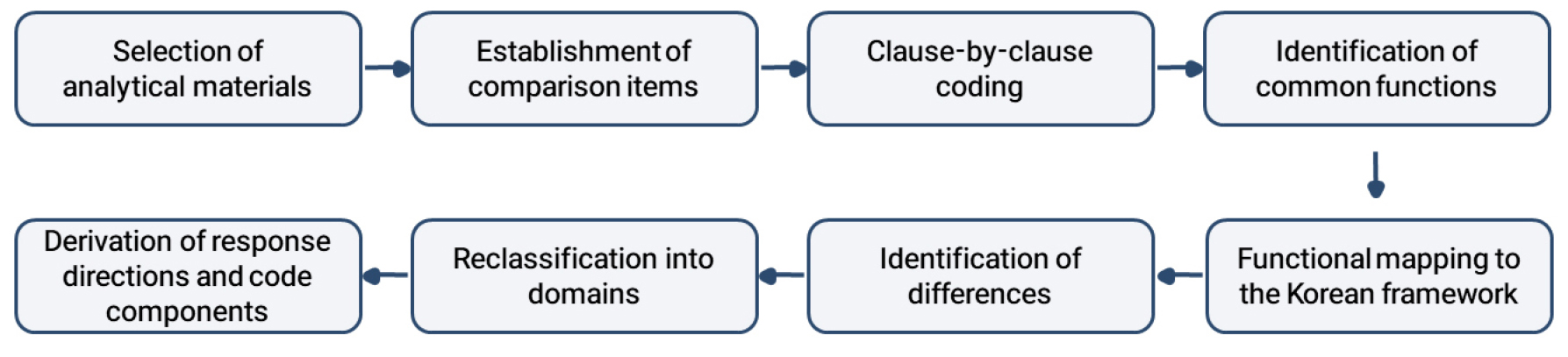
본 연구는 정성적 문헌분석과 조항 단위 비교분석을 결합하였다. 연구절차는 분석자료 선정, 비교항목 설정, 조항 코딩, 국제 공통기능 도출, 국내 기능 대응, 차이항목 식별, 영역 재분류, 제도적 대응방향 및 국가 코드 구성요소 도출의 순서로 진행하였다(Fig. 2).
https://cdn.apub.kr/journalsite/sites/ksmer/2026-063-05/N0330630521/images/ksmer_63_05_21_F2.jpg
Fig. 2.

Research procedure.

분석자료

본 연구에서 분석한 자료는 각 체계의 제정기관이 공표한 공식 문서로서 판본과 시행상태가 확인된 현행판을 우선하였다. 국제자료는 CRIRSCO IRT 2024년 6월판, JORC Code 2012, NI 43-101 2023년 통합본과 Companion Policy 43-101CP 및 Form 43-101F1, CIM Definition Standards 2014와 CIM Best Practice Guidelines 2019, SAMREC Code 2016, PERC Reporting Standard 2021, Regulation S-K Subpart 1300 및 관련 거래소·규제기관 문서(ASX Listing Rules Chapter 5, JSE Listings Requirements Section 14 등)이다(ASX, 2019; JSE, 2026). 공표되었으나 시행되지 않은 개정안은 현행 요건의 판정근거로 사용하지 않고 제도 동향으로만 검토하였다. NI 43-101과 CIM Definition Standards는 상호 연계되지만 제정주체와 규범적 지위가 다른 별개의 문서로 구분하였고, SME Guide와 자산가치평가 전용 기준은 보조자료로만 활용하였다(CIM, 2014; CIM, 2019; SME, 2014). 이 가운데 CRIRSCO IRT는 특정 관할권에서 직접 적용·집행되는 규범이 아니라 국가·지역 코드가 채택할 국제 참조 템플릿이므로, 나머지 다섯 개 체계와 동일한 집행규범으로 취급하지 않고 공통기능 도출의 참조선으로 사용하였다. 반면 다섯 개 관할권 체계는 각각의 법률·시장·전문직 구조 안에서 실제로 집행되는 요건으로 취급하여, 조항 코딩에서는 여섯 개 체계를 모두 대상으로 하되 공통기능 판정에서는 두 층위의 역할을 구분하였다. 국내 제도는 광업법령과 광업업무처리지침, 광량산출기준을 판정 대상으로 하였다. 국가표준인 KS E 2001(KATS, 2020)은 국제 측의 CRIRSCO IRT와 마찬가지로 그 자체가 특정 절차에 직접 적용·집행되는 규범이 아니라 정의·분류·전환에 관한 기술적 참조규범이므로, 국제와 국내 양측에 동일한 층위 구분을 적용하여 집행층인 광업법령·고시를 판정 대상으로 하고 KS E 2001은 국내 참조층으로 구분하여 취급하였다. 다만 이 구분이 판정 결과에 미치는 영향을 확인하기 위하여 KS E 2001을 판정 대상에 포함한 경우의 변화를 별도로 검토하였다.

본 연구에서 ‘광산’은 국제 공개보고 기준의 적용범위에 포함되는 고체광물 광산 전반을 의미하며, 금속·비금속·산업광물, 석탄, 보석광물, 석재·골재 및 경제적 가치가 있는 광미·폐석·저품위 광물을 포함하고 석유, 천연가스, 지하수, 지열자원은 제외한다. ‘광산 평가체계’는 광물 매장량·광물 가채매장량의 추정·분류·검증과 그 결과의 보고·공개를 규율하는 규범과 운영구조로 한정하고, ‘국제기준’은 본 연구가 분석한 CRIRSCO 계열 공개보고 기준과 이와 기능적으로 비교 가능한 증권규정을 지칭하는 용어로 사용한다.

비교항목 설정 및 조항 분류

비교분석의 틀은 제도적 성격과 적용구조, 적용범위, 기본원칙, 정의와 분류, 전환절차, 평가자의 자격과 책임, 자료 검증과 품질관리, 보고와 공시, 갱신과 집행의 9개 비교항목으로 구성하였다. 하나의 코딩 단위는 하나의 체계·문서·분석질문·조항근거를 원칙으로 하였다. 동일 조항이 복수 기능에 관련되는 경우 주된 기능을 대표 비교항목으로 지정하고 관련 기능을 보조항목으로 기록하였다.

국제기준 여섯 개 체계에 대하여 142개, 국내 제도에 대하여 36개, 총 178개의 조항 단위 기록을 구축·코딩하였다. 각 기록에는 원문 조항, 문서판본, 규범유형, 의무주체, 적용대상, 의무수준, 공개범위, 책임·집행구조 및 국내 시사점을 기록하였다. 의무수준은 명시적 의무, 조건부 의무, 권고·지침, 자율 및 해당없음으로 구분하였다. 문구의 존재 여부만으로 판정하지 않고 제도의 목적, 주체, 강제성, 공개범위 및 집행 가능성을 함께 검토하였다.

국제 공통기능은 개별 체계의 조항을 단순 합집합으로 모으지 않고, 다음 두 기준 중 하나 이상을 충족하는 기능으로 한정하여 도출하였다. 첫째, CRIRSCO IRT가 공개보고 요건으로 규정하는 기능이다. 둘째, IRT에 명시되어 있지 않더라도 다섯 개 관할권 체계(JORC, NI 43-101·CIM, SAMREC, PERC, S-K 1300) 가운데 셋 이상에서 명시적 조항 또는 기능적으로 동등한 규정으로 확인되는 기능이다. 기능적 동등성은 조문의 명칭이나 표현이 아니라 요구되는 정보의 내용, 의무주체, 의무수준 및 공개범위가 실질적으로 같은 목적을 수행하는지를 기준으로 판단하였다. 이 기준에 따라 특정 관할권에만 존재하는 추가요건은 공통기능으로 집계하지 않고 관할권별 변이로 구분하여 Table 4에 기록하였다. 이는 IRT를 공통 참조선으로, 다섯 개 관할권 체계를 그 구현층으로 구분하여 취급한 것으로, 관할권 고유 요건이 공통기능으로 과다 집계되는 것을 방지하기 위한 절차이다.

국제기준의 공통기능과 국내 제도의 대응수준은 부합, 부분부합, 미반영 및 목적상이로 구분하였다(Table 2). 부합은 기능의 목적·적용대상·의무수준·책임구조가 국내 제도에서 실질적으로 확인되는 경우이다. 부분부합은 관련 절차가 존재하지만 공개보고 목적, 적용범위, 의무수준 또는 책임체계 중 일부가 충족되지 않는 경우이다. 미반영은 대응하는 명시적 제도·절차 또는 의무를 분석대상 문서에서 확인하기 어려운 경우이며, 목적상이는 유사한 정보나 절차가 존재하지만 정보이용자와 제도목적이 달라 동일 척도로 충족 여부를 판단하기 어려운 경우이다. 부합으로 판정된 기능은 차이항목 집계에서 제외하였으며, 따라서 차이항목은 목적상이·부분부합·미반영으로 판정된 기능으로 구성된다.

Table 2.

Operational definitions of the analytical framework

Dimension Value Operational definition
Functional inclusion   Conformant The purpose, scope, obligation level and responsibility structure of the function are substantively confirmed in the Korean framework. Functions judged conformant were excluded from the difference count; no function met this criterion in the present analysis.
Partially aligned The relevant function is partly reflected, but at least one of its scope, procedure, responsibility or disclosure requirements differs from the international common function
Not reflected No corresponding explicit institution, procedure or obligation is identified in the analysed statutes, administrative rules and forms
Different purpose A related function exists, but its information users and institutional purpose differ from those of international public reporting, so fulfilment cannot be judged on a common scale and the difference is not treated as a mere deficiency
Difference level Structural The difference concerns the presence or absence of an institutional framework ‒ definitions, responsibility structure, recognition system or governance ‒ rather than the content of an individual provision.
Material The difference directly affects the interpretation, reliability or comparability of evaluation information, or a user’s decision
Supplementable An existing domestic procedure, dataset or form already performs much of the function, and the difference concerns the scope or level of detail of what is required or disclosed.
Primary domain Institutions and governance Institutional purpose and information users, legal structure, maintenance and governance of the standard, guiding principles, and the scope of public reporting
Definition, classification and conversion Definitions and classification of Mineral Resources and Mineral Reserves, the economic gate, conversion procedures, Modifying Factors, and technical studies
Responsible experts and professional organisations Qualifications, experience, independence, signature and consent, ethics, continuing professional development, and disciplinary mechanisms
Verification and public reporting QA/QC, site inspection, data verification, independent review, internal control and traceability, reporting formats, and disclosure requirements
Updating and enforcement Effective dates, periodic updating and reconciliation of changes, and enforcement including linkage with capital-market disclosure and sanctions
Response characteristic Supplementary A similar domestic procedure, dataset, form, or responsible body already exists, and the function can be implemented mainly by adding or extending reporting items, verification procedures, updating requirements, or data-linkage rules within existing statutes, notices, guidelines, or forms. Derivation rule: items recorded as “supplementable” difference level, or as “material” with applicability recorded as “immediately usable” or “partly usable”.
Structural The function cannot be implemented consistently through partial amendment of the current administrative framework alone and requires creation or redesign of a national public reporting code, a standing operating body, responsible-expert recognition, professional discipline, or an institutional linkage with capital-market disclosure and enforcement. Derivation rule: items recorded as “structural” difference level, or as “material” with applicability recorded as “new design”.
Primary response direction Forms and guideline enhancement Supplementation of existing administrative forms, reporting items or implementation guidelines
Linkage with related systems Coordination of data, procedures and roles with mining administration, environmental permitting, capital markets and production reporting
Separate national code Establishment of CRIRSCO-aligned definitions, principles, conversion procedures and reporting requirements
Separate operating framework Establishment of a reporting body, expert recognition, ethics, discipline and related governance mechanisms
Follow-up legal and policy research Further examination of legal basis, institutional arrangements and implementation measures

확인된 차이항목의 제도적 대응 가능성을 판단하기 위하여 대응 성격을 구조형과 보완형으로 구분하였다. 구조형은 기존 법령·고시·지침·행정서식의 일부 개정만으로는 해당 기능을 지속적이고 일관되게 구현하기 어렵고, 별도의 국가 공개보고 코드, 상설 운영주체, 책임전문가 인정체계, 전문적 윤리·징계 또는 자본시장 공시·집행과의 제도적 연계가 필요한 경우로 정의하였다. 특히 새로운 정의·분류·전환체계, 독립된 책임주체, 전문가 인정 및 징계권한, 코드의 제정·유지·개정 또는 시장규제와의 연계가 요구되는 항목은 구조형으로 판정하였다. 보완형은 국내에 유사한 자료, 절차, 서식 또는 담당주체가 이미 존재하고, 기존 법령·고시·지침·서식에 보고항목, 검증절차, 갱신요건 또는 자료연계 규정을 추가·확장함으로써 해당 기능을 구현할 수 있는 경우로 판정하였다.

대응 성격과는 별도로 각 차이항목의 주된 대응방향을 서식·지침 보완, 관계제도 연계, 별도 국가 공개보고 코드, 별도 운영체계 및 후속 법제·정책연구의 다섯 유형으로 구분하였다. 판정은 먼저 국내에 활용 가능한 제도요소나 자료가 존재하는지를 검토하고, 다음으로 기존 제도의 개정만으로 기능을 구현할 수 있는지, 새로운 기술규범이나 상설 운영주체가 필요한지, 또는 복수 제도 간 권한과 자료의 조정이 요구되는지를 순차적으로 판단하는 방식으로 수행하였다. 하나의 차이항목이 복수의 대응수단과 관련되는 경우에는 기능 구현에 가장 직접적인 수단을 주된 대응방향으로 지정하고, 나머지 수단은 보조 대응방향으로 기록하였다.

국내외 차이 분석

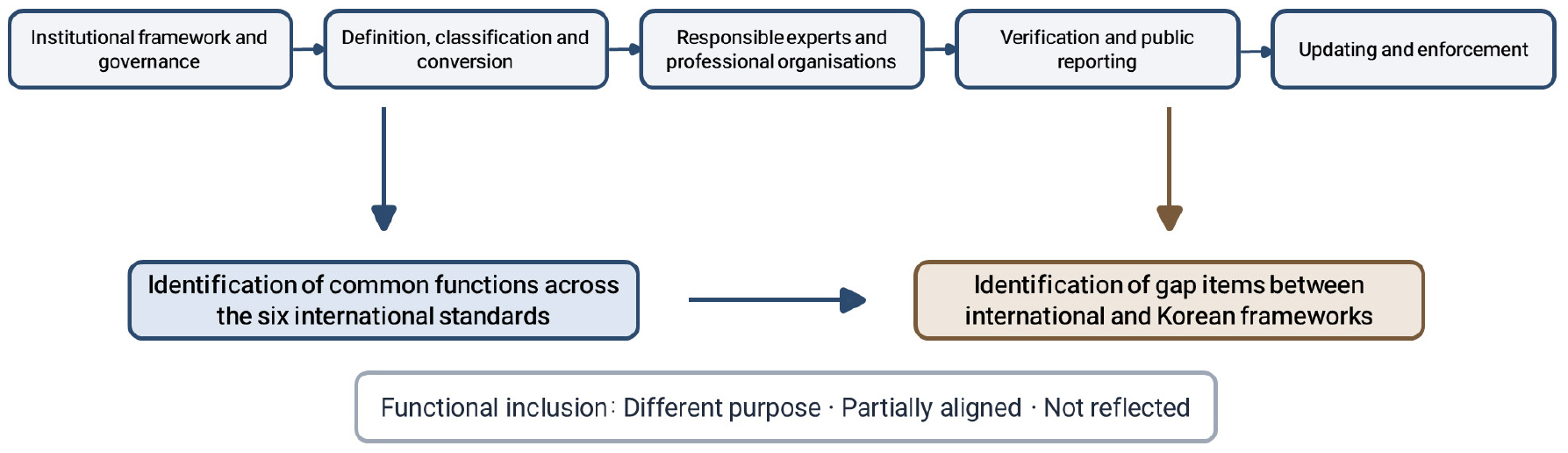
국제 공통기능과 국내 기능을 연결하여 차이항목을 도출하고, 각 항목을 주된 기능에 따라 제도·거버넌스, 정의·분류·전환, 책임전문가·전문단체, 검증·공개보고, 갱신·집행의 5개 영역으로 분류하였다. 이어서 각 차이에 대해 기존 제도요소의 존재 여부, 개정 가능한 규정·서식의 존재, 새로운 책임주체 또는 집행권한의 필요성, 복수 제도 간 조정 필요성을 순차적으로 검토하여 구조형 또는 보완형으로 판정하였다. 주된 대응방향은 기능 구현에 가장 직접적인 제도수단을 기준으로 지정하였으며, 복수 수단이 필요한 경우 보조 대응방향은 부록 Table A1에 기록하였다. 일부 항목은 복수 영역에 걸치지만 본문에서는 주된 영역 하나를 부여하고 관련 영역은 부록에서 보조적으로 설명하였다. 분석구조는 Fig. 3과 같다.
https://cdn.apub.kr/journalsite/sites/ksmer/2026-063-05/N0330630521/images/ksmer_63_05_21_F3.jpg
Fig. 3.

Framework of the comparative analysis between international standards and the Korean framework.

분석 검증절차와 한계

판정의 추적 가능성을 확보하기 위해 모든 차이항목은 근거 조항 식별자를 통해 관련 원문 및 문헌과 연결하였다(Table A1). 분석에 사용한 문서의 정식 명칭, 발행기관, 판본 및 시행상태는 Table A2에, 각 식별자가 지시하는 실제 조항번호와 그 근거상태는 Table A3에 제시하였다. 총 178개의 조항 단위 기록을 근거 상태에 따라 구분한 결과, 146건은 공식 원문에서 조항 위치와 적용 판본을 직접 확인하였고, 15건은 학술논문 및 해설서 등 보조문헌을 근거로 작성하였다. 나머지 17건은 단일 조항에 직접 대응하기보다 복수의 공식 문서와 조항을 종합하여 기능을 판정한 기록이다. 자료 탐색과 누락 점검에는 자동화 도구를 보조적으로 활용하였으나, 그 출력은 판정의 근거로 사용하지 않았으며 최종 판정은 관련 문헌과 원문 조항을 바탕으로 수행하였다. 판정의 재현성을 높이기 위해 앞서 제시한 판정절차와 Table 2의 조작적 정의에 따라 분석을 수행하였고, 모든 항목의 근거를 조항 식별자로 추적할 수 있도록 하였으며, 대응 성격은 기록값으로부터 규칙에 따라 도출하여 판정자의 주관적 판단 개입을 최소화하였다. 그럼에도 기능 포함 수준의 판정, 특히 부분부합과 미반영의 구분에는 국내 조항이 국제 공통기능을 실질적으로 수행하는지에 관한 해석이 개입한다. 본 연구에서는 복수 전문가에 의한 독립 코딩과 판정자 간 일치도 분석을 수행하지 않았으므로 이 해석의 안정성은 검증되지 않았다. 후속 연구에서는 광업행정, 자원평가 및 자본시장 공시 분야의 전문가를 포함한 복수 코더가 동일한 조작적 정의로 독립 판정을 수행하고 일치도를 산출하는 절차를 통해 본 판정의 신뢰성을 검증할 필요가 있다.

판정 대상의 층위 구분이 결과에 미치는 영향을 확인하기 위하여 KS E 2001을 판정 대상에 포함한 경우를 가정한 민감도 검토를 수행하였다. 이 표준은 매장량을 예상·추정·확정의 3개 범주로(3.1.1~3.1.3), 가채매장량을 추정·확정의 2개 범주로(3.3.1~3.3.2) 구분하고, 매장량의 정의에 경제적 개발에 대한 합리적 전망을 포함하며(3.1), 전환요인을 채광, 선광·제련, 시장, 경제성, 법률, 환경, 사회 및 정부 차원의 요인으로 규정하고(3.2), 가채매장량 평가에 최소한 예비타당성 평가 수준의 검토를 요구한다(3.3)(KATS, 2020). 따라서 이 표준을 판정 대상에 포함하면 정의·분류·전환 영역의 여섯 개 항목(항목 7~12)은 기술요건 수준에서 미반영이 아니라 부분부합으로 이동할 수 있으며, 평가자의 최소 경력요건과 성명·자격·서명의 기재요건에 관한 항목의 근거도 보강된다(3.5, 4.1.1, 4.2.1). 그러나 이 표준은 준수의무, 적용대상과 공개시점, 책임전문가 인정체계, 코드의 유지·개정 거버넌스 및 위반에 대한 집행수단을 규정하지 않으므로 차이항목의 수와 대응 성격의 분포는 변하지 않는다. 즉 층위 구분은 해당 기능이 국내에 존재하는지가 아니라 그 기능이 어느 층위에서 어떤 강제력으로 작동하는지를 구분하기 위한 것이다.

연구결과

국제 공개보고 체계의 공통기능

여섯 개 체계는 공개보고의 목적과 핵심 기술개념을 공유했지만, 규범의 제정주체와 강제력은 서로 달랐다(Table 3). CRIRSCO IRT는 국가·지역 코드가 채택할 공통 템플릿으로서 직접 집행권한이 없었다. JORC와 SAMREC은 전문단체 코드가 거래소 규정과 결합하는 구조였고, NI 43-101과 S-K 1300은 증권규정이 직접 공시의무를 부과하였다. PERC는 범유럽 전문표준으로서 인정 전문단체와 각국 제도의 연계를 통해 적용되었다(CRIRSCO, 2024; JORC, 2012; ASX, 2019; CSA, 2023a; SAMREC, 2016; PERC, 2021; SEC, 2018).

Table 3.

Basic characteristics of the six international reporting standards

Standard
Regulation
Country/
Region
Issuing body Institutional nature Scope Regulator/
Exchange
Evaluator Key reporting documents
CRIRSCO IRT 
(2024)
International CRIRSCO Advisory international template All solid minerals No direct regulatory or exchange linkage CP No prescribed format; 
Table 1 checklist; CPR
JORC Code (2012) Australasia JORC Professional code incorporated into ASX/NZX listing rules All solid minerals ASX, ASIC, NZX CP Public report + JORC Table 1
NI 43-101 (2023 consolidation) and CIM Definition Standards (2014) Canada CSA, CIM Securities disclosure instrument incorporating CIM definitions by law All scientific and technical disclosure CSA securities commissions; TSX/TSX-V QP Technical Report
(Form 43-101F1)
SAMREC Code 
(2016)
South Africa SAMCODES SSC Professional code incorporated into JSE listings requirements All solid minerals JSE, FSCA CP CPR + SAMREC Table 1
PERC Reporting Standard (2021) Europe PERC asbl Pan-European voluntary professional standard All solid mineral raw materials Not tied to a specific exchange CP CPR + PERC Table 1; CP Certificate
Regulation S-K Subpart 1300
(2018; mandatory from 2021)
United States SEC Federal securities regulation All material mining operations of SEC registrants SEC QP Technical Report Summary

Note: CP = Competent Person; QP = Qualified Person; CPR = Competent Person's Report; TRS = Technical Report Summary. The CRIRSCO IRT is treated as the international reference template against which national and regional codes are aligned, and the remaining five systems as jurisdictional implementations enforced through securities regulation, listing rules, or professional standards; common functions were identified accordingly (see Methods). Compiled from the official texts of each standard and Burnett et al. (2026).

앞서 제시한 판정기준을 적용한 결과, 25개 공통기능은 모두 IRT의 공개보고 요건이거나 다섯 개 관할권 체계 중 셋 이상에서 확인되는 기능이었다. 반면 캐나다의 독립 책임전문가·최신 현장검사 요건이나 미국의 연차 증감공시와 같이 특정 관할권에만 존재하는 추가요건은 공통기능으로 집계하지 않고 관할권별 변이로 기록하였다. 각 공통기능이 어느 체계의 어느 조항에서 확인되었는지는 Table A3에 제시하였다. 법적 성격의 차이에도 불구하고 여섯 체계에서는 Table 4의 공통기능이 확인되었다. 정보 생산의 측면에서는 탐사목표·탐사결과부터 광물 매장량, 광물 가채매장량에 이르는 단계별 공개 요건과 표현 제한, 3범주·2범주 분류와 경제성 게이트, 전환요인과 예비타당성조사 수준 이상의 기술연구에 기반한 전환절차가 공통적이었고, 예상(Inferred) 등급 광물 매장량의 가채매장량 직접 전환은 여섯 개 체계 모두에서 허용되지 않았다. 책임의 측면에서는 관련경력 5년 이상과 전문단체 규율을 갖춘 책임전문가의 평가 총괄, 성명·서명·동의의 공개가, 신뢰성 유지의 측면에서는 데이터 검증과 현장확인의 공개 또는 의무화, 중요 가정·위험의 공개, 기준일과 갱신·정정, 각 관할권의 제도구조에 따라 거래소·규제기관·전문단체 등과 연계되는 집행 체계가 공통 구조로 확인되었다.

Table 4.

Common functions and jurisdictional variations in the international frameworks

Functional area Common functions Main jurisdictional variations
Purpose and scope Disclosure of scientific and technical information to investors; application to solid minerals Range of covered entities: registrants, listed companies, members of professional bodies
Guiding principles Transparency, materiality and competence, or equivalent prescriptive provisions Whether principles are stated explicitly; addition of accountability
Definitions and classification Three Mineral Resource and two Mineral Reserve categories; staged restrictions on expression Nomenclature such as Ore Reserves/Mineral Reserves and detailed wording
Economic gate RPEE(E) required before declaring Mineral Resources Details of assessment methods and disclosure level
Conversion Application of Modifying Factors; no direct conversion of Inferred Resources; minimum PFS Scope allowed for Initial Assessment/PEA; market-study and reference-point requirements
Responsible experts Minimum five years of relevant experience; professional-body discipline; name, signature and consent Qualification routes, independence obligations, allocation of responsibility among multiple experts
Verification Disclosure or mandating of sample, assay and data verification and site confirmation Whether site visits are an explicit obligation, conditional disclosure or recommendation; whether traceability is required through an explicit internal-control framework (Australia, Canada, United States) or through database-integrity disclosure under a Table 1-type checklist
Reporting Standard report skeleton; disclosure of material assumptions, risks, limitations and responsibility Fixed Form/TRS versus Table 1/CPR approaches
Updating and enforcement Effective date; updating on material change; correction and accountability tracking Annual or trigger-based updating; roles of exchanges, regulators and professional bodies

국제체계 간 차이는 공통 정의 자체보다 적용과 집행의 층위에서 크게 나타났다. 전문단체 코드 계열은 투명성·중요성·전문성을 상위 원칙으로 선언하고 ‘if not, why not’ 체크리스트를 활용하는 경향이 있었다. 증권규정 계열은 원칙의 명칭보다 필수 기재사항, 내부통제 및 오도 방지조항을 통해 유사 기능을 구현하였다. 또한 캐나다는 특정 상황에서 독립 QP와 최신 현장검사를 요구하고, 미국은 내부통제와 연차 증감공시를 강조하는 등 추가요건이 존재하였다(CSA, 2023a, 2023b, 2023c; SEC, 2018). 특히 S-K 1300은 증권규정 체계에서 책임전문가 인정과 공시책임을 결합하는 방식을 취하고 있어, 국제 공개보고 기준의 향후 전개에 영향을 미칠 요소로 검토된 바 있다(Rupprecht, 2020). 이러한 차이는 어느 기준의 우열이라기보다 각 관할권의 법률·시장·전문직 구조가 공통기능을 구현하는 방식의 차이로 해석되었다. 국제기준은 광물 매장량·광물 가채매장량의 추정기법 자체를 통일하지 않았다. 동일 자료에서도 책임전문가의 모델링·분류 판단에 차이가 발생할 수 있으며, 그 편차가 실증적으로 보고된 바 있다(Owusu and Dagdelen, 2024). 국제기준의 핵심은 판단의 불확실성을 제거하는 데 있지 않고, 판단근거와 한계를 공개하고 책임전문가·전문단체·시장규율을 통해 그 편차를 관리하는 데 있다.

국내 현행제도의 구조와 특성

국내 현행제도에서는 광업행정 관점의 명확한 기능과 강점이 확인되었다. 광량산출기준은 조사간격·확장거리·심도한계 등 정량적 공간기준으로 광량산출구획을 설정하고, 시료 대표성, 품위 가중평균, 하한 품위기준 미달값의 제외 및 계산도면을 규정하였다(MOTIE, 2022a, 2022b). 이러한 구조는 행정기관이 동일한 신청자료를 일관된 기준으로 심사하고 채굴권·채굴계획 관련 결정을 수행하는 데 적합하였다.

반면 국제 공개보고의 정의·분류·책임구조와 기능적으로 대응되는 통합체계는 분석대상 문서에서 확인되지 않았다. 국내 광량은 조사밀도와 공간적 확장기준으로 산출범위가 정해지는 단일 행정수량인 반면 국제 광물 매장량 범주는 지질학적 신뢰도와 RPEE(E)를 함께 요구하는 3단계 분류이므로 대응하는 분류 기준이 존재하지 않으며, 채굴계획은 사업의 기술·행정자료를 포함하지만 그 존재만으로 예비타당성조사 또는 타당성조사 수준의 기술연구와 동일한 것으로 볼 수 없다. 행정서식상 ‘광량보고서’도 명칭과 달리 국제기준의 광물 매장량·광물 가채매장량 보고서와 직접 대응하지 않는다. 평가자 책임에 관한 제도적 골격은 부분적으로 존재한다. 「광업업무처리지침」은 광상설명서 작성자의 인정요건과 확인증 교부, 명부 등재와 3년 주기 재교부, 성실작성·직접조사 의무와 대리작성 금지를 규정한다(제13조부터 제13조의3까지). 다만 이는 광업권 설정단계의 광상설명서에 적용되는 제도로서, 채굴권 단계의 광량평가를 총괄하는 자에게 광상유형·광화유형별 관련경력과 인정 전문단체의 회원자격을 요구하는 국제기준의 책임전문가 요건과는 적용단계와 요건 구성이 다르다. 또한 행정기관의 검토와 사업자에 대한 행정제재는 중요한 집행장치이지만 전문직 윤리·징계 또는 자본시장 정정·재공표 제재의 기능을 대신하지 않는다. 이와 같은 국내 현행제도의 기능적 강점과 국제 공개보고 관점에서의 주요 경계는 Table 5에 정리하였다.

Table 5.

Functional strengths and boundaries of the current Korean mining-administration framework

Korean function Identified institutional strengths Functional boundary from a public-reporting perspective
Ore-quantity calculation Quantitative criteria of survey spacing, extension distance and depth limits that define the ore-quantity calculation block, with prescribed calculation procedures Ore quantity is reported as a single undifferentiated figure, with no confidence-based categories corresponding to the three Mineral Resource classes and no RPEE(E) gate
Forms and drawings Standard forms: ore-quantity calculation sheets, geological maps, sections, and the ore-quantity report prescribed in Appendix 15 of the mining-administration guidelines Limited external disclosure of material assumptions, uncertainty and the basis of expert judgement
Assay reliability Accredited assay institutions; sampling and weighted-average grade rules; exclusion of values below the prescribed cut-off grade Different in scope from integrated QA/QC covering reference materials, blanks, duplicates and databases
Permitting review Administrative review of mining plans and some permitting and facility elements Not a formal conversion procedure integrating Modifying Factors with quantity classification
Reporting and supervision Submission of production records and administrative change data Different in purpose and structure from effective dates, periodic updating and reconciliation
Responsibility Statutory roles of applicants, operators and administrative agencies No responsible-expert system of relevant experience, signature, consent and discipline identified

국제기준과 국내 현행제도의 차이

총 178개의 조항 단위 기록(국제기준 142개, 국내 제도 36개)을 9개 비교항목과 20개 분석질문에 따라 코딩하고, 여섯 개 국제체계가 공유하는 기능을 확인한 결과 25개의 국제 공통기능이 도출되었다. 하나의 분석질문에서 복수의 기능이 확인된 경우에는 이를 각각의 기능으로 구분하였다. 따라서 178개의 조항 단위 기록은 분석의 기초자료 수이며 최종 비교기능의 수와 동일하지 않다. 이 25개 공통기능을 국내 현행 제도의 기능과 대응시켜 판정한 결과, 부합으로 판정된 기능은 확인되지 않았고 목적상이 2개, 부분부합 10개, 미반영 13개로 나타나 25개 공통기능 전체가 차이항목으로 확인되었다. 공통기능의 도출은 국제체계 간 비교에서, 부합 여부의 판정은 국내 제도와의 대응에서 각각 별도로 수행하였으므로, 공통기능의 수와 차이항목의 수가 일치한 것은 분석틀의 설계가 아니라 판정의 결과이다. 주영역별로는 제도·거버넌스 5개, 정의·분류·전환 9개, 책임전문가·전문단체 4개, 검증·공개보고 4개, 갱신·집행 3개로 집계되었다(Table 6). 대응 성격은 구조형 14개와 보완형 11개로 구분되었다. 구조형은 별도의 코드, 운영주체, 책임전문가 인정 또는 전문적·시장적 집행체계의 신설이 필요한 항목이며, 보완형은 기존 국내 제도의 자료·서식·검증 및 보고절차를 확장하여 반영할 수 있는 항목이다. 기능 포함 수준과 대응 성격은 서로 독립된 판정기준이다. 실제로 미반영 13개 중 3개는 기존 행정자료나 제도적 기반을 활용할 수 있어 보완형으로, 부분부합 10개 중 2개는 새로운 책임주체나 제도 골격이 필요하여 구조형으로 분류되었다. 두 기준이 연동되었다면 이러한 교차 분포는 나타나지 않는다. 차이 수준별로는 구조적 11개, 중대 10개, 보완 4개였다.

Table 6.

Reclassification of the 25 differences between the current Korean framework and international standards

No. Difference item Domain Functional inclusion Response characteristic
1 Purpose and information users ① Different purpose Structural
2 Legal and institutional structure ① Partially aligned Structural
3 Standard maintenance and governance ① Not reflected Structural
4 Market and regulatory linkage ⑤ Not reflected Structural
5 Guiding principles ① Partially aligned Supplementary
6 Reporting scope ① Different purpose Structural
7 Terminology and definitions ② Not reflected Structural
8 Mineral Resource classification ② Not reflected Supplementary
9 Reasonable prospects for economic extraction ② Not reflected Structural
10 Mineral Reserve definition and classification ② Not reflected Structural
11 Resource-to-Reserve conversion ② Not reflected Structural
12 Level of technical studies ② Not reflected Structural
13 Modifying Factors ② Partially aligned Supplementary
14 Market and pricing ② Not reflected Structural
15 Evaluator qualification ③ Partially aligned Structural
16 Professional organisation / RPO ③ Not reflected Structural
17 Independence, signature, consent ③ Partially aligned Supplementary
18 Ethics, complaints, discipline ③ Not reflected Structural
19 Sampling and QA/QC ④ Partially aligned Supplementary
20 Site visit and data verification ④ Partially aligned Supplementary
21 Report and checklist ④ Partially aligned Supplementary
22 Environmental, social, permitting, closure ② Partially aligned Supplementary
23 Effective date, risk, uncertainty ⑤ Not reflected Supplementary
24 Updating and reconciliation ⑤ Not reflected Supplementary
25 Internal control and traceability ④ Partially aligned Supplementary

Note: Domains: ① institutions and governance; ② definition, classification and conversion of mineral resources and mineral reserves; ③ responsible experts and professional organizations; ④ verification and public reporting; ⑤ updating and enforcement. Functional-inclusion verdicts follow the original assessments in the research-management database; response characteristics are derived by the rules in Table 2. Totals: Different purpose 2, Partially aligned 10, Not reflected 13; Structural 14, Supplementary 11. Secondary domains and response directions of items spanning multiple domains are given in Appendix Table A1.

제도·거버넌스 영역(①)은 5개 항목으로 구성되었다. 목적·정보이용자와 보고범위는 국내 광업행정과 투자자 대상 공개보고의 제도목적 차이를 반영하여 목적상이로 판정되었다. 법적·제도 구조는 부분부합, 기준 유지·거버넌스는 미반영, 기본원칙은 부분부합이었다. 기본원칙을 제외한 4개 항목이 구조형으로 분류되어, 공개보고의 적용범위와 지속적 거버넌스는 개별 행정서식의 수정만으로 형성되기 어렵다는 점이 확인되었다.

정의·분류·전환 영역(②)에는 가장 많은 9개 항목이 속하며, 정의-분류-경제성 게이트-전환-기술연구로 이어지는 국제기준의 연쇄 구조가 행정체계에는 단계 전체로서 존재하지 않는다는 공통 경향을 보였다(미반영 7개·부분부합 2개). 대표적으로 등급 구분 없이 광량을 직접 산출하여 채굴계획 인가로 연결하는 단선 구조가 확인되어 지질학적 수량에서 경제적 개발가능 수량으로 이동하는 판단과 책임을 문서화하는 절차가 없었고, 행정서식상 명칭과 국제기준의 광물 가채매장량 개념이 실질에서 어긋나는 것으로 나타났다. 시장·가격과 환경·사회·인허가의 개별 요소는 국내 사업성·인허가 절차에서 검토될 수 있으나 이를 전환의 판단근거로 연결하는 구조는 확인되지 않았다. 분류·전환 체계는 개별 서식의 수정이 아니라 제도 골격의 신설을 요구하므로 9개 항목 중 6개가 구조형으로 분류되었다.

책임전문가·전문단체 영역(③)의 공통 경향은 평가 전반을 총괄하고 결과에 책임을 지는 주체가 제도화되어 있지 않다는 점이다(미반영 2개·부분부합 2개). 국내 기술자격이나 공인 분석기관의 존재와 공개보고 책임전문가 체계는 구분되어야 한다. 공인 분석기관 제도는 품위분석이라는 특정 기술행위의 신뢰성을 담보하는 장치로서 평가 총괄·서명·책임의 기능과 다르며, 신청인·작성자의 서명이 존재하는 경우에도 공개보고 판단의 범위와 책임을 명시하는 전문가 선언과는 기능이 달라 부분부합으로 판정되었다. 광상설명서 작성자에 대한 자격·등록·갱신 제도는 존재하지만 광량평가 총괄자의 관련경력·업무범위를 특정하는 요건은 확인되지 않았고, 평가자의 과실·윤리위반을 조사·제재하는 전문 징계절차 또한 확인되지 않았다. 책임전문가 제도는 전문단체의 회원등급·윤리·지속교육·징계와 일체로 작동하므로 4개 항목 중 3개가 구조형으로 분류되었다.

검증·공개보고 영역(④)은 4개 항목으로 구성되었으며 모두 부분부합·보완형으로 판정되었다. 국내 시료·재분석·도면·계산표는 정보 신뢰성의 일부를 지원하지만, QA/QC 프로그램, 책임전문가의 현장방문과 원자료 검증, 표준 보고골격, 모델 버전과 승인흐름의 추적성을 통합적으로 공개하는 기능은 제한적이었다. 이 영역은 기존 지침·서식을 활용할 여지가 상대적으로 크지만, 현장검증과 책임전문가의 검증범위 등은 국가 코드의 규정과 연계될 필요가 있다.

갱신·집행 영역(⑤)에는 시장·규제 연계, 유효일·위험·불확실성, 갱신·증감대사의 3개 항목이 배정되었으며 모두 미반영으로 판정되었다. 이 중 시장·규제 연계는 분석대상인 광업법령·행정규칙·서식에서 광물 프로젝트의 공개보고를 자본시장 공시·정정·제재와 연결하는 규정이 확인되지 않아 미반영으로 판정하였으며, 그 구현에 별도의 제도연계가 필요하여 구조형으로 분류되었다. 다만 본 판정은 분석대상 문서를 기준으로 한 것으로, 자본시장 법령과 거래소 공시규정에 광물 프로젝트에 특화된 규정이 존재하는지는 본 연구의 분석범위에 포함되지 않았다. 반면 유효일·위험·불확실성과 갱신·증감대사는 각각 기준일·위험정보의 기재와 행정상 생산·변경자료의 연계를 통해 단계적 보완이 가능하여 보완형으로 분류되었다. 이는 기능 포함 수준과 대응 성격이 동일한 기준이 아님을 보여준다.

국내 제도 보완 가능 항목과 국가 코드 구축 필요 항목

25개 차이항목은 기능의 성격과 기존 국내 제도의 활용 가능성이 서로 달라 단일한 방식으로 대응하기 어려웠다. 이에 먼저 기존 법령·고시·서식의 개정으로 기능을 구현할 수 있는지, 다음으로 복수 행정·규제체계 간 자료와 권한의 조정이 필요한지, 마지막으로 새로운 기술규범이나 상설 운영주체가 필요한지를 순차적으로 검토하였다. 그 결과 주된 대응방향은 서식·지침 보완 5개, 관계제도 연계 4개, 별도 국가 공개보고 코드 11개, 별도 운영체계 4개, 후속 법제·정책연구 1개로 구분되었다(Table 7). 이 분류는 각 항목의 최종적이고 배타적인 제도설계안을 의미하지 않으며, 기능 구현에 가장 직접적인 제도수단을 주된 대응방향으로 지정한 것이다. 실제 제도설계에서는 하나의 항목에 국가 코드, 기존 서식의 보완 및 관계제도 연계가 함께 요구될 수 있으므로, 필요한 경우 보조 대응방향을 병행하여 검토하였다. 원본 데이터에서는 필요에 따라 보조 대응방향을 함께 기록하여, 예를 들어 국가 코드에 규정되는 항목이 기존 KS·서식의 활용과 병행될 수 있도록 하였다.

Table 7.

Differences grouped by principal response direction

Response direction Items
(No.)
Main elements Rationale Recommended action
Amendment of forms and guidelines 5, 19, 21, 23, 25
(5 items)
Guiding principles, QA/QC items, standard checklist, effective date and risk disclosure, traceability Reporting items and control procedures can be added to existing reporting and verification procedures Review amendment of notices, guidelines and forms
Inter-institutional linkage 1, 4, 22, 24
(4 items)
Information users, capital-market linkage, permitting and environmental linkage, updating data Roles and data flows of multiple ministries, exchanges and agencies must be coordinated Review inter-institutional data and procedure linkage
National reporting code 6–14, 17, 20
(11 items)
Definitions, classification, economic gate, formal conversion, Modifying Factors, technical studies, reporting scope, expert declaration, data verification Common definitions and disclosure principles are difficult to apply consistently through administrative forms alone Prescribe in a national public reporting code
Dedicated operating system 3, 15, 16, 18
(4 items)
National reporting organisation, responsible-expert recognition, professional organisation, ethics and discipline A standing body is needed for recognition, education, discipline, revision and international liaison Design a national reporting organisation and recognition system
Follow-up legal-policy research 2
(1 item)
Legal status of the code, role allocation among document layers A specific institution or legal form cannot be determined by comparative analysis alone Legal, financial and administrative impact assessment

서식·지침의 보완은 비교적 단기간에 검토할 수 있지만 그것만으로 공개보고 체계 전체가 형성되지는 않는다. 특히 정의·분류·전환과 책임전문가 인정은 개별 서식에 문구를 추가하는 방식으로 일관되게 운영하기 어렵다. 반대로 모든 차이를 국가 코드에 포함시키는 것도 적절하지 않다. 자본시장 공시대상과 제재, 환경인허가 자료공유, 행정기관의 권한배분은 국가 코드의 기술규정만으로 결정할 수 없으며 후속 법제·정책연구가 필요하다.

CRIRSCO 정합형 국가 코드 개발을 위한 시사점

국내 현행 제도의 의의 및 국제 공개 보고 기능 차이

기능 포함 수준 분석에서 목적상이로 판정된 2개 항목은 국내 광업 행정 제도와 국제 공개 보고 체계가 상정하는 정보 이용자와 제도 목적의 차이에서 비롯되었다. 국내 광업 행정 제도는 광업권·채굴권의 설정, 채굴 계획 인가, 생산보고 및 행정감독을 지원하는 것을 주된 목적으로 하는 반면, 국제 공개 보고 체계는 투자자와 금융기관 등 외부 정보 이용자에게 광물 프로젝트의 과학적·기술적 정보를 제공하는 데 중점을 둔다. 따라서 이러한 차이는 국내 제도의 결함이라기보다 두 체계가 수행하는 기능과 책임 구조의 차이를 반영한다. 국내의 정량적 광량 산정기준과 표준화된 행정 서식은 행정 심사의 일관성과 재현성을 지원하는 고유한 기능을 가지므로, 향후 국가 공개 보고 체계를 도입하더라도 이를 대체하기보다 공개 보고에 활용할 수 있는 기초 자료와 행정절차로 연계하는 접근이 타당하다.

한편 25개 차이 항목 중 13개는 분석 대상 광업 법령·행정규칙·서식에서 국제 공개 보고 기능에 직접 대응하는 명시적 요건을 확인하기 어려워 미반영으로 판정되었고, 10개는 관련 자료나 절차가 존재하지만 적용목적, 범위, 의무 수준 또는 책임 구조가 충분히 대응하지 않아 부분부합으로 판정되었다. 특히 구조형으로 분류된 14개 항목에는 공통 정의와 분류체계, 광물 매장량에서 광물 가채매장량으로의 공식 전환절차, 책임전문가 인정, 전문단체의 윤리·징계, 코드의 유지·개정 및 시장·규제기관과의 연계 등 기존 행정 서식이나 지침의 일부 보완만으로는 일관되게 구현하기 어려운 기능이 포함되었다. 이러한 결과는 국내 광업 행정의 고유 기능을 유지하면서도, 외부 정보 이용자를 위한 공개 보고 기능을 수행할 별도의 국가 코드와 운영체계가 필요함을 보여준다.

국내 행정 용어와 국제 공개 보고 용어의 비대응성은 향후 제도 설계에서 우선적으로 검토할 필요가 있다. 국내 광량은 조사 간격과 공간적 확장 기준에 따라 산출되는 단일 행정수량으로서, 지질학적 신뢰도와 경제적 추출 전망을 기준으로 하는 국제기준의 예상·추정·확정 광물 매장량(Inferred, Indicated and Measured Mineral Resources)과 직접 대응하지 않는다. 또한 행정 서식인 ‘광량보고서’와 국제기준의 광물 가채매장량(Mineral Reserves) 보고 역시 목적과 판단기준이 다르다. 따라서 국제분류를 적용할 경우 기존 용어의 단순 치환보다 원자료의 품질, 지질학적 연속성, 경제적 추출 전망, 전환 요인 및 기술연구 수준을 재검토하는 절차와 경과조치를 함께 설계할 필요가 있다.

국내 광업 행정 제도와 CRIRSCO 정합형 국가 공개 보고 코드는 대체관계가 아니라 기능을 분담하는 병행·연계관계로 이해할 필요가 있다(Table 8). 광업 행정 제도는 광업권·채굴권, 채굴 계획, 생산보고 및 감독을 위한 행정적 판단과 절차를 계속 담당하고, 국가 공개 보고 코드는 외부 정보 이용자를 위해 광물 매장량·광물 가채매장량의 정의·분류·전환, 책임전문가의 자격과 책임, 자료 검증 및 중요정보 공개를 표준화하는 역할을 수행한다. 두 체계는 시추·시료·분석자료, 지질모델, 채굴 계획, 인허가 상태 및 생산실적 등 기초자료를 공유할 수 있으나, 동일한 자료를 활용하더라도 행정적 적정성에 관한 판단과 공개보고를 위한 전문적 판단은 구분되어야 한다. 따라서 자료의 소유권과 비밀보호, 기준일과 버전관리, 책임전문가의 검증범위 및 최종 책임을 명확히 하는 연계원칙이 필요하다.

Table 8.

Parallel and linked roles of mining administration and a national public reporting code

Aspect Mining administration Shared data and linkage arrangements National public reporting code
Purpose Establishment of rights, mining-plan authorisation, production and supervision Minimising duplicate submission and securing traceability Disclosure of scientific and technical information for investors and financial institutions
Key materials Ore-quantity calculation sheets, geological maps and sections, permitting and production data Drilling, sampling and assay data, spatial models, production records, permitting status Estimation of Mineral Resources and Mineral Reserves, Modifying Factors, technical studies
Decision-
maker
Administrative agencies and statutory applicants and reporters Management of data ownership, confidentiality, versions and effective dates Responsible experts, national reporting organisation and recognised professional organisations
Outputs Administrative dispositions, authorisations and supervisory records Data-linkage rules and cross-references Public reports, expert declarations, updating and reconciliation
Boundary Judgement on administrative adequacy Verification and responsibility separated by purpose even for the same data Judgement on materiality, transparency and professional accountability for investors

국내 공개보고 코드 개발의 필요성

국가 코드 개발을 위한 기술적 기반이 전혀 없는 것은 아니다. 현행 KS E 2001은 국제기준과 정합되는 정의와 분류, 경제적 추출에 대한 합리적 전망, 전환요인 및 최소 예비타당성 평가 수준의 기술연구 등 주요 기술요소가 이미 국내 규범에 반영될 수 있음을 보여주며(KATS, 2020), 앞의 민감도 검토에서도 정의·분류·전환 영역의 기술요건 상당 부분이 이 표준에 존재하는 것으로 확인되었다. 다만 이 표준은 임의표준으로서 현행 광업행정이나 자본시장 공시에 직접 적용되는 공개보고 코드가 아니며, 코드의 유지·개정, 책임전문가 인정, 전문단체의 윤리·징계 및 시장·규제기관과의 연계 기능을 자체적으로 제공하지 않는다. 따라서 향후 국가 공개보고 코드 개발에서는 KS E 2001을 정의·분류·전환체계의 기술적 참고선으로 활용하되, 코드의 법적 지위와 운영체계는 별도로 설계할 필요가 있다. 본 연구에서 도출한 25개 차이항목은 국내에도 CRIRSCO 정합형 국가 공개보고 코드와 이를 뒷받침하는 운영체계를 구축할 필요가 있음을 보여준다.

첫째, 국내 행정용어와 국제 공개보고 용어 간 비대응성을 관리할 국가 차원의 정의·분류·전환 규범이 필요하다. 개별 기업이 외국 기준을 프로젝트별로 적용하는 방식만으로는 국내 용어, 책임전문가의 자격경로, 행정자료와의 연계 및 공개범위를 일관되게 규율하기 어렵다. 따라서 국가 코드에는 국제 공개보고 분류의 적용원칙과 기존 자료의 재평가·전환절차를 명확히 규정할 필요가 있다

둘째, 책임전문가와 전문단체의 인정·윤리·징계는 일회성 지침이나 개별 서식만으로 유지하기 어려운 지속적 거버넌스 기능이다. 코드가 제정되더라도 이를 해석·개정하고, 책임전문가의 자격과 적격성을 관리하며, 지속적 전문교육을 운영하고, 민원·윤리위반·징계 사안을 처리할 운영체계가 마련되지 않으면 제도의 실효성은 제한될 수밖에 없다. 따라서 국가 공개보고 코드와 국가보고기구 또는 이에 준하는 운영주체는 기능적으로 함께 검토되어야 한다. 다만 특정 학회·협회·공공기관을 국가보고기구로 지정하거나 구체적인 운영형태를 확정하는 것은 본 비교분석의 범위를 넘으므로, 향후 법적 권한, 대표성, 전문성, 재원, 이해상충 및 기존 기관과의 역할분담을 포함한 별도의 제도설계가 필요하다.

셋째, 국가 공개보고 코드는 국내 광산정보의 국제적 비교 가능성을 높이고, 해외 금융조달·상장·투자유치 및 국제 공개보고 과정에서 반복적으로 발생하는 기준변환과 재평가 부담을 줄이는 기반이 될 수 있다. 이는 국내 광업행정 제도를 폐지하거나 외국의 코드를 그대로 이식해야 한다는 의미가 아니다. 국내 광업행정 제도는 광업권·채굴권, 채굴계획, 생산보고 및 행정감독을 위한 고유 기능을 계속 수행하고, 국가 공개보고 코드는 외부 정보이용자를 위해 정의·분류·전환, 책임전문가, 검증, 중요정보 공개, 기준일 및 갱신체계를 별도로 규율해야 한다. 따라서 두 체계는 대체관계가 아니라 목적과 책임을 구분하면서 기초자료와 절차를 공유하는 병행·연계관계로 설계하는 것이 타당하다.

이상의 결과는 현행 KS E 2001과 광업행정 제도를 기술적·행정적 기반으로 활용하면서, 국제 공개보고 기능을 담당할 별도의 국가 코드와 운영체계를 구축할 필요가 있음을 보여준다. 이에 따라 기존 광업행정과 국가 공개보고 코드는 상호 대체가 아닌 기능 분담과 자료 연계를 전제로 설계할 필요가 있다

다만 국가 코드의 개발과 CRIRSCO 가입은 서로 연계되어 있으나 동일한 절차는 아니다. 본 연구는 국내 현행제도와 국제 공개보고 체계의 기능적 차이를 분석하여 국가 코드 개발의 필요성을 제시하지만, CRIRSCO 가입시기, 신청주체 또는 국가보고기구의 구체적인 구성까지 결정하지는 않는다. CRIRSCO 가입을 위해서는 국가 코드의 IRT 호환성뿐 아니라 국가보고기구의 운영, 책임전문가 인정, 전문단체의 윤리·징계 및 국제협력 체계 등 회원요건에 대한 별도의 검토가 필요하다(CRIRSCO, 2019b). 따라서 본 연구의 결과는 CRIRSCO 가입을 위한 최종 제도안을 제시하기보다는, 향후 국내 국가 공개보고 코드가 갖추어야 할 기능적 기준선과 우선 검토영역을 제시하는 기초자료로 이해하는 것이 적절하다.

이러한 관점에서 비교분석을 통해 도출한 국가 코드의 주요 구성요소를 Table 9에 정리하였다. Table 9는 특정 법률형식이나 운영기관을 전제로 한 최종 설계안이 아니라, 25개 차이항목을 국가 코드 개발의 관점에서 재구성한 분석결과이다. 따라서 각 구성요소의 구체적인 의무수준, 적용대상, 예외조건, 시행시기 및 기존 제도와의 역할분담은 후속 코드 설계와 법제·정책연구를 통해 구체화할 필요가 있다.

Table 9.

Principal components for developing a CRIRSCO-aligned national public reporting code in Korea

Component area Key components Main functions Relation to the current Korean framework Priority review issues Related items
(Table 6)
Operating system National reporting organisation or an equivalent operating body Enactment, maintenance and revision of the code; international alignment Role division and cooperation with mining administration required Legal status, composition, representation, funding 2, 3, 4
Definitions and classification CRIRSCO-aligned definitions and classification system Production of internationally comparable Mineral Resource and Mineral Reserve information The current ore-quantity notice provides no confidence categories; KS E 2001 usable as a technical basis Korean terminology, definitions, transitional measures 7, 8, 
9, 10
Conversion system Formal conversion procedure and Modifying Factors Conversion based on economic mineability Mining-plan data usable as inputs Conversion routes, dilution and losses, responsibility 11, 13
Technical studies Economic gate and studies of at least PFS level Technical and economic substantiation of quantities Partially linkable to current mining plans Minimum study level by mine scale 9, 12, 
14, 22
Responsible experts Qualification, experience, signature, consent and liability Professional accountability for disclosed information The existing register of geological-report authors is usable as an administrative precedent; correspondence with national technical qualifications to be reviewed Scope of experience, mutual recognition, conflicts of interest 15, 17
Professional organisations Ethics, continuing education, complaints and discipline Maintenance of competence and enforcement of accountability Possible use of existing societies, associations and engineer bodies to be reviewed Recognition criteria, disciplinary power, due process 16, 18
Verification QA/QC, site inspection, data verification, independent review Accuracy, completeness and reproducibility of information Current sample, drawing and assay data usable Obligation level, exemptions, reviewing body 19, 20, 25
Public reporting Standard reports, checklists, disclosure of material information Prevention of omissions and comparability To be distinguished in purpose from existing administrative forms Materiality criteria, restrictions on expression, disclosure scope 5, 6, 
21, 23
Updating management Effective date, periodic updating, material change and reconciliation Currency of information and change tracking Production and mining-plan change data linkable Updating cycle, reasons for changes, correction procedure 23, 24
Institutional linkage Linkage with mining administration, capital markets and environmental permitting Minimising duplicate submission and expanding data use Role coordination among ministries and agencies required Disclosure targets, data sharing, confidentiality 1, 2, 4, 22, 24

국가 코드 개발의 초기 단계에서는 광물 매장량·광물 가채매장량의 정의·분류·전환체계와 책임전문가 제도를 우선적으로 정립할 필요가 있다. 공통된 의미체계와 공식 전환절차가 마련되어야 보고서 작성, 데이터 검증, 갱신 및 관계제도 연계가 일관되게 이루어질 수 있으며, 책임전문가의 자격·업무범위·서명·동의 및 책임을 명확히 해야 공개정보의 작성과 검증 과정에서 책임소재를 분명히 할 수 있다. 이후 국가보고기구, 전문단체 인정, 윤리·징계, 공개보고 형식 및 자본시장·광업행정과의 연계체계를 단계적으로 구축하는 것이 적절하다.

실제 적용에서는 광산과 프로젝트의 규모, 개발단계 및 정보의 중요성을 고려한 비례적 설계가 필요하다. 중소규모 광산의 부담을 줄이기 위해 적용대상, 중요성 기준, 단계적 시행 및 간소화된 보고유형을 검토할 수 있으나, 공통 정의와 책임전문가의 책임, 핵심적인 분류·전환·검증 원칙은 유지되어야 한다.

이러한 체계는 국내 광물 프로젝트 정보의 국제적 비교 가능성과 신뢰성을 높이고, 국제 투자유치·해외 상장·금융조달 과정에서 발생하는 기준변환과 재평가 부담을 줄이는 데 기여할 수 있다. 또한 해외 자원개발 사업에서 일관된 기술정보의 생산·검증·보고 기반을 제공하고, 향후 대한민국의 CRIRSCO 체계 참여를 위한 제도적 기반으로 활용될 수 있다.

결 론

본 연구는 여섯 개 국제 공개보고 체계의 공통기능을 도출하고, 이를 국내 현행 광업행정 제도와 비교하여 25개 차이항목을 분석하였다. 국제체계는 광물 매장량의 3개 범주와 광물 가채매장량의 2개 범주, 경제적 추출에 대한 합리적 전망, 전환요인과 최소 예비타당성조사 수준의 기술연구, 책임전문가의 자격·서명·동의, 데이터 검증, 중요정보 공개 및 갱신·집행체계를 공통적으로 갖추고 있었다. 반면 국내 제도는 정량적 광량 기준, 표준서식, 공인 분석절차, 채굴계획 및 생산자료를 통해 행정심사의 일관성을 지원하지만, 투자자 대상 공개보고를 위한 정의·분류·전환 및 책임·검증·공개기능을 통합한 체계는 확인하기 어려웠다.

25개 차이항목은 제도·거버넌스 5개, 정의·분류·전환 9개, 책임전문가·전문단체 4개, 검증·공개보고 4개, 갱신·집행 3개로 구분되었다. 기능 포함 수준은 목적상이 2개, 부분부합 10개, 미반영 13개였으며, 대응 성격은 구조형 14개와 보완형 11개로 분류되었다. 대응방향은 서식·지침 보완 5개, 관계제도 연계 4개, 별도 국가 코드 11개, 별도 운영체계 4개, 후속 법제·정책연구 1개로 정리되었다. 이 중 정의·분류·공식 전환, 기술연구 및 책임전문가의 선언·검증은 국가 공개보고 코드에 규정할 필요가 있으며, 코드의 유지·개정·전문가 인정·윤리·징계는 별도의 운영체계를 요구한다.

따라서 대한민국이 국제적으로 비교 가능한 광물 매장량·광물 가채매장량 정보를 생산하고 CRIRSCO 체계와의 정합성을 확보하기 위해서는, 기존 광업행정과 병행·연계되는 국가 공개보고 코드와 국가보고기구 또는 이에 준하는 운영주체, 책임전문가 인정체계를 단계적으로 구축할 필요가 있다. 이 코드는 국내 광업행정을 대체하는 제도가 아니라, 기존 행정자료를 활용하면서 외부 정보이용자를 위한 책임·검증·공개기능을 보완하는 체계로 설계되어야 한다.

본 연구는 국가 코드 개발의 제도적 필요성과 핵심 구성요소를 제시하였으나, 특정 운영기관, 법적 지위, 자본시장 적용범위 및 CRIRSCO 가입일정을 확정하지는 않았다. 또한 복수 전문가 검토, 판정 일치도 분석, 국내 운영실태 조사 및 실제 광산자료 적용이 이루어지지 않았다는 한계가 있다. 향후 독립검토와 시범적용을 통해 분석결과를 검증하고, 국내 실정에 적합한 코드 조문, 운영체계 및 단계적 도입방안을 구체화할 필요가 있다.


Acknowledgements

본 연구는 2026년도 정부(산업통상부)의 재원으로 한국산업기술기획평가원 「자원 안보를 위한 고부가가치 한국형 텅스텐 전주기 기술개발 및 실증」 사업의 지원을 받아 수행되었다(과제명: ERP 기반 전주기 관리 시스템 개발 및 국제표준 매장량 탐사/평가 체계 구축, 과제번호: RS-2026-25581029).

References

1

ASX, 2019. Listing Rules Chapter 5 and Appendix 5A, Australian Securities Exchange, Sydney, Australia.

2

Burnett, M., Musingwini, C., Birch, C.C., and Njowa, G., 2026. Comparison of the committee for mineral reserves international reporting standards template-based mineral reporting codes with implications for mine planning in mineral development projects, Journal of the Southern African Institute of Mining and Metallurgy, 126(3), p.175-192.

10.17159/2411-9717/3702/2026
3

Camisani-Calzolari, F.A., 2004. National and international codes for reporting mineral resources and reserves: Their relevance, future and comparison, Journal of the Southern African Institute of Mining and Metallurgy, 104(5), p.297-306.

4

Choi, Y.K., Kim, J.H., and Kim, W.J., 2019. Review of standards for mineral resources and reserves estimation in Korea, Journal of the Korean Society of Mineral and Energy Resources Engineers, 56(2), p.172-182.

10.32390/ksmer.2019.56.2.172
5

CIM, 2014. CIM Definition Standards for Mineral Resources and Mineral Reserves, Canadian Institute of Mining, Metallurgy and Petroleum, Canada, 10p.

6

CIM, 2019. CIM Estimation of Mineral Resources and Mineral Reserves Best Practice Guidelines, Canadian Institute of Mining, Metallurgy and Petroleum, Westmount, Quebec, Canada.

7

CRIRSCO, 2019a. Organisational Statutes (Version 2.1), Committee for Mineral Reserves International Reporting Standards.

8

CRIRSCO, 2019b. Membership Application Policy and Process (Version 2.1), Committee for Mineral Reserves International Reporting Standards.

9

CRIRSCO, 2024. International Reporting Template for the Public Reporting of Exploration Targets, Exploration Results, Mineral Resources and Mineral Reserves (June 2024 Update), Committee for Mineral Reserves International Reporting Standards.

10

CSA, 2023a. National Instrument 43-101: Standards of Disclosure for Mineral Projects (2023 Consolidation), Canadian Securities Administrators, Canada.

11

CSA, 2023b. Companion Policy 43-101CP to National Instrument 43-101 (2023 Consolidation), Canadian Securities Administrators, Canada.

12

CSA, 2023c. Form 43-101F1 Technical Report (2023 Consolidation), Canadian Securities Administrators, Canada.

13

Enforcement Decree of the Mining Industry Act, 2025. Presidential Decree No. 35803, Republic of Korea.

14

JORC, 2012. Australasian Code for Reporting of Exploration Results, Mineral Resources and Ore Reserves (The JORC Code, 2012 Edition), Joint Ore Reserves Committee of the Australasian Institute of Mining and Metallurgy, Australian Institute of Geoscientists and Minerals Council of Australia, Australia, 44p.

15

JSE, 2026. JSE Listings Requirements, Service Issue 1 (Third Edition), Section 14: Minerals and Oil/Gas, Johannesburg Stock Exchange, Johannesburg, South Africa.

16

KATS, 2020. KS E 2001:2020 Standard for estimation of ore resources and reserves (revised 31 December 2020), Korean Agency for Technology and Standards, Republic of Korea.

17

Kim, Y.J., Choi, Y.K., and Lee, S.H., 2020. Revised KS for estimation of mineral resources and reserves in Korea, Journal of the Geological Society of Korea, 56(6), p.817-824.

10.14770/jgsk.2020.56.6.817
18

Lock, N., 2020. RPEEE (Reasonable Prospects for Eventual Economic Extraction): The critical core to the SAMREC Code, Journal of the Southern African Institute of Mining and Metallurgy, 120(9), p.497-504.

10.17159/2411-9717/1240/2020
19

Mining Industry Act, 2026. Act No. 21438, Republic of Korea.

20

MOTIE, 2022a. Guidelines on the Handling of Mining Affairs, MOTIE Notification No. 2022-24, Ministry of Trade, Industry and Energy, Republic of Korea.

21

MOTIE, 2022b. Standards for the Calculation of Ore Tonnage for Extraction-Right Approval, MOTIE Notification No. 2022-25, Ministry of Trade, Industry and Energy, Republic of Korea.

22

MOTIR, 2025. Enforcement Rule of the Mining Industry Act,Ordinance of the Ministry of Trade, Industry and Resources No. 1, Ministry of Trade, Industry and Resources, Republic of Korea.

23

Owusu, S.K.A. and Dagdelen, K., 2024. Impact of Competent Persons’ judgements in Mineral Resources classification, Journal of the Southern African Institute of Mining and Metallurgy, 124(7), p.371-382.

10.17159/2411-9717/1538/2024
24

PERC, 2021. PERC Reporting Standard 2021: Pan-European Standard for Reporting of Exploration Results, Mineral Resources and Mineral Reserves, Pan-European Reserves and Resources Reporting Committee, Brussels, Belgium, 106p.

25

Rendu, J-M. and Miskelly, N., 2001. Mineral resources and mineral reserves: progress on international definitions and reporting standards, Mining Technology (Transactions of the Institutions of Mining and Metallurgy: Section B), 110 (3), p.133-138.

10.1179/mnt.2001.110.3.133
26

Rupprecht, S.M., 2020. Future trends in the international Reporting Codes based on SEC’s Regulations SK-1300, Journal of the Southern African Institute of Mining and Metallurgy, 120(12), p.659-664.

10.17159/2411-9717/1300/2020
27

SAMREC, 2016. The South African Code for the Reporting of Exploration Results, Mineral Resources and Mineral Reserves (The SAMREC Code, 2016 Edition), SAMCODES Standards Committee, Johannesburg, South Africa, 98p.

28

SEC, 2018. Regulation S-K, Subpart 1300: Disclosure by Registrants Engaged in Mining Operations (17 CFR 229. 1300-229.1305), U.S. Securities and Exchange Commission, Washington, D.C., USA.

29

Sides, E. and Allington, R., 2024. Mineral Reporting Standards: PERC’s role in CRIRSCO and its relevance to the European mining sector, Earth Science, Systems and Society, 4, 10080.

10.3389/esss.2024.10080
30

SME, 2014. The SME Guide for Reporting Exploration Information, Mineral Resources and Mineral Reserves, Society for Mining, Metallurgy and Exploration, Englewood, CO, USA.

31

Waltho, A., Stoker, P., and Ténière, P., 2022. JORC Competent Person – A baseline review in a global context, Australasian Institute of Mining and Metallurgy and Australian Institute of Geoscientists, Australia.

Appendix

Appendix

Table A1.

Detailed functional mapping, domains, and response directions for the 25 differences

No. Item Analysis question International common requirement Current Korean practice Domain Principal response direction Basis IDs
(see Table A3)
1 Purpose and information users What are the purpose and scope of the standard? Transparent disclosure of scientific and technical information on mineral projects to investors and the market Submission of administrative information for mining/extraction-right approval and rational mineral development (COD-0701) ① Inter-institutional linkage COD-0101·
0201·0301·
0401·0501·
0601
2 Legal and institutional structure What is the legal and regulatory nature of the standard? Clear separation of the roles and precedence of statutes, market rules, professional standards, and practice guidelines The Mining Industry Act, its Decree, Rules, and notices directly govern mining administration (COD-0702) ① Follow-up legal-policy research (national code) COD-0202·
0302·0402·
0602
3 Standard maintenance and governance Which body or NRO maintains the standard? An NRO or joint committee that maintains and revises the standard and reviews international alignment Administrative management centred on the competent ministry and the Mining Registration Office (COD-0703) ① Dedicated operating system (follow-up research) COD-0103·
0203·0403·
0503
4 Market and regulatory linkage What is its relationship to securities markets and regulators? Linking public reporting to securities markets, prospectuses, and continuous disclosure, with correction, re-publication, and sanctions on violation Centred on submissions to administrative agencies (mining rights, mining plans, production reports); no linkage to securities disclosure is identified in the analysed mining-administration documents (COD-0704) ⑤·① Inter-institutional linkage (follow-up research) COD-0204·
0304·0404·
0604
5 Guiding principles What are the guiding principles? Transparency, materiality, competence, and where needed accountability as overarching principles Technical clauses on blocks, samples, grade, and drawings exist, but public-reporting principles are not separately declared (COD-0705) ① Amendment of forms and guidelines (national code) COD-0105·
0205·0405·
0505
6 Reporting scope What is disclosed and under what conditions? Staged disclosure requirements for Exploration Targets, Exploration Results, Resources, and Reserves, extending to web and presentation materials Submission of administrative documents (ore-quantity report under Appendix 15, mining plan, production records) (COD-0706) ①·④ National reporting code COD-0106·
0206·0306·
0406·0506·
0606~0607
7 Terminology and definitions How are Mineral Resources defined and classified? Distinguishing Mineral Resource and Mineral Reserve by economic prospect, confidence, and conversion logic the confirmed/estimated distinction was deleted from the notice in 2019 (COD-0707·0709) ② National reporting code COD-0107~
0109
8 Mineral Resource classification How are Mineral Resources defined and classified? Inferred/Indicated/Measured classification based on data quality, geological continuity, and uncertainty Defines a single ore-quantity calculation block by outcrop, drilling, adit and placer-type spacing, extension distance and depth limits, without any confidence classification (COD-0708) ② National reporting code (amendment) COD-0107·
0207·0307·
0407·0507~
0508·0608
9 Reasonable prospects for economic extraction How are Mineral Resources defined and classified? Demonstrating reasonable prospects for (eventual) economic extraction before declaring Resources The definition mentions “mineable” and values below a fixed cut-off grade are excluded from the calculation block, but there is no project-specific gate via price, cost, recovery or mining concept (COD-0707·0722) ② National reporting code COD-0107·
0207·0307·
0408·0507·
0608
10 Mineral Reserve definition and classification How are Mineral Reserves defined and classified? Classifying the economically mineable part of Indicated/Measured Resources, demonstrated by at least a PFS and Modifying Factors, as Probable/Proved (Proven) No report or category corresponding to international Mineral Reserves exists; the prescribed form is an ore-quantity report, and no definition, categories or minimum study level for Reserves is provided (COD-0709) ② National reporting code COD-0108·
0208·0308·
0409·0509·
0610
11 Resource-to-Reserve conversion What is the logic for converting Resources to Reserves? Specifying convertible Resource categories, Modifying Factors, dilution and losses, and category downgrading Ore quantity is calculated directly without confidence categories, and no international-style conversion procedure is provided (COD-0710) ② National reporting code COD-0109·
0209·0309·
0310·0410·
0411·0510·
0611
12 Level of technical studies What level of technical study is required? Distinguishing Scoping, Initial Assessment/PEA, PFS, and FS, and setting the minimum for Reserves at PFS A mining plan is required, but international study stages, accuracy, and Reserve-use scope are not defined (COD-0711) ② National reporting code COD-0110·
0210·0311·
0412·0511·
0612
13 Modifying Factors Which Modifying Factors are considered? Integrating mining, processing, metallurgical, infrastructure, market, economic, legal, environmental, social, and governmental factors as the basis for conversion Ore-quantity calculation centres on geology, grade, and volume; some permitting/facility factors are reviewed in the mining plan (COD-0712~0713) ② National reporting code (amendment) COD-0111·
0211·0312·
0313·0413·
0414·0512~
0513·0614
14 Market and pricing How are market factors treated? Substantiating price, demand, sales contracts, and product specifications, with separate market studies for limited-market products Market, saleability, and product specifications are not required for ore-quantity classification (COD-0722) ② National reporting code COD-0313·
0513·0522·
0613·0624
15 Evaluator qualification What are the CP/QP qualifications and minimum experience? At least five years of experience relevant to deposit type, mineralisation style, and activity, plus recognised professional-body membership A qualification, certificate, register and three-year renewal system exists for authors of geological reports at the mining-right stage, but no relevant-experience or scope requirement applies to the person responsible for ore-quantity estimation (COD-0714) ③ Dedicated operating system (follow-up research) COD-0112·
0212·0314·
0415·0514·
0615
16 Professional organisation / RPO What are the professional organisation / RPO requirements? A recognised professional organisation that enforces competence, ethics, CPD, and discipline and publishes eligible membership grades Administrative agencies and accredited assay institutions exist, but there is no RPO-type structure with evaluator membership grades and disciplinary power (COD-0715) ③ Dedicated operating system COD-0113·
0213·0315·
0416·0515·
0616
17 Independence, signature, consent What are the independence, conflict, consent, and signature requirements? Evaluator name, affiliation, scope, conflicts of interest, independence, written consent, and signature/certification Applicant/preparer signatures exist, but there is no independence, scope, or consent system for the technical evaluator (COD-0716) ③ National reporting code (form amendment) COD-0114·
0214·0316·
0417·0516·
0517·0617·
0618
18 Ethics, complaints, discipline What are the ethics, complaint, and disciplinary structures? Evaluator code of ethics, complaint intake, investigation, suspension/expulsion, and referral to regulators Administrative sanctions exist for operators’ false reporting/violations, but there is no separate professional discipline for evaluators (COD-0717) ③·⑤ Dedicated operating system COD-0115·
0215·0317·
0418·0518·
0619
19 Sampling and QA/QC What are the site-visit, data-verification, and peer-review requirements? Systematic verification of sampling, assaying, reference materials, blanks, duplicates, laboratories, and databases Regulates sampling interval, representativeness, weighted averaging, exclusion of sub-cut-off assay values, and accredited institutions (COD-0718~0719) ④ Amendment of forms and guidelines COD-0116·
0216·0318·
0319·0419·
0519·0620·
0621
20 Site visit and data verification What are the site-visit, data-verification, and peer-review requirements? Disclosure of the responsible expert’s site visit, primary-data checks, verification limits, and audit/peer review Survey data and drawings are submitted, but responsible-expert site visit, independent verification, and peer review are not clearly required (COD-0718~0719) ④ National reporting code (operating system) COD-0116·
0216·0318·
0319·0419·
0519·0520·
0621
21 Report and checklist What report and checklist format is used? Documenting bases, assumptions, and reasons for omission via a standard technical report, a Table 1-type checklist, or a fixed Form Administrative forms exist (ore-quantity calculation sheet, geological map, cross-section, ore-quantity report) (COD-0720) ④ Amendment of forms and guidelines COD-0117·
0217·0320·
0420·0521·
0622~0623
22 Environmental, social, permitting, closure How are environmental, social, permitting, market, and economic factors treated? Linking permitting, environmental, social, community, rehabilitation, and closure to Resource/Reserve and economic judgement Some permitting/environmental factors are reviewed in mining-plan authorisation and inter-statute consultation (COD-0721~0722) ②·④ Inter-institutional linkage (national code) COD-0118·
0218·0321·
0421·0522·
0624
23 Effective date, risk, uncertainty How are uncertainty, risk, and updating disclosed? Specifying the effective date, key assumptions, category uncertainty, and key risks and cautions Sample and calculation bases are provided, but integrated disclosure of effective date, risk, and uncertainty is limited (COD-0723) ⑤·④ Amendment of forms and guidelines COD-0119·
0219·0322·
0422·0523·
0625
24 Updating and reconciliation How are uncertainty, risk, and updating disclosed? Periodic review, re-estimation on material change, and reconciliation of year-on-year Resource/Reserve changes and causes Production and mining-plan changes are reported, but no periodic Resource/Reserve reconciliation system is found (COD-0723) ⑤ Inter-institutional linkage (national code) COD-0219·
0322·0422·
0625
25 Internal control and traceability What are the site-visit, data-verification, and peer-review requirements? Traceability of data creation, entry, storage, change and approval ‒ including database integrity, model versions and reliance on external experts ‒ disclosed through Table 1-type requirements or an explicit internal-control framework Accredited institutions, cut-off screening, drawings and calculation sheets exist, but there is no integrated control of database, model versions and approval flow (COD-0719~0720) ④ Amendment of forms and guidelines COD-0216·
0219·0318~
0319·0419·
0519·0620
Table A2.

Documents analyzed, with issuing body, version, and status

Doc. ID Jurisdiction Document Version / date Issuing body Status
INT-001 International CRIRSCO International Reporting Template 2024 CRIRSCO In force
INT-002 International Terms of Reference v2.1, 2019 CRIRSCO Governance document
INT-003 International Organisational Statutes v2.1, 2019 CRIRSCO Governance document
INT-004 International Membership Application Policy and Process v2.1, 2019 CRIRSCO Governance document
AUS-001 Australasia JORC Code 2012 JORC In force
AUS-002 Australia Listing Rules Chapter 5 and Appendix 5A 2019 ASX In force
AUS-003 Australia Guidance Note 31 – Reporting on Mining Activities Current ASX Guidance (in force)
CAN-001 Canada National Instrument 43-101 2023 CSA In force
CAN-002 Canada Companion Policy 43-101CP 2023 CSA In force
CAN-003 Canada Form 43-101F1 Technical Report 2023 CSA In force
CAN-004 Canada CIM Definition Standards for Mineral Resources and Mineral Reserves 2014 CIM In force
CAN-005 Canada CIM Estimation of Mineral Resources and Mineral Reserves Best Practice Guidelines 2019 CIM Guidance
ZAF-001 South Africa SAMREC Code 2016 SAMCODES Standards Committee In force
ZAF-002 South Africa SAMESG Guidelines 2017 SAMCODES Standards Committee In force
ZAF-003 South Africa JSE Listings Requirements, Section 14: Minerals and Oil/Gas Service Issue 1 (Third Edition), 2026 JSE In force
EUR-001 Europe PERC Reporting Standard 2021 PERC In force
EUR-002 Europe PERC List of Recognised Professional Organisations 2021 PERC In force
EUR-003 Europe PERC Summary Guide to Public Reporting for Mineral Companies in Europe First Edition, 2022 PERC In force
USA-001 United States Regulation S-K Subpart 1300 Final Rule (Release No. 33-10570) 2018 SEC In force
USA-003 United States 17 CFR Part 229, Subpart 229.1300 – Disclosure by Registrants Engaged in Mining Operations eCFR, 2026 SEC / eCFR In force
USA-004 United States Regulation S-K Item 601(b)(96) – Technical Report Summary eCFR, 2026 SEC / eCFR In force
KOR-001 Korea Mining Industry Act, its Enforcement Decree and Enforcement Rule Act No. 21438, 2026
Presidential Decree No. 35803, 2025 Ordinance No. 1, 2025
MOTIR In force
KOR-002 Korea Guidelines on the Handling of Mining Affairs MOTIE Notification No. 2022-24, 2022 MOTIE In force
KOR-004 Korea Standards for the Calculation of Ore Tonnage for Extraction-Right Approval MOTIE Notification No. 2022-25, 2022 MOTIE In force
KOR-005 Korea KS E 2001 Standard for estimation of ore resources and reserves KS E 2001, 2020 KATS In force (voluntary standard; reference layer)
LIT-007 South Africa /
United States
Future trends in the international Reporting Codes based on SEC's Regulations S-K 1300 (Rupprecht, 2020) 2020 S.M. Rupprecht Secondary literature
LIT-014 Australia JORC Competent Person – A baseline review in a global context (Waltho et al., 2022) 2022 AusIMM and AIG Secondary literature
LIT-022 South Africa RPEEE: The Critical Core to the SAMREC Code (Lock, 2020) 2020 N. Lock Secondary literature

Note: Short titles used in Table A3 — "Mining Affairs Guidelines" = Guidelines on the Handling of Mining Affairs (KOR-002); "Ore-Tonnage Standards" = Standards for the Calculation of Ore Tonnage for Extraction-Right Approval (KOR-004); and "Enforcement Rule" = Enforcement Rule of the Mining Industry Act (KOR-001). KOR-005 was treated as a domestic reference-layer document and was not included among the documents assessed; it was used in the sensitivity check reported in the Methods. The SME Guide (2014) and dedicated mineral-asset valuation standards were reviewed as supporting material only and were not used as a basis for any verdict; therefore, they are not listed here.

Table A3.

Documents analyzed, with issuing body, version, and status

No. Difference item Clause-level basis
1 Purpose and information users CRIRSCO (0101): INT-001 Cl. 1.2–1.5, 2.1–2.3 / JORC (0201): AUS-001 Cl. 1, 6–7 / Canada (0301): CAN-001 s.1.1, 2.1; CAN-002 General Guidance (1) / SAMREC (0401): ZAF-001 Cl. 1–5 / PERC (0501): EUR-001 2.1–2.5 / S-K 1300 (0601): USA-001 Final Rule Executive Summary; USA-003 §229.1301 / Korea (0701): KOR-001 Arts. 1, 3; KOR-004 Arts. 1–2
2 Legal and institutional structure JORC (0202): AUS-001 Cl. 3; AUS-002 LR 5.6 / Canada (0302): CAN-001 Parts 2–10, s.10.1 / SAMREC (0402): ZAF-001 Introduction; ZAF-003 14.1 / S-K 1300 (0602): USA-003 §229.1300–1305; USA-001 Final Rule 33-10570 / Korea (0702): KOR-001 and subordinate legislation; KOR-002; KOR-004
3 Standard maintenance and governance CRIRSCO (0103): INT-002–004 ToR; Statutes; Membership Policy v2.1 / JORC (0203): AUS-001 Cl. 1, 3, 8 / SAMREC (0403): ZAF-001 Foreword and governance text / PERC (0503): EUR-001 Foreword; EUR-003 3.3 / Korea (0703): KOR-001 competent-ministry and Mining Registration Office provisions; administration of KOR-002 and KOR-004
4 Market and regulatory linkage JORC (0204): AUS-001 Cl. 3; AUS-002 LR 5.6–5.24; AUS-003 GN31 1 / Canada (0304): CAN-001 s.2.1, 4.1–4.3, 5.3, 9.1; CAN-002 General Guidance / SAMREC (0404): ZAF-003 14.1, 14.14–14.15 / S-K 1300 (0604): USA-003 §229.1301, 229.1303–1304 / Korea (0704): KOR-001 Arts. 42–43, 83; KOR-002 Arts. 32–34
5 Guiding principles CRIRSCO (0105): INT-001 Cl. 2.4–2.7 / JORC (0205): AUS-001 Cl. 4 / SAMREC (0405): ZAF-001 Cl. 4 / PERC (0505): EUR-001 2.6–2.10 / Korea (0705)‡: KOR-004 Arts. 3–10; KOR-002 Arts. 29, 32
6 Reporting scope CRIRSCO (0106): INT-001 Cl. 2.9–2.14, 5.1, 6.1, 7.1, 8.1 / JORC (0206): AUS-001 Cl. 6–7, 17–19; AUS-002 LR 5.6–5.9 / Canada (0306): CAN-001 s.2.1–2.4, 3.1–3.5 / SAMREC (0406): ZAF-001 Cl. 6, 20–24, 35; ZAF-003 14.7, 14.10 / PERC (0506): EUR-001 2.11–2.19, 5–7 / S-K 1300 (0606): USA-003 §229.1301–1304; (0607): USA-003 §229.1302(c), 229.1304(g) / Korea (0706): KOR-001 Enforcement Rule Art. 8(2)1; KOR-002 Art. 29 and Appendix 15, Art. 32
7 Terminology and definitions CRIRSCO (0107): INT-001 Cl. 7.1–7.10; (0108): Cl. 8.1–8.10; (0109): Cl. 4.3–4.8, Fig. 1, 8.1 / Korea (0707): KOR-004 Arts. 3–4; (0709)‡: KOR-002 Art. 33(4)
8 Mineral Resource classification CRIRSCO (0107): INT-001 Cl. 7.1–7.10 / JORC (0207): AUS-001 Cl. 20–28 / Canada (0307): CAN-004 Mineral Resource and category definitions / SAMREC (0407): ZAF-001 Cl. 24–34 / PERC (0507): EUR-001 6.1–6.15; (0508): EUR-001 6.11–6.12 / S-K 1300 (0608): USA-003 §229.1300, 229.1302(d) / Korea (0708): KOR-004 Art. 4
9 Reasonable prospects for economic extraction CRIRSCO (0107): INT-001 Cl. 7.1–7.10 / JORC (0207): AUS-001 Cl. 20–28 / Canada (0307): CAN-004 Mineral Resource and category definitions / SAMREC (0408)†: ZAF-001 Cl. 24, Table 1 4.3; LIT-022 / PERC (0507): EUR-001 6.1–6.15 / S-K 1300 (0608): USA-003 §229.1300, 229.1302(d) / Korea (0707): KOR-004 Arts. 3–4; (0722)‡: KOR-004 Art. 9(3); KOR-002 Appendix 1
10 Mineral Reserve definition and classification CRIRSCO (0108): INT-001 Cl. 8.1–8.10 / JORC (0208): AUS-001 Cl. 29–36 / Canada (0308): CAN-004 Modifying Factors and Mineral Reserve definitions / SAMREC (0409): ZAF-001 Cl. 35–40 / PERC (0509): EUR-001 7.1–7.13 / S-K 1300 (0610): USA-003 §229.1300, 229.1302(e) / Korea (0709)‡: KOR-002 Art. 33(4)
11 Resource-to-Reserve conversion CRIRSCO (0109): INT-001 Cl. 4.3–4.8, Fig. 1, 8.1 / JORC (0209): AUS-001 Cl. 12, 29–32, Fig. 1 / Canada (0309): CAN-004 category and Reserve classification; (0310): CAN-001 s.2.3(3); CAN-002 1.1(4), 2.3 / SAMREC (0410): ZAF-001 Cl. 26, 35–38; (0411): ZAF-001 Cl. 42 / PERC (0510): EUR-001 4.8, 7.1–7.13, Fig. 1 / S-K 1300 (0611): USA-003 §229.1300, 229.1302(e), 229.1303(b), 229.1304(d) / Korea (0710)‡: KOR-004 Arts. 4, 10; KOR-002 Art. 32(2)
12 Level of technical studies CRIRSCO (0110): INT-001 Cl. 9.3–9.8, 4.6, 8.3 / JORC (0210): AUS-001 Cl. 29, 37–40 / Canada (0311): CAN-001 s.1.1, 1.4, 2.3(3); CAN-004 PFS and FS definitions / SAMREC (0412): ZAF-001 Cl. 44–47, Table 2 / PERC (0511): EUR-001 8.1–8.7, Table 2 / S-K 1300 (0612): USA-003 §229.1300, 229.1302(d)–(e) / Korea (0711)‡: KOR-001 Art. 42; KOR-002 Arts. 32–34
13 Modifying Factors CRIRSCO (0111): INT-001 Cl. 4.7–4.8, Table 1 / JORC (0211): AUS-001 Cl. 12, 29, 35; Table 1 Section 4 / Canada (0312): CAN-004 Modifying Factors definition; (0313): CAN-003 Form Items 15–22; CAN-005 BPG 7.2–7.15 / SAMREC (0413): ZAF-001 Cl. 35, Table 1 4–5; (0414): ZAF-002 SAMESG 1–4 and reporting guidance / PERC (0512): EUR-001 4.8, Table 1; (0513): EUR-001 9–12 / S-K 1300 (0614): USA-003 §229.1300 modifying factors, 229.1302(e) / Korea (0712): KOR-004 Arts. 5–10; (0713): KOR-001 Arts. 42–43; KOR-002 Arts. 32–34
14 Market and pricing Canada (0313): CAN-003 Form Items 15–22; CAN-005 BPG 7.2–7.15 / PERC (0513): EUR-001 9–12; (0522): EUR-001 10–12 / S-K 1300 (0613): USA-003 §229.1300 preliminary/final market study, 229.1302(e)(3)–(5); (0624): USA-003 §229.1300 MF, 229.1302(e); USA-004 Item 601(b)(96) 17–18 / Korea (0722)‡: KOR-004 Art. 9(3); KOR-002 Appendix 1
15 Evaluator qualification CRIRSCO (0112): INT-001 Cl. 3.6–3.10 / JORC (0212): AUS-001 Cl. 11 / Canada (0314): CAN-001 s.1.1 qualified person; CAN-004 Qualified Person guidance / SAMREC (0415): ZAF-001 Cl. 9–10 / PERC (0514): EUR-001 3.2–3.6; EUR-002 RPO List 2021 / S-K 1300 (0615): USA-003 §229.1300 qualified person and relevant experience / Korea (0714)‡: KOR-004 Art. 8; KOR-002 Arts. 12(5), 13, 13-2, 13-3
16 Professional organisation / RPO CRIRSCO (0113): INT-001 Cl. 3.6 Guidance; INT-004 Membership Policy / JORC (0213): AUS-001 Cl. 11 and guidance / Canada (0315): CAN-001 s.1.1 professional association; CAN-002 1.1(5),(7), Appendix A / SAMREC (0416): ZAF-001 Cl. 9–11 / PERC (0515): EUR-002 RPO List 2021 and assessment criteria / S-K 1300 (0616): USA-003 §229.1300 recognized professional organization; LIT-014 3, 10 / Korea (0715)‡: KOR-002 Art. 12(5)
17 Independence, signature, consent CRIRSCO (0114): INT-001 Cl. 3.1–3.4, Table 1 / JORC (0214): AUS-001 Cl. 9–10, Appendix 2; AUS-002 LR 5.22–5.23; AUS-003 GN31 2.5 / Canada (0316): CAN-001 s.1.5, 5.1–5.3, 8.1–8.3; CAN-002 1.5, Part 8 / SAMREC (0417): ZAF-001 Cl. 7–10 and CP declaration; ZAF-003 14.4, 14.7, 14.13 / PERC (0516): EUR-001 2.10, 3.5–3.10, Appendix 11; (0517): EUR-001 Appendix 11; LIT-014 10.2 / S-K 1300 (0617): USA-003 §229.1302(b)(1),(4),(5); USA-004 Item 601(b)(96); (0618): USA-003 §229.1302(b)(6) / Korea (0716)‡: KOR-001 Enforcement Rule Art. 8(2)1; KOR-002 Art. 29 and Appendix 15
18 Ethics, complaints, discipline CRIRSCO (0115): INT-001 Cl. 3.6; INT-002 ToR / JORC (0215): AUS-001 Cl. 3–4, 11 / Canada (0317)†: CAN-001 s.1.1 professional association; CAN-002 1.1; LIT-014 Canada section / SAMREC (0418): ZAF-001 Cl. 11; ZAF-003 14.14–14.15 / PERC (0518): EUR-001 2.9, 3.2; EUR-002 RPO criteria; EUR-003 3.4 / S-K 1300 (0619)†: USA-003 §229.1300 RPO; USA-001 Final Rule liability discussion; LIT-007 / Korea (0717)‡: KOR-001 supervision, permit-revocation and administrative-fine provisions; KOR-002
19 Sampling and QA/QC CRIRSCO (0116): INT-001 Table 1 Sampling, Data Verification, Audits / JORC (0216): AUS-001 Table 1 Sections 1–3; Cl. 19, 27 / Canada (0318): CAN-001 s.3.2, 6.2–6.3; CAN-002 6.2–6.3; CAN-003 Form Items 2, 12; (0319): CAN-005 BPG 4.1–4.5, 6.10, 6.13–6.14, 7.18–7.19 / SAMREC (0419): ZAF-001 Table 1 1–4; CP declaration / PERC (0519): EUR-001 Table 1; Appendix 11 / S-K 1300 (0620): USA-003 §229.1305; (0621): USA-004 Item 601(b)(96)(iii)(B)(2), (9) / Korea (0718): KOR-004 Arts. 7–8; (0719): KOR-004 Art. 9; KOR-002 Art. 12(5) and Appendix 1
20 Site visit and data verification CRIRSCO (0116): INT-001 Table 1 Sampling, Data Verification, Audits / JORC (0216): AUS-001 Table 1 Sections 1–3; Cl. 19, 27 / Canada (0318): CAN-001 s.3.2, 6.2–6.3; CAN-002 6.2–6.3; CAN-003 Form Items 2, 12; (0319): CAN-005 BPG 4.1–4.5, 6.10, 6.13–6.14, 7.18–7.19 / SAMREC (0419): ZAF-001 Table 1 1–4; CP declaration / PERC (0519): EUR-001 Table 1; Appendix 11; (0520): EUR-001 Table 1 1.0(xi), 4.5(viii), 3.15–3.16 / S-K 1300 (0621): USA-004 Item 601(b)(96)(iii)(B)(2), (9) / Korea (0718): KOR-004 Arts. 7–8; (0719): KOR-004 Art. 9; KOR-002 Art. 12(5) and Appendix 1
21 Report and checklist CRIRSCO (0117): INT-001 Cl. 1.8, 2.18, Table 1 / JORC (0217): AUS-001 Cl. 5, 19, 27, 35; AUS-002 LR 5.7–5.9 / Canada (0320): CAN-001 s.4.3; CAN-003 Form Instructions and Items 1–27 / SAMREC (0420): ZAF-001 Cl. 6 and Table 1; ZAF-003 14.3–14.7 / PERC (0521): EUR-001 1.8–1.9, 2.18, Table 1, Appendix 11 / S-K 1300 (0622): USA-004 Item 601(b)(96)(iii)(A)–(B); (0623): USA-003 §229.1302(b)(2); USA-004 Item 601(b)(96) / Korea (0720): KOR-002 Art. 29 and Appendix 15; KOR-004 Art. 10
22 Environmental, social, permitting, closure CRIRSCO (0118): INT-001 Cl. 4.7–4.8, Sections 10–13, Table 1 / JORC (0218): AUS-001 Cl. 12, 20, 29; Table 1 Sections 3–4 / Canada (0321): CAN-003 Form Items 19–22, 25; CAN-005 BPG 7.11–7.19 / SAMREC (0421): ZAF-001 Cl. 24, 35 and Table 1 4–5; ZAF-002 SAMESG guidance / PERC (0522): EUR-001 10–12 / S-K 1300 (0624): USA-003 §229.1300 MF, 229.1302(e); USA-004 Item 601(b)(96) 17–18 / Korea (0721): KOR-001 Arts. 42–43; KOR-002 Arts. 32–34; (0722)‡: KOR-004 Art. 9(3); KOR-002 Appendix 1
23 Effective date, risk, uncertainty CRIRSCO (0119): INT-001 Cl. 2.19; Table 1 risk criteria / JORC (0219): AUS-001 Cl. 5, 9, 15, 24, 32; AUS-002 LR 5.21–5.23; AUS-003 / Canada (0322): CAN-001 s.1.1 effective date, Part 4, s.6.3; CAN-002 General Guidance (2)–(5); CAN-003 Form Items 1, 25 / SAMREC (0422): ZAF-001 Cl. 41–42 and Table 1; ZAF-002 reporting date; ZAF-003 14.5, 14.10 / PERC (0523): EUR-001 2.17–2.18, 2.24, 2.10 Guidance, Appendix 11 item 16 / S-K 1300 (0625): USA-003 §229.1304(d)–(f), 229.1303(b) / Korea (0723)‡: KOR-001; KOR-002; KOR-004 ‒ provisions of the current statutes, guidelines and notices examined; no integrated requirement for effective date, risk or periodic reconciliation is identified
24 Updating and reconciliation JORC (0219): AUS-001 Cl. 5, 9, 15, 24, 32; AUS-002 LR 5.21–5.23; AUS-003 / Canada (0322): CAN-001 s.1.1 effective date, Part 4, s.6.3; CAN-002 General Guidance (2)–(5); CAN-003 Form Items 1, 25 / SAMREC (0422): ZAF-001 Cl. 41–42 and Table 1; ZAF-002 reporting date; ZAF-003 14.5, 14.10 / S-K 1300 (0625): USA-003 §229.1304(d)–(f), 229.1303(b) / Korea (0723)‡: KOR-001; KOR-002; KOR-004 ‒ provisions of the current statutes, guidelines and notices examined; no integrated requirement for effective date, risk or periodic reconciliation is identified
25 Internal control and traceability JORC (0216): AUS-001 Table 1 Sections 1–3; Cl. 19, 27; (0219): AUS-002 LR 5.21.5 / Canada (0318): CAN-001 s.3.2, 6.2–6.3; CAN-002 6.2–6.3; CAN-003 Form Items 2, 12; (0319): CAN-005 BPG 4.1–4.5, 6.10, 6.13–6.14, 7.18–7.19 / SAMREC (0419): ZAF-001 Table 1 1–4; CP declaration / PERC (0519): EUR-001 Table 1; Appendix 11 / S-K 1300 (0620): USA-003 §229.1305 / Korea (0719): KOR-004 Art. 9; KOR-002 Art. 12(5) and Appendix 1; (0720): KOR-002 Art. 29 and Appendix 15; KOR-004 Art. 10

Note: Basis identifiers are given in parentheses; the prefix “COD-” is omitted. Symbols denote evidence status as described in the Methods: ‡researcher synthesis (10 identifiers), †secondary literature (3 identifiers); and all other entries were confirmed in official texts (131 identifiers), yielding 144 unique identifiers in total. Full titles, versions, and issuing bodies of the documents are given in Table A2. Identifiers supporting more than one difference item are listed under each of those items. Where a verdict for the Korean framework rests on the absence of a corresponding provision, the provisions examined are cited together with a statement of that absence. Because this table lists basis identifiers rather than clause-level records, its totals are not directly comparable with the distribution of the 178 clause-level records reported in the Methods (146 confirmed in official texts, 15 based on secondary literature, and 17 derived by researcher synthesis).

페이지 상단으로 이동하기