


서 론
산업재해의 중요성과 연구 배경
건설업과 광업의 안전관리 특성 비교
산업별 안전관리 현황과 문제점
통합 안전관리 정책 제안
제도 통합 및 정보 공유 기반
ICT 기반 안전관리
교육·훈련 및 안전문화 개선
성과 기반 규제 및 인센티브 체계 강화
결 론
서 론
산업재해의 중요성과 연구 배경
산업재해는 국내 산업 현장에서 시급히 해결해야 할 핵심 과제이다. 특히 건설업과 광업은 다른 산업에 비해 위험도가 높아, 근로자의 안전을 보장하면서도 사업을 지속적으로 운영해야 하는 어려운 상황에 직면해 있다(Gunningham, 2008). 국내 건설업의 경우 2024년부터 중대재해처벌법이 5인 이상 사업장까지 확대 적용되어 법적 규제가 강화되었으며, 특히 다단계 하청 구조에서 원청의 책임이 강화되고 있다. 광업은 건설업과 유사한 위험요소 외에도 가스폭발이나 갱도 붕괴와 같은 광업 특유의 위험요소를 안고 있다. 특히 제한된 지하 공간에서 작업이 이루어지기 때문에 사고 발생 시 대피나 구조가 어려운 특성이 있다(Qian and Lin, 2016).
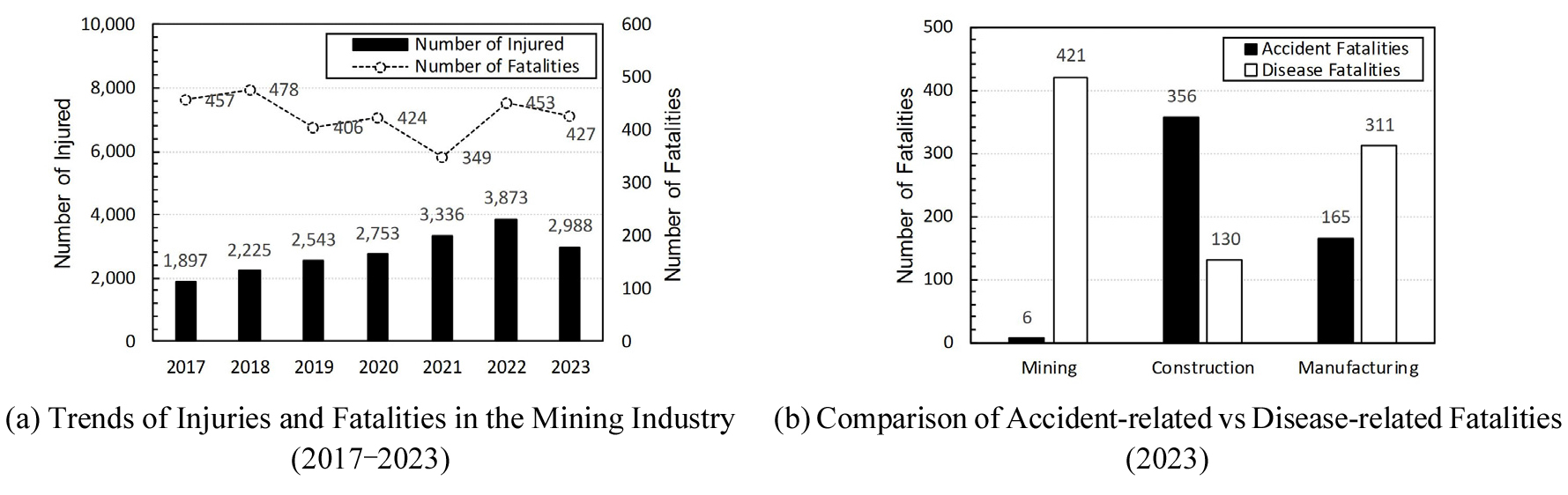
고용노동부(MOEL, 2024)의 산업재해 현황분석을 정리한 Fig. 1(a)에 따르면, 광업의 재해자 수와 사망자 수 추세는 개선되지 않는 것으로 나타났다. 주목할 점은 Fig. 1(b)에서 나타나는 건설업과 광업의 사망 원인 차이이다. 광업 분야 사망자 427명 중 421명(98.6%)이 업무상 질병으로 사망했지만, 건설업은 사고로 인한 사망이 73.3%를 차지하여 뚜렷한 대조를 보인다.
건설업과 광업의 안전관리 특성 비교
현재 건설업과 광업 분야에서는 각기 다른 안전관리 접근법을 채택하고 있다. Fig. 2에서 확인할 수 있듯이, 건설업은 추락사고 제로화를 위한 현장 중심의 즉각적 위험 관리에 집중하는 반면, 광업은 디지털 전환과 통합 플랫폼 구축을 통한 시스템적 관리를 강조한다.
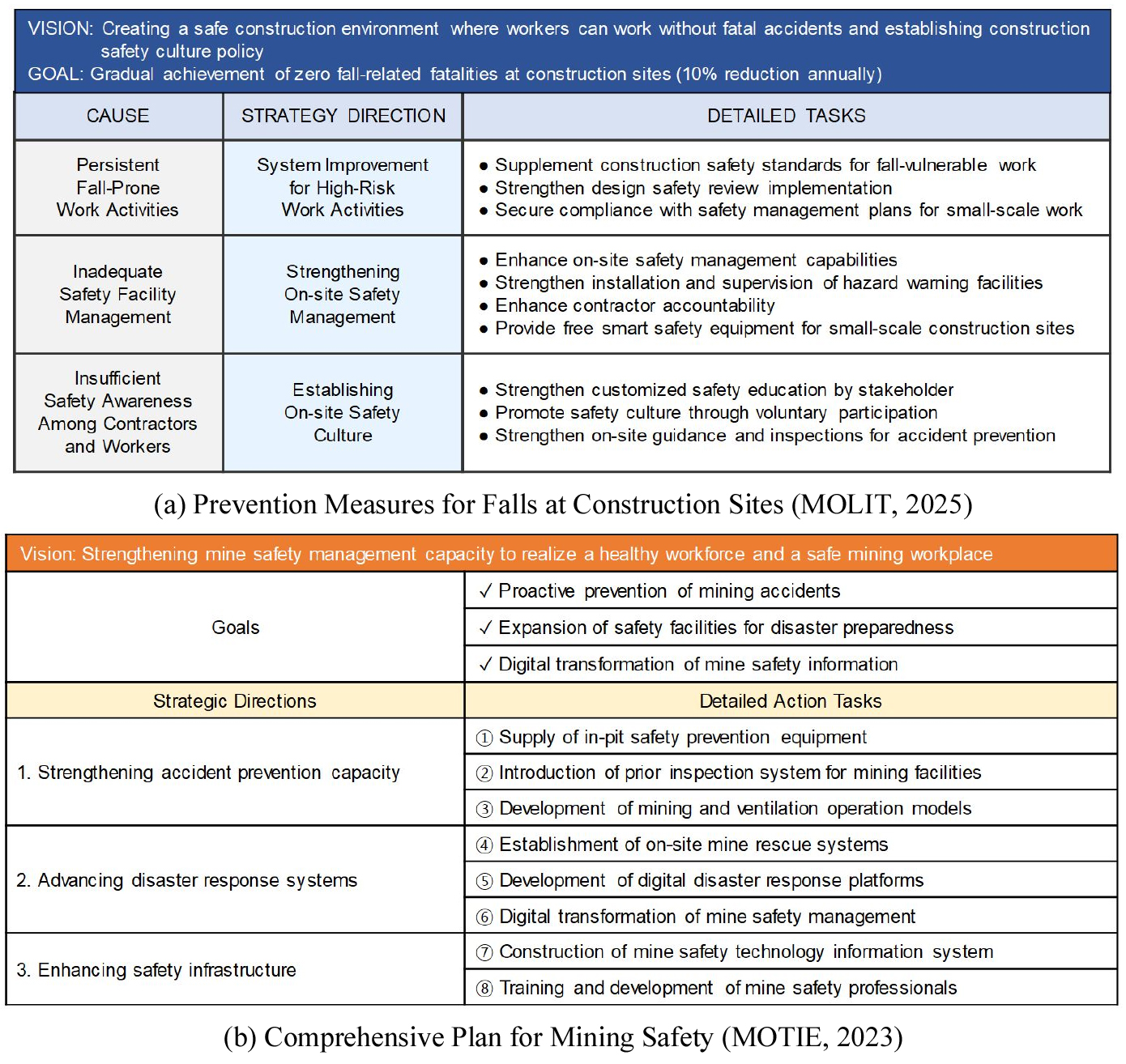
두 산업의 안전관리 접근법 차이는 근본적 작업 특성에서 비롯된다. 건설업은 단기 고강도 작업으로 인한 추락, 충돌 등 즉각적 사고 위험이 크므로 사업장 자율 안전관리가 효과적이다(Masindi, 2023). 광업은 지하 밀폐공간의 고위험 환경 특성상 국가 직접 규제와 전문 관리가 필수적이다(Warhurst, 1994). 이러한 특성 차이는 구조적으로 건설업의 원청-하청 다단계 구조에서 각 사업주 중심의 현장 독립 체계와, 광업의 국가 체계적 규제 중심 관리로 나타난다(Valluru et al., 2020). 결과적으로 급성 위험과 구조적 위험이라는 산업별 특성을 반영하면서도, 상호 보완적 통합 안전관리 체계의 필요성을 시사한다.
산업별 안전관리 현황과 문제점
현재 두 산업은 서로 다른 기술적 접근을 보인다. 건설업은 ICT 기반 스마트 안전기술, 웨어러블 디바이스, 드론, AI를 활용한 실시간 모니터링과 예방 중심의 설계안전성 검토 제도를 통해 즉발적 위험에 신속 대응한다(Tang, 2024). 광업은 IoT 환경 모니터링, 작업자 추적시스템, 가스센서를 통한 구조적 재난 대응과 생존박스 등 비상설비 강화에 주력하나, 만성질환 예방 체계는 미흡하다(Rungani, 2020). Table 1에서 확인되는 바와 같이, 각 산업의 독립적 발전으로 인한 복합 위험 대응 체계 미흡, 법제 간 연계 부족 등이 공통 과제로 나타난다.
Table 1.
Comparative analysis of the safety management systems in construction and mining industries
건설업의 현장 자율성 기반 관리와 광업의 국가 주도적 전문 관리는 각각의 위험 특성에 최적화된 방식이다. 그러나 Table 2에서 나타나는 바와 같이, 건설업은 하청구조로 인한 책임 분산과 현장 통제의 어려움, 광업은 만성질환 예방 체계 부족과 사후 대응 중심의 한계를 드러내고 있다.
Table 2.
Strengths and weaknesses of the safety management systems by industry
각 산업이 독립적으로 발전하면서 복합 위험에 대한 통합 대응 체계가 미흡하다는 것이다. 법제 간 연계 부족, 예방적 건강관리 사각지대, 산업 간 기술 공유 부재 등이 공통 과제로 확인된다. 이에 따라 산업 간 교차 위험 관리체계, 범산업적 법제도 연계, 데이터 기반 통합 위험 예측 체계 등 융합적 접근이 요구되는 상황이다.
통합 안전관리 정책 제안
제도 통합 및 정보 공유 기반
통합 법령 및 협력 체계 구축
현행 국내 안전관리 법령체계는 산업안전보건법을 축으로 하여 건설산업기본법, 광산안전법 등이 산업별 특수성을 반영하는 구조를 가지고 있다. 그러나 이러한 분산적 법령체계는 법령 간 중복 및 비일관성, 부처 간 협력 부족이라는 근본적 한계를 드러내고 있어 통합적 법령체계와 정책 실행 협력 플랫폼 구축이 시급하다. Table 3에서 호주의 작업건강안전법은 통합 법령체계의 대표적 성공사례로, 모든 산업에 적용되는 범용 프레임워크와 산업별 세부 가이드라인을 병행 운영하는 이중 계층 시스템을 보여주고 있다.
Table 3.
Policy proposals and international benchmarks for integrated safety governance
| Classification | Domestic Proposals | International Benchmarks |
|
Legal Reform |
Enactment of a unified Basic Industrial Safety Act (Lingard, 2015) | Australia's Work Health and Safety Act: unified legislation |
|
Governance Model |
Establishment of Industrial Safety Policy Council (Macrory, 2006) | UK HSE: centralized control with independent agency |
|
Standards System |
Dual-layer system: Common + Sector-specific standards (Kjellen and Albrechtsen, 2017) | Australian model: universal framework + industry-specific guides |
영국의 HSE 모델은 독립 기관을 통한 중앙집권적 통제 방식으로, 부처 간 정책 조율과 일관된 규제 집행을 가능하게 한다. 국내 정책 제안은 이러한 국제 모범사례를 바탕으로 통합 산업안전 기본법 제정과 산업안전정책협의회 설립을 핵심으로 한다(Lingard, 2015; Macrory, 2006). 통합 기본법은 건설업과 광업에 공통 적용되는 기본 안전 원칙과 절차를 규정하되, 각 산업의 특수성을 반영한 하위 기준을 별도로 운영하는 이중 계층 구조를 지향한다(Kjellen and Albrechtsen, 2017). 이러한 접근은 법령의 일관성을 확보하면서도 산업별 특성에 맞는 유연성을 동시에 보장할 수 있다.
정보 및 지식 공유 체계
건설업과 광업은 작업환경과 위험 유형에서 상당한 차이를 보이지만, 스마트 안전관리 기술의 발전으로 상호 지식 교류와 정보 공유의 잠재력이 크게 확대되고 있다. Table 4에서 제시된 정보 공유 체계는 4가지 핵심 기능으로 구성된다.
Table 4.
Proposed mechanisms for cross-industry safety information and knowledge sharing
| Function | Proposal Description | Reference |
|
Data Integration | Establishment of Industrial Safety Big Data Center using AI | Tewari and Paiva, 2022 |
|
Knowledge Exchange | Creation of an Industrial Safety Convergence Forum, joint R&D, and expert rotation | Rameezdeen et al., 2021 |
|
Standardized Investigation | Common accident investigation and reporting protocols | Leveson, 2011 |
|
Technology Cross-Use | Share construction’s real-time monitoring and mining’s health management know-how | Zhou et al., 2022 |
첫째, AI를 활용한 산업안전 빅데이터 센터 구축을 통해 건설업의 실시간 사고 데이터와 광업의 장기 노출 데이터를 통합 분석한다(Tewari and Paiva, 2022). 둘째, 산업안전 융합 포럼 창설을 통한 지식 교환 플랫폼을 구축한다(Rameezdeen et al., 2021). 셋째, 공통 사고 조사 및 보고 프로토콜을 정착시켜 사고 분석의 표준화를 추진한다(Leveson, 2011). 넷째, 기술 상호 활용 체계를 통해 건설업의 실시간 모니터링 기술과 광업의 건강관리 기술을 상호 전파한다(Zhou et al., 2022).
ICT 기반 안전관리
스마트 기술 및 데이터 활용
정보통신기술(ICT)의 발전은 건설업과 광업의 안전관리 체계를 융합하는 데 있어 핵심적 동력으로 작용하고 있다. 특히 위치정보, 환경정보, 생체정보를 실시간으로 감지하고 통합하는 기술은 건설업의 즉각적 사고 대응 요구와 광업의 장기적 건강관리 필요를 동시에 충족시킬 수 있는 혁신적 솔루션을 제공한다. Table 5에서 제시된 스마트 기술 통합 방안은 3가지 시스템 유형으로 구분된다.
Table 5.
Smart safety technology integration for construction and mining industries
| System Type | Technology Components | Functional Contribution | Reference |
|
Worker Safety Monitoring | Wearables + RFID (Radio Frequency Identification) | Real-time location and vital sign tracking | Pishgar et al., 2021 |
|
Environment Monitoring | Drone (construction) + Gas/Dust Sensors (mining) | Continuous monitoring of hazardous environments | Li et al., 2022 |
|
Equipment/Facility Monitoring | IoT Sensors + Digital Twin | Risk-based diagnostics and maintenance for high-risk assets | Lee et al., 2016 |
작업자 안전 모니터링 시스템은 웨어러블 디바이스와 RFID 기술을 결합하여 작업자의 실시간 위치와 생체신호를 추적한다(Pishgar et al., 2021). 환경 모니터링 시스템은 건설업의 드론 기술과 광업의 가스·분진 센서를 융합하여 위험 환경의 지속적 감시를 실현한다(Li et al., 2022). 장비 및 시설 모니터링 시스템은 IoT 센서와 디지털 트윈 기술을 결합하여 고위험 자산의 위험 기반 진단과 예방적 유지보수를 지원한다(Lee et al., 2016).
빅데이터 기반 위험 예측
안전관리 기술의 지속적 발전으로 빅데이터를 활용한 위험 예측과 의사결정 지원 체계 구축이 현실화되고 있다. 건설업에서 수집되는 단기간 사고 데이터와 광업에서 축적되는 장기간 노출 데이터를 통합하면, 기존 단일 산업 접근으로는 발견할 수 없었던 새로운 위험 패턴과 예측 모델을 개발할 수 있다. Table 6에서 제시된 빅데이터 기반 위험 예측 시스템은 3가지 핵심 구성요소로 이루어진다.
Table 6.
Big data-based risk prediction and decision support systems
| Component | Key Function | Sectoral Application | Reference |
|
AI Risk Pattern Identification | Real-time pattern analysis from integrated safety data | Short-term (construction), long-term (mining) | Zhou et al., 2022 |
|
Decision Support Engine | AI-driven safety alerts and task adjustments | Supports low-experience decision-makers | Pereira et al., 2025 |
|
Adaptive Learning Model | Continuous model update with new incident/environment data | Enhances predictive accuracy | Xu et al., 2023 |
AI 위험 패턴 인식 기능은 통합된 안전 데이터에서 실시간 패턴 분석을 수행하여 건설업의 단기적 위험 신호와 광업의 장기적 위험 누적을 동시에 파악한다(Zhou et al., 2022). 의사결정 지원 엔진은 AI 기반의 안전 경고와 작업 조정 방안을 실시간으로 제시하여, 특히 안전관리 경험이 부족한 중소 사업장의 의사결정자들을 지원한다(Pereira et al., 2025). 적응형 학습 모델은 새로운 사고 데이터나 환경 변화 정보가 입력될 때마다 예측 알고리즘을 지속적으로 업데이트하여 예측 정확도를 향상시킨다(Xu et al., 2023).
교육·훈련 및 안전문화 개선
계층별 맞춤형 교육
통합 안전관리체계의 성공적 정착을 위해 단순한 지식 전달을 넘어서 조직 내 안전문화를 정착하고 위험 상황에서 적절히 대응할 수 있는 역량을 기르는 교육 시스템이 필수적이다. 특히 건설업과 광업의 상이한 위험 특성을 모두 고려한 통합적 안전 인식을 확산시키기 위해서 조직 내 역할과 책임 수준에 따른 계층별 맞춤형 교육이 요구된다. Table 7에서 제시된 계층별 교육 프로그램은 4개 대상 그룹별로 차별화된 접근을 취한다.
Table 7.
Tier-specific safety education programs for integrated management
| Target Group | Program Name | Core Content | Reference |
| Executives | Integrated Safety Leadership Course | Safety prioritization, subcontracting risk, disease prevention | Clarke, 2013 |
| Middle Managers | Integrated Safety Management Expert Course | Risk assessment, system planning, policy integration | Mohammadi et al., 2021 |
| Field Workers | Practical Integrated Safety Course | Fall prevention, gas hazard response, emergency behavior drills | Zhao et al., 2016 |
| Designers/Clients | DfS Expert Course | Hazard elimination in design stage, integrated safety planning | Gambatese et al., 2008 |
경영진을 위한 통합 안전 리더십 과정은 안전을 조직 전략의 최우선 순위로 설정하는 리더십 역량 강화에 중점을 둔다(Clarke, 2013). 중간관리자를 위한 통합 안전관리 전문가 과정은 위험성 평가, 안전시스템 설계, 정책 통합 능력 배양을 핵심으로 한다(Mohammadi et al., 2021). 현장 작업자를 위한 실무 통합 안전 과정은 즉시 적용 가능한 실용적 기술과 대응 방법에 중점을 둔다(Zhao et al., 2016). 설계자와 발주자를 대상으로 하는 설계안전성검토(DfS) 전문가 과정은 설계 단계에서부터 위험요소를 사전에 제거하는 예방적 안전관리 역량을 배양한다(Gambatese et al., 2008).
체험형 안전교육 및 비상대응 훈련 강화
기존의 이론 중심 안전교육이 실제 행동 변화로 이어지기 어렵다는 한계를 극복하기 위해, 가상현실(VR)과 증강현실(AR)을 활용한 몰입형 체험 교육이 대안으로 주목받고 있다. Table 8에서 제시된 몰입형 안전교육은 2가지 프로그램 유형으로 구성된다.
Table 8.
Components of immersive safety training for multi-industry hazards
| Program Type | Technology Used | Training Scenario Example | Functional Benefit | Reference |
| Immersive VR/AR Training | VR headsets, AR overlays |
Fall from height (construction) Mine collapse (mining) | Realistic simulation, improved emergency response | Sacks et al., 2013 |
| Data-Fused Hazard Simulation | Drone + IoT sensor data | Real-time mixed hazard monitoring | Cross-industry risk experience and skill sharing | Queralta, 2022 |
VR/AR 기반 몰입형 훈련은 건설현장의 고소 추락과 광산의 갱도 붕괴 등 실제로는 체험하기 어려운 극한 위험 상황을 가상으로 재현한다(Sacks et al., 2013). 데이터 융합 위험 시뮬레이션은 건설업의 드론 영상 데이터와 광업의 IoT 센서 데이터를 결합하여 복합적 위험 상황을 실시간으로 모의 재현한다(Queralta, 2022). 이는 단일 산업에서는 경험하기 어려운 복합 위험에 대한 대응 능력을 기를 수 있으며, 산업 간 위험 대응 전략과 기술의 상호 교류를 촉진한다.
성과 기반 규제 및 인센티브 체계 강화
성과 기반 규제 체계 도입
전통적인 절차 중심 규제에서 결과 중심의 성과 기반 규제로의 전환은 기업의 자율성을 존중하면서도 실질적인 안전 성과 개선을 유도할 수 있는 효과적 방안이다. 성과 기반 규제의 핵심은 정량적으로 측정 가능한 안전 지표를 설정하고, 이를 바탕으로 차등적 규제와 지원을 제공하는 것이다. 이를 위해서는 먼저 산업별 특성을 반영한 종합적 성과 평가 지표 체계를 구축해야 한다. 건설업의 경우 재해율, 중대재해 발생률, 안전교육 이수율, 안전장비 착용률 등을 종합한 지표를, 광업의 경우 직업병 발생률, 환경 모니터링 수준, 비상대응 시스템 구축률 등을 포함한 지표를 개발한다. 특히 건설업의 소규모 하청업체나 광업의 영세 광산과 같이 자원이 제한된 사업장에 대해서는 기술 지원과 재정 지원을 병행 제공하여 규제의 실효성과 형평성을 동시에 확보한다.
인센티브 체계 강화
안전 성과를 효과적으로 유도하기 위해서는 경제적 혜택과 비경제적 혜택을 함께 제공하는 다층적 인센티브 체계가 필요하다. 경제적 인센티브는 안전관리 우수 기업에 대한 산업재해보험료 할인과 세제 혜택을 핵심으로 한다(European Agency for Safety and Health at Work, 2010; Young and Ringen, 2022). 안전교육 투자, 스마트 안전기술 도입, 근로자 건강관리 프로그램 운영 등에 대한 세제 지원을 확대하여 기업의 자발적 안전 투자를 유도한다. 기술 지원 인센티브는 산업별 특성에 맞는 차별화된 접근을 취한다(Yang et al., 2021). 건설업에는 ICT 기반 스마트 안전기술 도입을 지원하고, 광업에는 근로자 건강관리 시스템 구축과 환경 모니터링 장비 도입을 지원한다. 행정적 인센티브는 우수 사업장에 대한 인증 혜택과 각종 행정 절차의 간소화를 포함한다(Zwetsloot et al., 2011). 개인 수준의 인센티브는 관리자와 작업자 모두를 대상으로 하는 다층적 보상 체계를 구축한다(Salah, 2016). Table 9에서 제시된 인센티브 구조는 4가지 유형으로 구성된다. 재정적 인센티브는 보험료 할인과 세제 혜택을 통해 직접적인 경제적 동기를 제공하며, 기술 지원은 각 산업의 특성에 맞는 차별화된 접근을 통해 실질적 안전 개선을 유도한다.
Table 9.
Incentive structure for safety investment in construction and mining industries
| Type | Application Example | Applicable Sector | Reference |
| Financial | Insurance premium discounts, tax relief | Construction, Mining | Kankaanpää, 2010 |
| Technical Subsidy | Support for smart tech adoption, health screening | Construction (ICT), Mining (health management) | Yang et al., 2021 |
| Administrative | Certification benefits, simplified procedures | All | Zwetsloot et al., 2011 |
| Individual Rewards | Manager/worker-level performance bonuses | Multi-layered (all roles) | Salah, 2016 |
행정적 인센티브는 절차적 편의성을 제공하여 우수 기업의 경쟁력을 강화하고, 개인 보상은 현장 단위의 안전 동기를 높인다. 이러한 다층적 인센티브 체계는 기업의 안전 투자뿐만 아니라 현장 관리자와 근로자의 참여를 활성화하며, 건설업의 복잡한 하도급 구조와 광업의 단일 사업장 구조 모두에 적용 가능한 유연성을 갖추고 있다.
안전 책임 강화 및 소통 체계
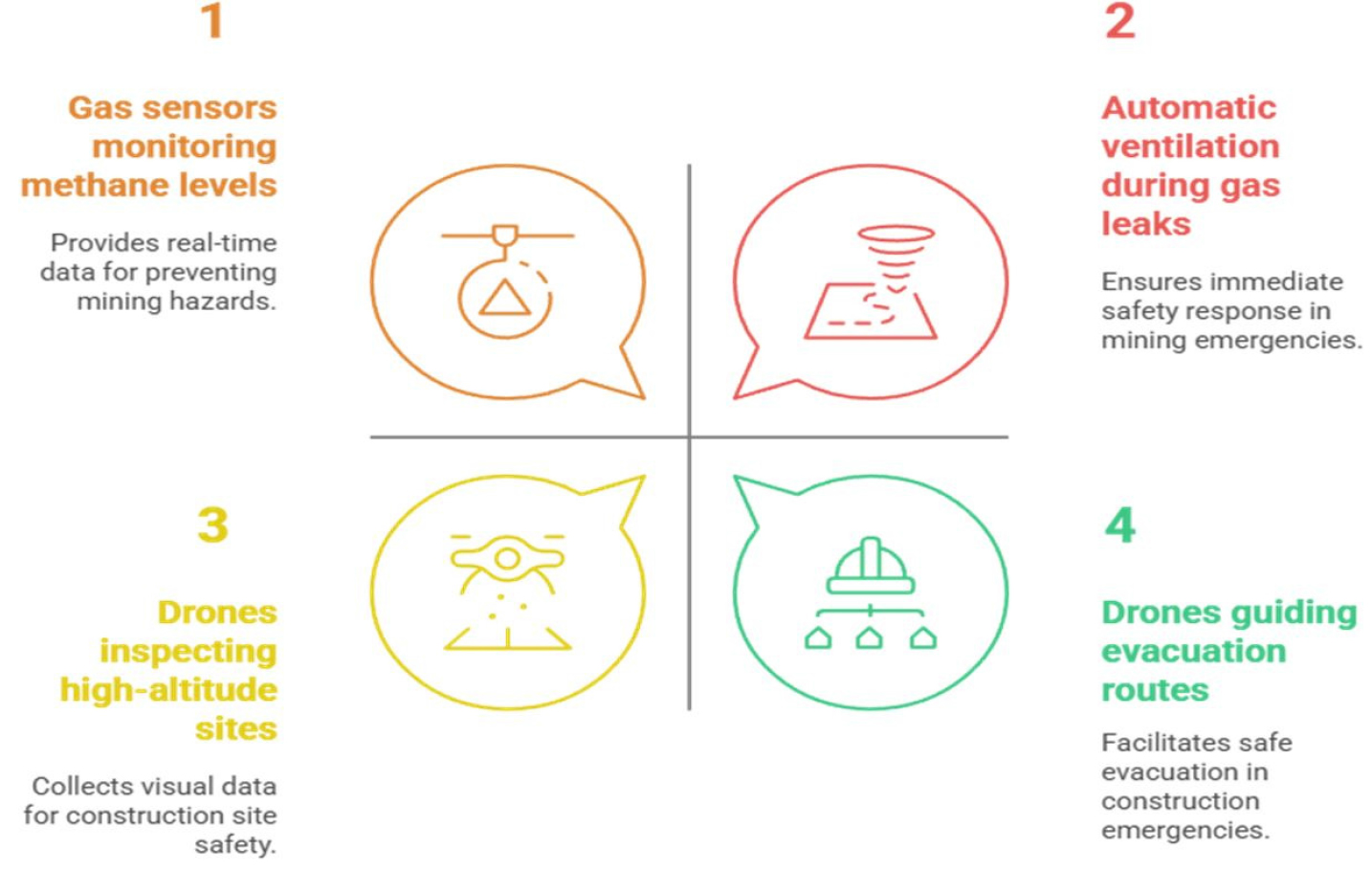
광업 분야에서는 Fig. 3에서 제시된 4가지 핵심 스마트 안전기술 활용이 특히 중요하다. 사물인터넷(IoT) 센서를 기반으로 한 환경 감시 시스템은 실시간으로 작업 환경을 모니터링할 수 있다. 디지털 트윈 기술을 활용한 설비 진단은 장비의 상태를 사전에 파악하여 사고를 예방하고, 작업자 위치 기반 알림 시스템과 사고 대응 시뮬레이션 기술은 위험 상황에 대한 즉각적이고 체계적인 대응을 가능하게 한다(Soori et al., 2023). 이러한 통합형 정책의 성공적 실행을 위해서는 중장기적 계획을 기반으로 한 단계별 전략이 필요하다. Fig. 4는 정책 실행을 위한 3단계 접근 전략을 정리한 것이다.
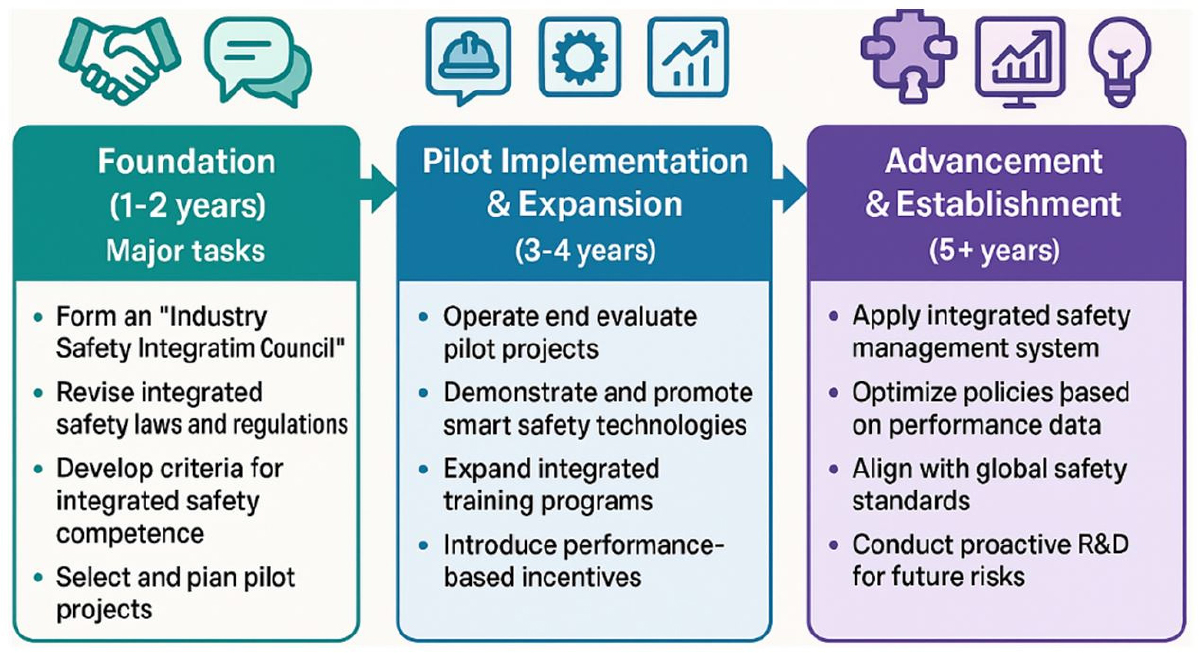
정책 실행은 3단계로 접근하는 것이 효과적인데, 첫 번째 단계에서는 파일럿 프로그램을 통해 실행 가능성을 검증하고, 두 번째 단계에서는 시범 운영 결과를 바탕으로 제도를 보완하여 확대 적용하며, 마지막 단계에서는 전면 시행과 함께 지속적인 모니터링을 통해 제도를 정착시킨다. 이러한 단계적 접근은 현장 수용성을 높이고 실제 경험을 바탕으로 한 피드백을 반영함으로써 건설업과 광업 모두에서 안전관리 수준의 실질적 향상을 기대할 수 있다. 특히 제도의 현장 수용성을 높이고, 실증 기반의 피드백을 반영함으로써 통합 정책의 유연성과 지속가능성을 확보한다.
결 론
본 연구는 국내 건설업과 광업의 안전관리 체계를 비교 분석하고, 두 산업의 강점을 결합한 통합 안전관리 정책을 제안하였다. 건설업은 즉발성 사고 위험이 높아 현장 중심의 자율적 안전관리가 중요한 반면, 광업은 만성 직업병 위험이 커 국가 주도의 체계적 관리가 필수적이라는 근본적 차이를 확인하였다. 제안된 통합 안전관리 정책은 네 가지 핵심 영역으로 구성된다.
• 첫째, 제도 통합 및 정보 공유 기반 구축을 통해 산업안전 기본법 제정과 산업안전 정책협의회 설립을 제안하였다. 이는 법령 간 중복과 비일관성 문제를 해결하고 부처 간 협력을 강화할 수 있다.
• 둘째, ICT 기반 스마트 안전관리 시스템 도입을 통해 건설업의 실시간 모니터링 기술과 광업의 환경 감시 기술을 융합한 통합 플랫폼을 구축할 수 있다.
• 셋째, 계층별 맞춤형 교육과 체험형 안전훈련을 통해 조직 전반에 안전문화를 정착시키고, 경영진부터 현장 작업자까지 각자의 역할에 맞는 안전 역량을 강화할 수 있다. 넷째, 성과 기반 규제와 다층적 인센티브 체계를 통해 기업의 자발적 안전 투자를 유도하고, 절차 중심에서 결과 중심으로 안전관리 패러다임을 전환할 수 있다.
이러한 통합 접근법은 여러 가지 긍정적 효과를 기대할 수 있다. 우선 산업 간 지식과 기술 공유를 통해 각 산업의 안전관리 수준을 상향 평준화할 수 있다. 건설업의 스마트 기술과 광업의 건강관리 노하우가 상호 교류되면서 복합 위험요소에 대한 통합적 대응이 가능해진다. 또한 중복 투자를 방지하고 자원 활용을 최적화함으로써 안전관리의 효율성을 크게 높일 수 있다.
특히 단계적 정책 실행 전략을 통해 현장의 수용성을 확보하고 실증적 피드백을 반영할 수 있어, 정책의 실효성과 지속가능성을 동시에 보장할 수 있다. 이는 기존의 개별 산업 중심 접근에서 벗어나 산업 간 협력을 강조하는 새로운 안전관리 패러다임을 제시한다는 점에서 의미가 크다.
통합 안전관리 정책의 성공적 정착을 위해서는 몇 가지 과제가 남아 있다. 먼저 관련 부처와 산업계의 적극적인 협력과 참여가 필요하며, 법제도 개선과 예산 확보 등 정책적 뒷받침이 수반되어야 한다. 또한 기술 발전 속도에 맞춰 정책과 제도를 지속적으로 업데이트하고, 국제적인 안전관리 동향을 반영하여 글로벌 경쟁력을 확보하는 것도 중요하다. 나아가 안전한 작업 환경 조성을 통해 산업 경쟁력 강화와 지속 가능한 발전에도 긍정적인 영향을 미칠 것으로 기대된다.