
Technical Report

Journal of the Korean Society of Mineral and Energy Resources Engineers. 31 October 2025. 537-558
https://doi.org/10.32390/ksmer.2025.62.5.537

ABSTRACT


MAIN

  • 서 론

  • 해저 자원에 농축된 핵심금속들의 분류

  • 핵심금속들의 농축요인

  •   전하 친화도

  •   성장률

  •   수심

  •   퇴적 이후의 인산염화

  •   구조적 흡착 및 흡수

  • 핵심금속들의 농축 과정

  •   코발트와 니켈

  •   구리와 아연

  •   희토류와 이트륨

  •   백금족 원소들

  •   텔루륨(Tellurium)

  •   탈륨(Thallium)

  •   셀레늄(Selenium)

  •   카드뮴(Cadmium)

  •   리튬(Lithium)

  •   몰리브데넘(Mo), 텅스텐(W), 바나듐(V)

  •   티타늄(Titanium)

  •   안티몬(Sb)과 비소(As)

  • 서태평양 마젤란 해저 망간각 시료 광물 및 화학분석

  • 결 론

서 론

해저 망간각(ferromanganese crust)과 다금속 망간단괴(polymetallic nodule)는 심해저에서 형성되는 중요한 광물 자원으로, Mn과 Fe뿐만 아니라 Co, Ni, Cu, REE 등 첨단 산업에 필수적인 금속의 주요 공급원으로 주목받고 있다(Hein et al., 2020; Zhang et al., 2023). 이러한 광물은 초저속 침전 과정을 통해 수백만 년에 걸쳐 성장한다. 망간각은 주로 해산(seamount) 정상부와 사면에 부착되어 높은 농도의 핵심 금속을 함유하는 반면, 망간단괴는 심해 평원 전역에 광범위하게 분포하여 막대한 자원 잠재력을 가진다(Mizell et al., 2022). 최근 연구에 따르면 이들 광물의 형성과 성장 과정은 해양 미생물군의 금속 순환과 밀접한 관련이 있는 것으로 밝혀졌다(Zhang et al., 2023). 심해 미생물들은 생화학적 대사 과정에서 금속을 금속효소(metalloenzyme)의 보조인자로 활용하며, 이 과정에서 금속의 산화·환원 반응, 침전 작용 등을 매개한다. 이러한 미생물 활동은 금속 원소의 이동, 농축, 순환에 중대한 영향을 미치며, 이는 해양 지구화학적 메커니즘뿐 아니라 심해 생태계 이해에도 중요한 단서를 제공한다(Blöthe et al.,2015). 더 나아가, 전 세계적인 에너지 전환과 전기차·재생에너지 산업의 급속한 성장에 따라 전략 금속 수요는 지속적으로 증가하고 있다. 이에 따라 해저 망간각과 망간단괴 등 심해 광물 자원은 미래 산업의 지속 가능성과 에너지 전환의 안정성을 보장하기 위한 핵심적 공급원으로서 그 중요성이 더욱 부각되고 있다(Hein and Koschinsky, 2020).

망간각과 망간단괴는 대양 심해저 평원, 해산 측면, 해저 고원 등에서 발견되는 자생성(authigenic) 침전물로, 주로 해수기원(hydrogenetic) 침전에 의해 형성된다(Lusty and Murton, 2018; Hein and Koschinsky, 2014; Hein et al., 2020). 이들은 교질(colloidal) 상태의 금속을 풍부하게 함유하며, 산소가 풍부한 해수에서 직접적인 해수 침전을 통해 성장한다(Hein et al., 2020; Halbach et al., 2017; Kuhn et al.,2017). 망간단괴의 경우, 미생물 산화로 형성된 저산소(suboxic) 환경의 원양 퇴적물과 공극수 내 용존 금속이 속성작용(diagenetic process)을 거쳐 생성되기도 한다(Hein and Koschinsky, 2014; Kuhn et al., 2017; Wegorzewski and Kuhn, 2014). 속성작용은 해수와 퇴적물의 경계면에서 해수에 녹아 있는 금속 성분들이 퇴적물과 화학 반응을 일으켜 침전하면서 형성되는 과정을 말한다. 망간, 니켈, 구리 등의 금속이 화학적 침전을 통해 서서히 축적되면서 나무의 나이테처럼 동심원 형태로 단괴가 성장하는 방식이다. 이들의 성장 속도는 매우 느려(약 1–10 mm/Ma) 장기간 금속 농축이 가능하며, 낮은 체적 밀도(평균 1.3 g/cm3, 건조 기준), 넓은 표면적(평균 300 m2/g), 높은 공극률(평균 60%) 등 독특한 물리적 특성을 갖는다(Halbach, 1986; Marino et al., 2018; Hein et al., 2000). 광물학적으로는 vernadite, birnessite, buserite, asbolan, todorokite, 비정질 철 산화수산화물(Fe-oxyhydroxide) 등이 주를 이루며(Sutherland et al., 2020; Li and Schoonmaker, 2014; Lee and Xu, 2016; Manceau et al., 2014), 층간 공간·터널 구조·층상구조 발달 등 금속을 다량 수용할 수 있는 구조적 특성을 지닌다(Kwon et al.,2013; Bodei et al., 2007; Manceau et al., 1997; Lee et al.,2019). 이러한 특성 덕분에 해수 내 금속 포집에 중요한 역할을 한다.

핵심 금속(critical metals)은 친환경 기술과 산업 발전에 필수적인 전략 자원으로, 희소성·첨단기술 활용도·공급 안정성 등을 기준으로 정의된다. 망간각과 망간단괴에는 Co, Ni, Cu, Zn(Manceau et al., 1997; Takahashi et al., 2007; Peacock and Sherman, 2007a; Usui, 1979), REE, PGM 및 Y(Elderfield et al., 1981; Ohta and Kawabe, 2001; Bau et al.,1996) 등이 고농도로 농집되어 있어 과학적·경제적 가치가 높다. 예를 들어, Pacific Prime Crust Zone의 망간각은 Co·Mo·Tl 농도가 지각 평균치보다 100배 이상, Te는 무려 5만 배 이상 높게 보고되었다(Hein et al., 2003). 전 세계적으로 약 1억 2천만 톤 이상의 Co, Ni, REE가 심해저 망간각에 매장된 것으로 추산된다(Hein et al., 2017; Marino et al., 2017).

수십 년간 이들 침전물의 핵심 원소 생성 양상, 흡착 과정, 농축 메커니즘에 관한 연구가 활발히 진행되어 왔다(Koschinsky and Halbach, 1995, Koschinsky and Hein, 2003; Takahashi et al., 2007; Koschinsky et al., 2020). Li, Te, Mo, W, V, As, Sb 등 다양한 금속의 농축 특성과 기작(Kashiwabara et al., 2014; Kuhn et al., 2003; Jiang et al., 2007), 광물 조성과 자원 잠재성(Toro et al., 2020; Lusty et al., 2018), 화학적 농축 과정(Kuhn et al., 2017; Hein et al., 2013)에 대한 이해가 확대되었으나, 여전히 농축 경로와 메커니즘에 대한 완전한 해석은 제한적이다.

본 연구는 해저 망간각과 망간단괴 내 핵심 원소들의 흡착 및 농축에 영향을 미치는 요인을 규명하고, 주요 농축 경로와 구조 내 특정 위치에 대한 금속의 선호도를 분류하는 것을 목표로 한다. 이를 위해 기존 문헌을 종합하여 다섯 그룹의 핵심 원소별 농축 특성과 미세 흡착 과정 및 그 메커니즘을 상세히 검토하였다. 연구의 초점은 해수기원 철-망간 산화수산화물에 두었으며, 동시에 망간단괴와 인산염화 망간각 등 다양한 지질 환경을 함께 다루었다. 참고로, 열수기원 망간각과 망간단괴는 Co·Ni(Kuhn et al., 2003; Usui and Terashima, 1997), REE(Surya Prakash et al., 2012; Kuhn et al., 1998; Mikhailik et al., 2017) 농도가 200 ppm 이하로 낮으며, 자원량과 경제성이 제한되고 분포 범위 또한 협소하다(Kuhn et al., 2017). 반면 해수기원 망간각과 망간단괴는 광물학적·화학적 조성, 형성과정, 그리고 해수기원 금속의 흡착 메커니즘이 유사하여 본 연구에서는 이를 집합적으로 논의하였다. 또한 본 논문에서는 핵심 금속을 중심으로 논의를 전개하되, 일부 핵심 원소도 포함한다. 다만 서술의 편의를 위해 본문에서는 모두 ‘핵심 금속’으로 통칭한다.

해저 자원에 농축된 핵심금속들의 분류

핵심금속의 식별은 희소성이나 기존 표준 목록의 단순 참조에 그치지 않으며, 해당 금속이 가지는 경제·사회·기술적 중요성과 공급망 취약성, 전략적 가치가 종합적으로 고려된다(Gulley et al., 2018; Hein et al., 2022). 일반적으로 핵심금속은 (1) 국가 경제 번영과 사회적 안정 유지에 필수적이며, (2) 공급이 중단될 경우 핵심 산업과 제품 생산에 심각한 지장을 초래하고, (3) 첨단 제조, 내수 및 수출용 전략 산업, 친환경·첨단 기술 응용에서 핵심적인 역할을 담당한다. 이들 금속의 공급 차질은 전 세계 경제와 사회 전반에 부정적인 파급효과를 일으킬 수 있다. 중국, 미국, 유럽연합 등 주요 수입·소비국은 핵심금속의 안정적 확보라는 공통 과제를 직면하고 있으며, 높은 수입 의존도는 글로벌 자원 경쟁이 지속되고 있음을 보여준다(U.S.G.S., 2023; Sovacool et al., 2020). 본 절에서는 해저 망간각과 망간단괴에서 농축되는 주요 핵심금속 그룹을 다섯 가지 범주로 분류하고, 각 군의 농축 특성과 메커니즘을 논의한다(Hein, 2003; Lee and Xu, 2024; Lusty et al., 2018; Huang and Fu, 2023).

첫째, 광석 형성 원소(Ore-forming elements)로 Co, Ni, Cu, Zn이 여기에 해당한다. 이들 원소는 주로 해수기원(hydrogenetic) 또는 혼합기원(mixed-type) 침전 과정을 통해 해수로부터 철-망간 산화수산화물 표면에 강하게 흡착되어 농축된다.

둘째, 희토류 원소(REE) 및 이트륨(Y)은 해저 Fe-Mn 침전물에서 높은 농축률을 보이는 대표적인 원소군이다. 특히 네오디뮴(Nd), 디스프로슘(Dy), 이트륨 등은 첨단 영구자석 및 전자재료의 핵심 소재로 평가받으며 그 중요성이 매우 크다.

셋째, 백금족 원소(Platinum-Group Elements, PGEs)는 백금(Pt), 팔라듐(Pd), 로듐(Rh) 등을 포함하며, 해저 망간각과 망간단괴에 수 ppm 수준으로 농축된다. 이들은 귀금속 및 촉매 산업에서 필수적인 역할을 담당한다(Berezhnaya et al., 2018).

넷째, 분산 원소(Dispersed elements)인 텔루륨(Te), 탈륨(Tl), 셀레늄(Se), 카드뮴(Cd) 등은 지각 내 평균 존재비가 10⁻9–10⁻6 수준으로 매우 낮아 독립적인 광상을 형성하는 경우가 드물다. 갈륨(Ga), 저마늄(Ge), 인듐(In), 레늄(Re) 역시 이 그룹에 속하며, 철-망간 침전물 내에서 매우 높은 수준으로 농축되는 특성을 보인다.

다섯째, 기타 부화 금속(Other enriched elements)으로는 Li, Ti, As, Sb, W, Mo, V 등이 있다. 이들 원소는 특정 지구화학적 환경에서 선택적으로 농축되며, 일부는 차세대 배터리, 특수합금, 반도체 소재로서 주목받고 있다. 이 외에도 Bi, U 등 일부 핵심 원소가 해저 철-망간 침전물에서 특정 농축 경향을 보이지만, 현 단계에서는 관련 연구가 부족하기 때문에 본 논의에서 제외하였다.

핵심금속들의 농축요인

해저 망간각과 망간단괴에서 금속 원소가 흡착 및 흡수되어 농축되는 과정은 다양한 화학적 상호작용과 외부 환경 요인의 영향을 받는다. 이러한 요인에는 금속 종 분화(speciation)의 전기화학적 선호도, 해수의 깊이, 망간각·망간단괴의 성장률, 퇴적 후 인산염화, 그리고 철-망간 광물의 미세구조 특성이 포함된다(Halbach, 1986; Koschinsky and Halbach, 1995; Verlaan and Cronan, 2022; Hodkinson and Cronan, 1991).

전하 친화도

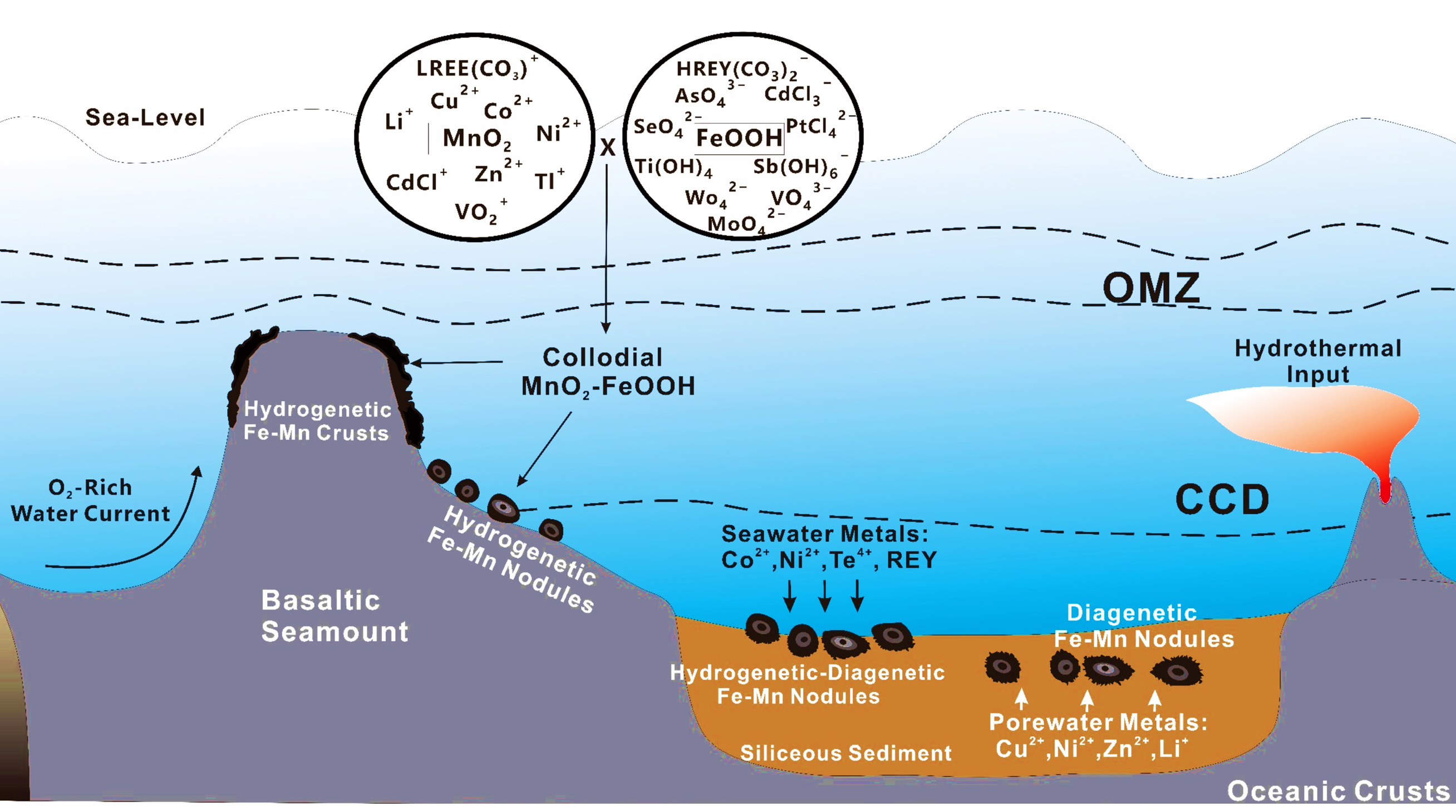
망간각과 망간단괴 내 금속의 농축은 주로 결합상과의 전기화학적 친화성(electro-affinity)에 의해 제어된다(Fig. 1). 해저 철-망간 침전물에서 특정 금속은 망간 상 또는 철 상에 대해 뚜렷한 흡착 선호도를 보이는 것으로 알려져 있다(Koschinsky et al., 2020; Mohwinkel et al.,2014). 이러한 현상은 구성 광물의 표면 전하 특성으로 설명할 수 있다. 주요 구성 광물인 버나다이트(vernadite)와 철 산화수산화물(FeOOH)은 각각 2.8과 8.5의 영점전하점(pHzpc)을 가지므로, 일반적인 해수 pH(약 8.0) 조건에서 서로 다른 표면 전하를 띤다. 구체적으로, 음으로 하전된 버나다이트 표면에는 Co2+, Ni2+, ZnCl+와 같은 자유 양이온 및 약한 염기성 복합체, 그리고 양전하를 띠는 경희토류(LREE)가 강하게 흡착된다. 반면, Mo, Te, 중희토류(HREE)와 같이 산소 음이온(oxyanion) 복합체를 형성하는 원소들은 약하게 양으로 하전된 철 산화수산화물 표면에 우선적으로 결합한다(Koschinsky and Halbach, 1995; Koschinsky and Hein, 2003; Byrne, 2002).

이와 같은 선택적 결합 선호도는 쿨롱 상호작용과 화학적 교환 반응을 통해 금속 농축을 유도하는 핵심 기작으로 이해되어 왔다(Koschinsky and Halbach, 1995). 그러나 후속 연구들은 표면 전하 특성만이 금속 흡착을 결정하는 유일한 요인이 아님을 밝혔다. 일례로, Pt와 W는 해수 내에서 음전하를 띠는 화학종으로 존재함에도 불구하고, 정전기적 반발력(electrostatic repulsion)을 극복하고 음으로 하전된 망간 상에 흡착되는 현상이 보고되었다(Koschinsky et al., 2020; Kashiwabara et al., 2013; Maeno et al., 2016). 한편, 해저 철-망간 산화수산화물의 흡착 특성을 규명하기 위한 많은 흡착·침전 실험에서는 합성 침철석, 페리하이드라이트(ferrihydrite), 버네사이트(birnessite) 등이 활용되어 왔다(Zhao et al., 2023; Zhu et al., 2020; Mitsunobu et al., 2010). 이 논문에서 수착(sorption)의 용어는 용액에 존재하는 원소들을 인접한 고체 상으로 제거되는 과정을 지칭하며, 표면흡착(adsorption)과 내부흡수(absorption)을 포괄하는 개념으로 사용했다. 그러나 이들 합성 광물은 자연 상태의 망간각이나 망간단괴에 비해 구조적으로 이상화되어 있으며, pHzpc 값의 미세한 차이가 흡착 특성의 변동을 야기할 수 있다. 더욱이, 과거에 수행된 단계적 용출(sequential leaching) 실험 결과, 일부 금속이 실험 과정에서 재흡착(readsorption)되거나 다른 변질 과정을 겪는 것으로 나타났다. 이러한 결과는 기존에 제시된 원소별 전기적 선호도와 망간 및 철 상에 대한 흡착 선호도를 재평가할 필요가 있음을 시사한다(Koschinsky et al., 2020; Koschinsky and Halbach, 1995; Koschinsky and Hein, 2003).

성장률

해저 망간각과 망간단괴의 성장률은 함유 금속의 조성과 농도에 중요한 영향을 미친다(Verlaan et al., 2004; Takematsu et al., 1989). 해수기원(hydrogenetic) 성장률은 매우 낮아 약 1–10 mm/Ma 수준이지만, 공극수 기여와 해저 퇴적물 기반의 퇴적물기원 성장률은 이보다 2–50배 빠르다(Hein and Koschinsky, 2014; Halbach et al., 2017; Usui et al., 2017).

일반적인 해수 환경에서의 초저속 성장률은 철-망간 산화물이 장기간에 걸쳐 해수로부터 핵심금속을 흡착·농축할 수 있는 충분한 시간을 제공한다. 이러한 특성은 특히 Co와 Ce와 같이 성장률과 강한 음의 상관관계를 보이는 원소에서 뚜렷하게 나타나며, 해수기원 철-망간 산화물의 높은 금속 수용력(metal capacity)을 입증한다(Hein et al.,2000; Takahashi et al., 2007; Halbach and Marbler, 2009). Co의 경우, 해수 내 농도가 낮음에도 불구하고 초저속 성장률 환경에서 농축이 가능하며, 성장률 변화에 대한 민감도가 특히 높다(Halbach et al., 1983; Puteanus and Halbach, 1988). 반대로, 성장률이 높은 망간각과 망간단괴는 일반적으로 Ni과 Cu 함량이 높고, 해저 퇴적물 기원 원소의 비율이 증가하며, 해수 기원 금속의 농도는 낮아지는 경향을 보인다(Wegorzewski and Kuhn, 2014; Bodei et al., 2007). 따라서 성장률 변동은 금속 함량 차이를 설명하는 핵심 요인 중 하나이며, 이는 특정 핵심금속의 상대적 농축 경향을 합리화한다(Halbach, 1986; Lusty et al., 2018; Fu and Wen, 2020).

육상에 가까운 연안이나 영해에서 형성된 망간각과 망간단괴는 심해 퇴적물에 비해 망간 함량과 상관성이 낮은 원소들이 상대적으로 높게 나타나며, 육상기원 물질 유입으로 인해 성장률이 증가하는 사례가 보고되었다(Verlaan and Cronan, 2022; Conrad et al., 2017; Guan et al., 2017). 성장률과 금속 농축의 관계를 요약하면, Co, Ce, Ti, Pt, REE 등 해수 기원 원소는 성장률이 낮을수록 점진적으로 축적되며, Mo, W, V, Tl 등은 성장률의 영향이 상대적으로 적다. 반면, Cu, Ni 등은 성장률이 높을수록 농도가 증가한다(Hein et al.,2017; Bau et al., 2014; Li et al., 2023). 다만, 성장률이 유사한 지역이라도 금속 농도에서 차이가 발생할 수 있다. 예를 들어, 열대 북태평양의 망간각들은 비슷한 성장률을 보이지만 금속 함량은 지역마다 상이하며, 이는 위도와 해저 생산성 차이 등 다른 환경 요인에 기인할 수 있다(Mikhailik et al., 2023; Yi et al., 2023; Verlaan et al., 2004).

수심

수심의 변화는 해저 망간각과 망간단괴의 성장률과 금속 함유량에 강한 영향을 미친다(Verlaan et al., 2004; Hodkinson and Cronan, 1991; Halbach and Puteanus, 1984). 특히, 해저 생산성과 관련된 최저 산소권역(OMZ, Oxygen Minimum Zone)과 탄산염 보상수심(CCD, Carbonate Compensation Depth)는 망간각과 망간단괴 형성에 필요한 금속 교질(colloids)과 물질을 방출하는 중요한 수심대이다(Halbach, 1986; Verlaan and Cronan, 2022; Jiang et al., 2004)(Fig. 1). 이상적인 망간각은 일반적으로 OMZ 바로 아래와 CCD 바로 아래에서 침전되며, 두 구간 모두 산소가 풍부한 해류의 영향으로 성장 물질이 활발히 공급되는 특징을 보인다(Halbach, 1986). 망간각은 대체로 수심 400–4000 m 범위에서 형성되며, 망간단괴는 전 지구 심해 평원의 CCD 바로 아래 더 깊은 해역에서 주로 발견된다(Hein et al.,2000; Hodkinson and Cronan, 1991; Halbach et al., 1989).
https://cdn.apub.kr/journalsite/sites/ksmer/2025-062-05/N0330620503/images/ksmer_62_05_03_F1.jpg
Fig. 1.

Schematic illustration depicting the genesis, precipitation depths, and distribution of oceanic Fe-Mn crusts and nodules, together with an electrochemical model of the sorption preferences of negatively charged Mn oxides and slightly positively charged Fe oxyhydroxides (OMZ: oxygen minimum zone; CCD: carbonate compensation depth). The diagram was taken from Lusty et al., 2018 and modified.

망간 또는 철과 결합된 금속 원소, 그리고 영양염형 원소에서는 뚜렷한 수심별 농도 패턴이 관찰된다(Hodkinson and Cronan, 1991; Ren et al., 2022; Nozaki , 2001). 해양 수주(water column) 전반에서 수심이 깊어질수록 Mn/Fe 비율은 감소하는 역전된 분포가 나타나며, 망간 관련 원소(Co, Ni, Te, Mo, W)와 철 관련 원소(Cu, Ti, REE)도 유사한 경향을 따른다(Halbach, 1986; Halbach and Marbler, 2009). 일반적으로 수심이 깊어질수록 망간 관련 원소의 농도는 감소하고, 철 관련 원소의 농도는 증가하는 경향을 보인다. 해수는 핵심금속의 주요 공급원이며, 다양한 수심에서 망간각과 망간단괴에 농축되는 금속은 해수 기원임이 확인된다(Bau et al., 1996; Halbach et al., 1983; Nozaki, 2001; Bruland, 1980). 이 외의 공급원으로는 육상 하천과 지하수, 열수, 대기 낙진, 해저 기질(substrates)의 풍화, 그리고 우주 기원 물질의 유입이 포함된다. 그러나 금속별로 공급원의 기여 비율과 분포를 정량적으로 규명하는 일은 여전히 미해결 과제이다.

퇴적 이후의 인산염화

인산염화(Phosphatization)는 상부 수층의 높은 생물 생산성에 의해 촉발되는 대표적인 후기 퇴적 변질 작용으로, 망간각의 광물학적·지구화학적 특성을 변화시킨다. 이 과정은 특히 장기간에 걸쳐 진행된 오래된 망간각에서 뚜렷하게 나타나며, 기존의 광물 구조와 조직을 크게 변형시킨다(Halbach et al., 2017; Koschinsky et al., 1997; Cui et al., 2008). 인산염화에 수반되는 주요 지구화학적 변화는 크게 세 가지 메커니즘으로 구분할 수 있다.

첫째는 인산염 광물의 침전이다. 이 과정에서 주로 형성되는 인회석은 희토류 원소와 구리를 선택적으로 흡착하여 이차적인 부화를 유도한다(Koschinsky et al., 1997; Pan et al.,2003; Josso et al.,2021). 둘째는 환원적 용해이다. 저산소 또는 무산소 환경에서는 해수기원 철-망간 산화물이 분해되어 코발트 등 금속이 용출된다(Halbach et al., 2017; Oldham et al.,2017). 인산염 광물의 침전 이후, 유기물이 인산염 광물로 대체되는 화석화 과정은 이런 환원적 환경에서 발생하여 광물의 재결정화로 이어진다(Föllmi, 1996). 셋째는 퇴적물 기원 재결정화이다. 기존의 버나다이트가 부분적으로 터널 구조를 갖는 토도로카이트(todorokite)로 상전이하며, 이 과정에서 Cu와 Ni 같은 원소가 구조 내에 재농축될 수 있다(Jiang et al.,2020; Hein et al.,1993). 부서라이트(buserite)와 토도로카이트의 존재는 해수기원 전구체의 용해와 재결정화 과정에서 활발한 금속 교환이 있었음을 지시한다.

이러한 복합적인 변질 과정은 핵심금속의 재분배를 야기하며, 그 경향성은 원소에 따라 상이하다. 일반적으로 REE, Li, Pt, Se, Cu, Te는 인산염화 환경에서 부화되는 반면, Co, Sb, As, Ti, W은 결핍되는 경향을 보인다. 한편 Mo, V, Cd, Tl, Zn, Ni 등은 일관되지 않은 변화를 나타낸다. 특히 Ni, Cu, Zn에서 농축과 감소가 모두 관찰되는 현상(Jiang et al.,2020; Ren et al., 2011)은 주목할 만하다. 이는 토도로카이트의 형성 정도에 따라 금속의 거동이 달라지기 때문으로 해석된다. 즉, 토도로카이트의 재결정화가 활발할 경우 Ni와 Cu가 재농축될 수 있지만, 시료에 따라 그 형성 정도가 달라 환원적 용해에 의한 손실을 상쇄하지 못해 복합적인 증감 패턴이 나타날 수 있다. 인산염화의 강도는 수심이 깊어짐에 따라 약해지는 경향이 있다(Halbach et al.,2017).

구조적 흡착 및 흡수

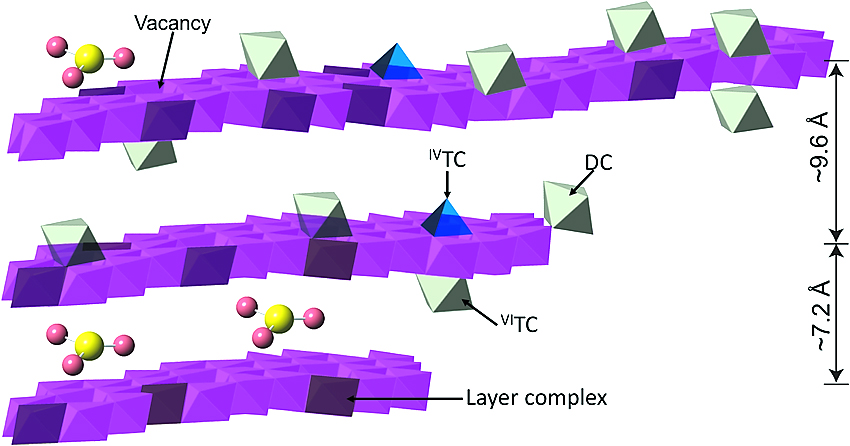
해저 망간각과 망간단괴의 높은 금속 함유량은 이들의 미세 흡수(micro-uptake) 메커니즘과 광물학적 구조에 의해 크게 좌우된다. 금속의 농축 과정은 주로 원자·분자 규모에서, 금속이 망간각과 망간단괴의 층상(layered) 또는 터널 구조 내에 어떻게 부화되는지를 설명하는 방식으로 해석된다(Kwon et al., 2013; Takahashi et al., 2007; Kim and Kwon, 2022; van Genuchten and Pena, 2016)(Fig. 2). 이들 퇴적물은 주로 층상 구조의 vernadite와 buserite와 3차원 터널 구조의 todorokite로 구성되며, 망간 산화물과 함께 성장한 MnO6 팔면체와 나노 크기의 비정질 수산화철이 상호 결합한 형태를 보인다(Sutherland et al., 2020; Lee et al.,2019; Wegorzewski et al., 2015; Post et al.,2021). MnO6 팔면체는 Mn4+ 또는 Mn3+의 치환에 의해 동종 치환(isomorphic substitution)이 활발히 일어나고, 층내 빈 8면체 공간은 금속 이온이 점유할 수 있는 주요 흡착 부위로 작용한다(Kwon et al., 2013; Bodei et al., 2007; Kim and Kwon, 2022; Hens et al., 2019; Grangeon et al.,2014).
https://cdn.apub.kr/journalsite/sites/ksmer/2025-062-05/N0330620503/images/ksmer_62_05_03_F2.jpg
Fig. 2.

Schematic diagram of the vernadite structure, including the monolayered, 7-Å, 10-Å, and interstratified phases. TC and DC denote triple-corner sharing and double-corner sharing, respectively. IV and VI represent tetrahedral (blue) and octahedral (gray) coordination, respectively. The yellow circles indicate monovalent cations (e.g., Na+ and K+), while the pink circles represent oxygen. The diagram was taken from Lee et al. (2019) and adapted.

저원자가 양이온(예: Co2+)이 Mn4+를 치환할 경우 발생하는 전하 결손은 내부층 또는 터널 중앙에 위치한 수화 양이온(Mg2+, Ca2+, Zn2+, Li+, Na+ 등)의 통합으로 보상된다(Manceau et al., 2014; Peacock and Sherman, 2007a; Zhu et al.,2010). 이러한 내부 양이온은 결정 구조를 안정화하며, 인산염화나 속성과정에서 환원 생성된 Mn3+가 구조 내에 잔존하여 광물 안정성과 변형에 기여하기도 한다(Bodei et al., 2007; Yang et al., 2018). 결과적으로, 이 광물학적 구조는 매우 높은 금속 흡착 용량을 제공한다.

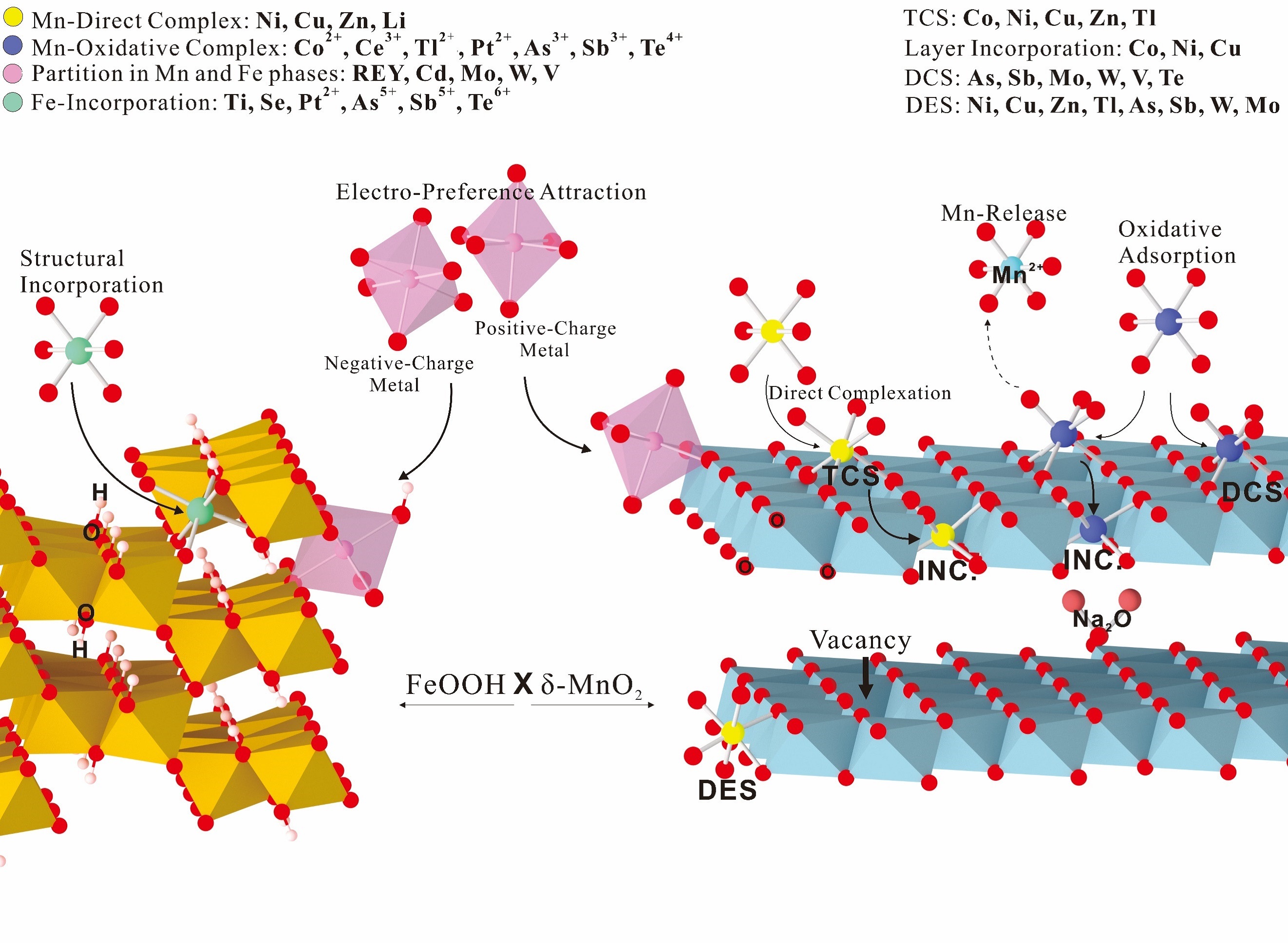
망간 산화물의 원자 단위 흡수 메커니즘은 결정 구조에 따라 구분된다. 버나다이트나 버네사이트와 같은 층상 구조 광물에서는 팔면체 층 내의 빈 공간(vacancy)이 핵심적인 흡착 부위로 작용한다(Tournassat et al., 2002)(Fig. 3). 금속 양이온은 이 빈 공간의 위와 아래에서 산소 원자와 결합하여 이중 또는 삼중 모서리 공유(double/triple-corner sharing, DCG/TCG) 복합체를 형성하거나, 격자 내 망간을 직접 치환하여 테두리 공유(double/triple-edge sharing, DES/TES) 구조를 이룬다(Grangeon et al.,2017; Kwon et al., 2013; Manceau and Steinmann, 2021; Sherman and Peacock, 2010). 반면, 토도로카이트와 같은 터널 구조 광물에서는 터널의 내부 공간과 벽면이 흡착 부위를 제공하며, 특히 이온 반경이 큰 양이온(Mg, Ca, Li, Tl)과 일부 핵심금속(Ni, Cu)을 선택적으로 수용한다(Bodei et al., 2007; Wegorzewski et al., 2020; Atkins et al., 2016). 두 경우 모두, 흡착된 금속은 구조 내 Mn3+/Mn4+와의 이온 교환을 통해 안정한 금속-산소(Metal-O) 또는 금속-수산화기(Metal-OH) 결합을 형성한다.
https://cdn.apub.kr/journalsite/sites/ksmer/2025-062-05/N0330620503/images/ksmer_62_05_03_F3.jpg
Fig. 3.

Schematic illustration of the major enrichment pathways in hydrogenetic Fe–Mn (oxy)hydroxides. The color legend shown at the top left assists in understanding the enrichment pathways and their associated metals. The major metal configurations and corresponding metals are indicated at the top right. TCS refers to a triple corner-sharing position above a layer vacancy, and DCS refers to a double corner-sharing position. DES refers to a double edge-sharing site at the layer terminal, and INC refers to the incorporation of metals into the layer from the interlayer. The diagram was taken from Huang and Fu (2023) and adapted.

버나다이트는 결정 구조 내 풍부한 빈 공간으로 인해 금속 이온에 대한 높은 흡착 능력을 보이며, 초기 단계에서는 Mn 또는 Fe 산화수산화물 격자에서 형성되는 금속-산소-금속 형태의 모서리 및 테두리 공유 배위가 흡착을 주도한다(Simanova and Pena, 2015). 이러한 배위 구조는 표면에 노출된 산소가 흡착 가능한 결합자리를 제공하여 Co2+, Ni2+, Cu2+ 등 전이금속 이온의 선택적 흡착을 촉진한다. 그러나 금속의 농축이 진행되어 결합된 금속/망간 비율이 높아지면 내부의 빈 공간이 점차 포화되어, 상대적으로 결합력이 약한 외부 테두리 부위(edge sites)가 주요 흡착 위치가 된다(Grangeon et al., 2017). 이러한 금속 흡착 과정은 주변 환경의 산화환원 조건에 의해 크게 영향을 받는다. 특히 환원 환경에서는 망간 산화물의 용해가 촉진되는데, 이 과정에서 Mn4+가 Mn2+나 Mn3+로 환원된다. 새로 생성된 저원자가 망간 이온은 다른 금속 양이온과 흡착 부위를 두고 경쟁하며, 금속이 농축된 격자 자체의 붕괴는 총체적인 흡착 능력의 저하를 초래한다. 실제로 δ-MnO2를 이용한 실험 결과는 환원 조건이 핵심금속의 흡착을 저해함을 명확히 보여준다(Zhao et al., 2023; Sun et al.,2019). 결국, 환원 환경에서 저원자가 망간 이온의 경쟁적 우위는 다른 금속들이 층의 주변부로 밀려나게 만드는 결과를 가져온다(Simanova et al., 2015).

핵심금속들의 농축 과정

코발트와 니켈

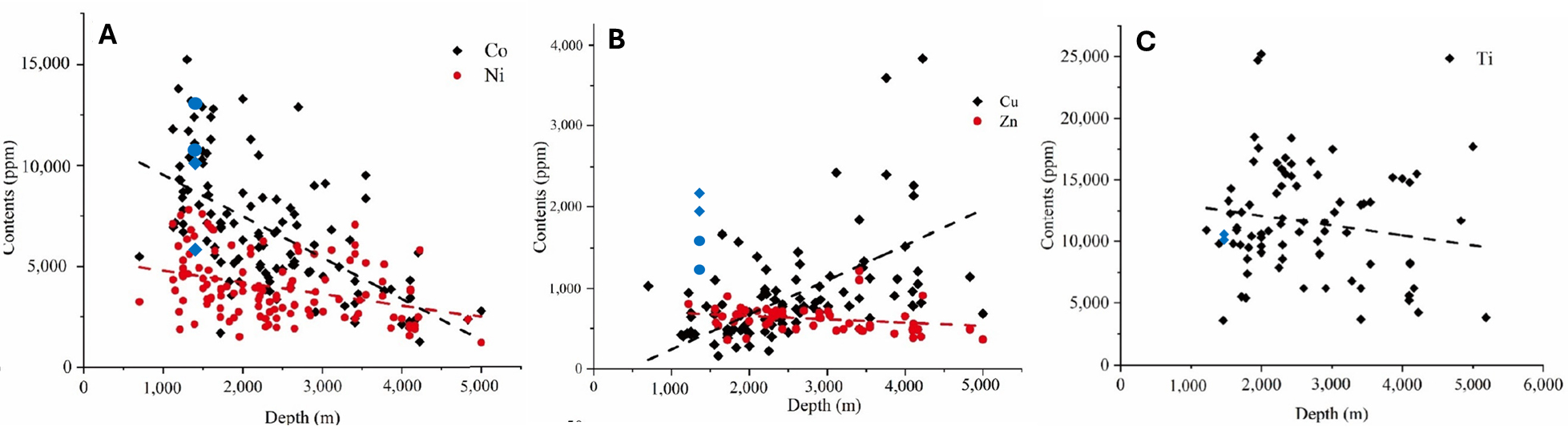
Co와 Ni는 해저 망간각과 망간단괴에서 가장 두드러지게 부화되는 대표적 광화 핵심 원소이다(Halbach et al., 1983). 특히 Co의 함량은 침적 환경과 생성 기원에 따라 큰 차이를 보인다. 예를 들어, 페루 분지의 퇴적물 기원 망간단괴에서는 평균 475 ppm, PPCZ의 해수기원 망간각에서는 평균 6,662 ppm이 보고되며(Hein and Koschinsky, 2014; Kuhn et al., 2017; Marchig et al.,2001), 순수한 해수기원 조건에서는 최대 1–2 wt.%에 달하기도 한다(Halbach et al., 2017; Li and Schoonmaker, 2014)(Fig. 4).
https://cdn.apub.kr/journalsite/sites/ksmer/2025-062-05/N0330620503/images/ksmer_62_05_03_F4.jpg
Fig. 4.

Variations in critical metal abundances of hydrogenetic Fe–Mn crusts and nodules with seawater depth. The blue symbols indicate the values of Mn crusts from the Magellan Seamounts analyzed in this study. The graphs and trend lines were generated and calculated using data from Huang and Fu (2023).

Co는 Mn과 높은 양의 상관관계를 보이며, 주로 해수기원 Mn 산화물이 주요 숙주 상(host phase) 역할을 한다(Koschinsky and Halbach, 1995; Mohwinkel et al., 2014). 반면, Co-Fe 간 음의 상관관계는 수심이 깊어질수록 약화되며, 심해 퇴적 환경에서는 거의 사라진다(Verlaan et al., 2004). 해수기원 망간각에서 Co 부화는 주로 해수 내 Co2+가 Mn3+/Mn4+에 의해 불용성 Co3+로 산화되어 구조적으로 통합되는 산화적 치환 메커니즘으로 설명된다(Manceau et al., 1997; Takahashi et al., 2007). Co3+의 원자 반지름(0.54 Å)은 Mn4+(0.53 Å)와 거의 동일하여, Mn 층위 내 치환이 매우 용이하다. 이러한 산화·치환 과정이 반복되면 Co의 고농축으로 이어지며, TCS(triple-corner sharing) 수착 이후 상당량의 Co가 Mn 층위에 구조적으로 통합된다.

pH 조건은 Co의 층위 통합 과정에 중요한 영향을 미친다. 알칼리성 해수 환경에서는 TCS 수착 Co의 대부분이 Mn 층위로 통합되며(Kwon et al., 2013; Manceau et al., 1997), 이는 부화 효율을 높인다. 그러나 인산염화(phosphatization) 환경에서는 해수기원 Mn 산화물의 용해와 함께 Co가 방출되며, Co의 함량 손실은 30–50% 수준으로 보고된다(Bodei et al., 2007; Jiang et al., 2020). 퇴적물 기원 환경에서는 Co가 Mn3+/Mn4+ 치환에 비효율적이며, 대신 Fe 수산화물에 대한 흡착성이 강화된다(Halbach, 1986; Jiang et al., 2004). 하지만 퇴적물 기원 망간단괴에서도 여전히 Mn 산화물이 Co의 주요 숙주 상 역할을 하며, 특히 vernadite와 buserite에서 부화가 뚜렷하게 나타난다(Manceau et al., 2014; Li et al., 2020).

Ni2+는 Co와 유사하게 해수기원 Mn 산화물과 강한 상관관계를 보이며, 숙주 상을 공유한다. 그러나 Ni는 퇴적물 기원 망간단괴에서 더 높은 함량을 나타내는 경향이 있다. 해수기원 조건에서는 2,581–4,643ppm 범위를 보이고, CCZ(Clarion-Clipperton Zone) 망간단괴의 경우 평균 1.3 wt.%까지 보고된다(Peacock and Sherman, 2007b). Ni의 부화 메커니즘은 Mn 층위의 구조적 치환과 내부층(interlayer) 수착이 핵심이며(Atkins et al., 2016), 이는 수성·퇴적물 기원 환경 모두에서 나타난다. Ni2+는 TCS를 통한 내부계면의 표면 복합체(inner-sphere complex) 형성을 거쳐, 점진적으로 Mn 층위로 통합된다. 이 과정은 pH 8 이상의 알칼리 환경에서 특히 효율적이다(Hens et al., 2019; Sorensen et al., 2020).

퇴적물 기원 망간단괴에서 Ni 함량은 Mn/Fe 비와 양의 상관관계를 보이며, 이는 해저 퇴적물과 저산소 공극수에서 용출된 Ni가 Mn 산화물에 재흡착되기 때문이다(Wegorzewski and Kuhn, 2014). 모의실험 결과, Ni는 수화된 todorokite 터널에 우선적으로 흡착되는 경향이 있으며(Kim and Kwon, 2022), 인산염화 과정에서도 재동원되어 새로운 todorokite 내에 농축될 수 있다. 그러나 이 과정의 효율과 결과는 지역·시료·환경 조건에 따라 크게 변동하며, 이에 따라 Ni 농축과 감소가 모두 보고되고 있다(Hein et al., 2016; Jiang et al., 2020).

구리와 아연

Cu와 Zn는 해저 망간각과 망간단괴 형성에서 중요한 핵심금속으로, 철-망간 산화수산화물의 결정 구조를 안정화하고 표면 전하 결손을 보상하는 역할을 한다(Kwon et al., 2013). 이들 금속은 일반적으로 해수기원(hydrogenetic) 조건보다 퇴적물 기원(diagenetic) 조건에서 더 효율적으로 부화된다.

퇴적물 기원 유입이 큰 CCZ와 페루 분지에서 Cu의 평균 함량은 각각 10,600 ppm과 5,988 ppm이며, PPCZ의 해수기원 망간각에서는 976 ppm에 불과하다. Zn의 경우, CCZ와 페루 분지의 퇴적물 기원 망간각 평균 함량은 각각 1,385 ppm과 1,845 ppm이고, PPCZ 해수기원 망간각에서는 668 ppm이 보고된다(Hein and Koschinsky, 2014). 이러한 경향은 Cu와 Zn가 퇴적물 기원 10-Å 망간산염(특히 todorokite)에 통합되는 특성을 반영한다(Manceau et al., 2014; Usui, 1979; Wegorzewski et al., 2020). 다만 페루 분지의 Cu 함량은 CCZ보다 낮으며, 이는 두 지역 퇴적물의 화학 조성 차이(CCZ: 규산질, Peru: 석회질)에 기인한다는 해석이 제시되어 있다(Wegorzewski and Kuhn, 2014).

Cu는 영양염형(nutrient-type) 원소로서, 해수에서의 해수기원 포집보다 저산소(suboxic) 해저 퇴적물에서 더 높은 흡착 효율을 보인다(Wegorzewski et al., 2020; Nozaki, 2001). 과거 조사에서는 망간단괴의 성장 구조 상부 20 cm(퇴적물 기원 영향이 강한 구간)에서 Cu가 주로 부화됨이 확인되었으며, 이는 퇴적물 기원 10-Å 망간산염의 효과적인 포집을 의미한다. Cu와 Zn 모두 todorokite의 격자 채움(lattice-filling)과 결손 보상 과정에서 중요한 역할을 하며, 수화된 터널 중앙을 점유하거나 터널 벽 내부의 모서리 공유 복합체(edge-sharing complexes)를 형성한다(Wegorzewski et al., 2020; Kim and Kwon, 2022; Wang et al.,2022).

해수기원 조건에서도 Cu와 Zn의 농축 메커니즘에 대한 연구는 상당한 수준으로 진행되어 왔다. 이들 금속은 주로 망간 광물들과 연관되어 분포하며, 상관관계 분석에서도 철 상보다 망간이 풍부한 영역과 더 강한 연관성을 보인다(Manceau et al., 2014; Sherman and Peacock, 2010). 그러나 연속 용출 및 흡착 실험에서는 Cu와 Zn가 부분적으로 Fe 상에도 흡착될 수 있음이 관찰되었으며, 이에 대한 추가 연구가 필요하다(Koschinsky et al.,2020).

해수기원의 층서형 Mn 산화물에서 Cu와 Zn의 흡착은 직접 치환(direct substitution)과 가용한 빈 공간의 점유를 통해 이루어진다. 구체적으로, 이들 금속은 Mn3+/Mn4+의 손실을 대가로 TCS배열을 통해 흡착되며, 일부는 전기적 보상 양이온으로서 수화된 중간층(interlayer)에 흡착된다(Sherman and Peacock, 2010; Little et al.,2014). 실험 결과, Cu는 TCS 위치에서 Mn 층위로 통합되는 경향이 있는 반면, Zn는 주로 TCS 배열 내에 머물며 Mn 층위로는 통합되지 않는 것으로 나타났다(Kwon et al., 2013; Zhao et al., 2018). Zn가 해수 내 Mn 층위에서 왜곡되지 않은 8면체 형태로 관찰된다는 사실도 이를 지지한다(Wang et al., 2023; Yin et al.,2018).

또한, TCS 부화 이외에 DES배열은 금속 적재량이 많거나 덜 산화된 환경에서 Cu·Zn 농축에 유리하며, 경쟁이 적은 환경에서는 Mn 층위보다 가장자리(edge) 부위에서 우선적으로 부화되기도 한다(Zhao et al., 2023). Cu와 Zn 모두 인산염화 과정에서 함량이 뚜렷하게 증가하며(Jiang et al., 2020), 이 시기 형성된 퇴적물 기원 10-Å 망간산염과 인회석이 부화를 강화하는 것으로 보인다(Koschinsky and Hein, 2003). 이는 인산염화 변질 이후 Cu와 Zn가 Mn 및 잔류 광물 상에 더욱 집중적으로 부화되는 결과를 낳는다.

희토류와 이트륨

해저 망간각과 망간단괴의 REE 함량은 기원에 따라 뚜렷한 차이를 보인다. 예를 들어, Peru 분지의 퇴적물 기원 망간단괴에서는 평균 403 ppm이 보고되지만, PPCZ에서 채취된 해수기원 망간각에서는 2,454 ppm에 달한다. 일반적으로 해수기원 조건에서 REE 함유량이 더 높게 나타나며, 이에 관한 연구가 광범위하게 진행되어 왔다(Bau et al., 1996; Hein et al., 2013; Byrne and Sholkovitz, 1996; Bau, 1999). REE는 포집형 원소로서, Fe-Mn 교질(colloidal) 입자 내에서 대부분 해수 기원이며, 해양 퇴적물로부터 기여되는 비율은 상대적으로 작다. 해수기원 망간 산화물과 수화된 수산화철(FeOOH)은 내부 구조의 넓은 공간 덕분에 REE를 효과적으로 흡착할 수 있는 매체로 평가된다(Surya Prakash et al., 2012; Douville et al., 1999). 반면, 퇴적물 기원 10-Å 망간산염은 REE의 통합 능력이 상대적으로 낮아 이에 관한 논의는 제한적이다.

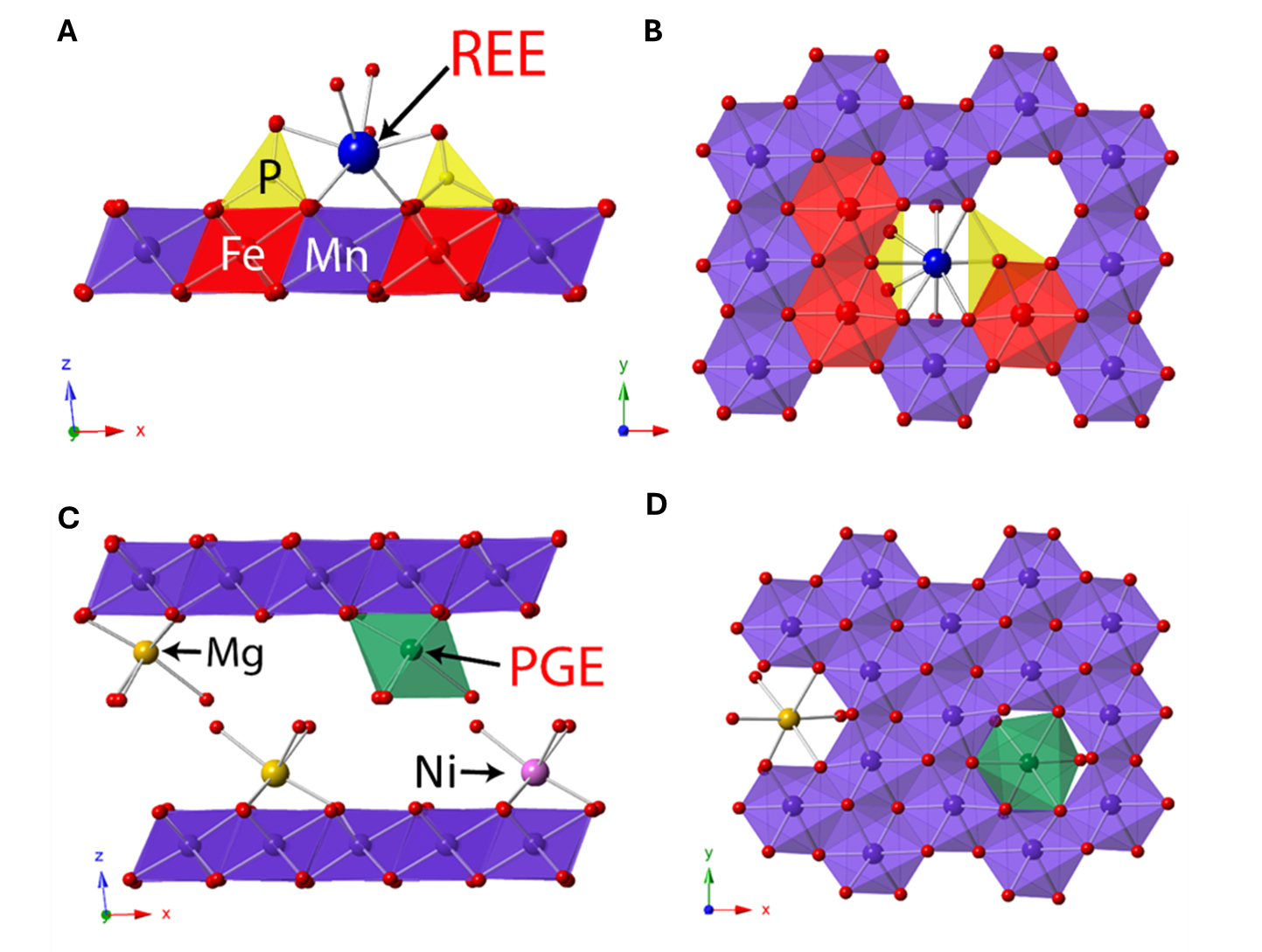
해수 기원의 REE농축은 주로 Fe-Mn 산화수화물 표면에서의 복합체화(surface complexation)를 통해 이루어진다(Fig. 5a-b). 해수 중 REE의 약 89%는 자유 이온 형태가 아니라 탄산염 복합체(LREE-CO3+, HREE-CO32⁻) 형태로 존재하며(Byrne, 2002), 이러한 형태적 차이는 Mn 산화물과 비정질 FeOOH에 대한 흡착 선호와 직결된다. REE의 표면 흡착은 탄산염과 수산기(hydroxyl) 간의 배위자 교환(ligand exchange) 반응을 통해 이루어진다(Ren et al., 2019; Byrne and Sholkovitz, 1996). REE의 분포 경향은 철 함량이 높은 시료에서 HREE 비율이, 망간 함량이 높은 시료에서 LREE 비율이 증가하는 형태를 보이며, 이는 Fe가 HREE, Mn이 LREE를 상대적으로 선호한다는 점을 시사한다(Ohta and Kawabe, 2001; Surya Prakash et al., 2012). 다만, 육상 기원의 물질 유입이 강한 환경(예: Detroit Guyot)에서는 잔류 상이 망간각 내 REE 농축에 최대 30%까지 기여할 수 있음이 보고되었다(Khanchuk et al., 2015).

알칼리성 해수 pH와 느린 성장률은 해수에서의 REE의 효율적인 제거를 촉진하여 더 높은 농도를 형성한다(Ohta and Kawabe, 2001; Bau et al., 2014). 반대로, 남중국해처럼 육상물질 유입으로 성장률이 높은 지역의 망간각은 태평양 서부의 전형적인 해수기원 망간각에 비해 REE의 함량이 낮다(Guan et al., 2017). 인산염화 또한 REE의 함량을 크게 증가시키며, 그 농도는 인산염화 과정에서 20–50%까지 상승할 수 있다(Halbach et al., 2017; Jiang et al., 2020). 이는 탄산염 형광인회석(CFA, carbonate fluorapatite)이 해양 인산염화 환경에서 형성되는 과정과 밀접하게 관련되어 있으며, 이때 다양한 금속 이온이 결정 격자 내에 포획되어 결합한다. 이러한 형성 과정에서 Ca, Na, Si 등의 양이온이 치환되면서 희토류원소(REE)가 농축될 가능성이 높아진다.

Ce와 Y는 REE 중에서도 특히 주목받는 원소로, 해저 망간각·망간단괴의 기원 구분과 환원 조건 해석에 자주 활용된다(Ohta and Kawabe, 2001; Bau et al., 2014). Ce3+는 Mn 산화물 표면에서 산화되어 불용성 Ce4+로 전환되며, 이 과정은 Co의 산화적 흡착 메커니즘과 유사하다(Takahashi et al., 2007). Mn 산화물에 의한 Ce의 산화적 농축은 보편적으로 관찰되며, Ce와 Mn 간에는 높은 양의 상관성이 존재한다. 일부 연구에서는 철 산화수화물에서도 Ce의 농축이 가능하다고 보고하였으나(De Carlo and Wen, 1997), Mn에 비해 기여도는 낮다. Bau(1999)는 Fe-Mn 산화수화물 모두에서 Ce의 산화적 부화를 주장하며, 이를 뒷받침하는 사례를 제시하였다. Y는 음전하를 띤 탄산염 복합체(HREE-CO32⁻) 형태로 존재하며, 표면 복합체화를 통해 철 산화수화물에 우선적으로 흡착된다. Fe 기원의 Y 농축은 다수의 연구에서 확인되었으며(Hein and Koschinsky, 2014), 해수기원 Fe-Mn 산화물에서는 61–132 ppm 수준의 Y가 보고된다. Y 또한 인산염화 과정에서 현저한 부화를 보이며, 이 시기 CFA의 형성이 Y 농도를 더욱 높이는 주요 원인으로 작용한다(Jiang et al., 2020).

백금족 원소들

PGEs는 Ru, Rh, Pd, Os, Ir, Pt로 구성되며, 해수 중 함량은 매우 낮다(Ir: 0.0013 ppb; Ru: 0.002 ppb; Rh: 0.09 ppb; Pt: 0.19–1 ppb; Pd: 0.04 ppb)(Varghese et al., 2021; Goldberg, 1987; Sharma, 2019). 그러나 해저 망간각과 망간단괴에서는 이들 원소가 상당히 농축되어 나타난다. 특히 Pt는 육상 지각과 해수 내 농도에 비해 최대 100배 이상 부화되며(Hein et al., 2013; Banakar et al., 2007), 평균 함량은 망간각에서 408 ppb, 망간단괴에서 181 ppb이다. 일부 해수기원 망간각에서는 Pt의 농도는 1–3 ppm까지 증가할 수 있다(Halbach et al., 1989; Banakar et al., 2007). 다른 PGE의 경우, 망간각에서 Ru, Rh, Os, Ir의 농도는 각각 16, 16, <7.3, 2.5, 5.1 ppb로 보고된다(Koschinsky et al., 2020). 기존 연구들은 수심, 성장률, 그리고 지역적 특성과 PGE 농축의 관계를 규명해 왔으며, 성장률과 수심은 PGE 함량과 뚜렷한 음의 상관관계를 보인다(Baturin et al.,2005; Asavin et al., 2008; Berezhnaya et al., 2018; Halbach et al., 1984).

Pt는 망간각·망간단괴에서 가장 높은 농도를 보이는 PGE이며 가장 깊은 연구가 진행된 원소이다(Koschinsky et al., 2020; Halbach et al., 1989). 얕은 수심에서 성장률이 느린 망간각일수록 Pt 함량이 높으며, 이에 따라 Pt는 수심과 Fe-Mn 흡착제의 성장률 모두와 음의 상관관계를 갖는 것으로 보고된다(Halbach et al.,2017). 해수 내 Pt 종(species)은 주로 PtCl42⁻, PtCl3OH2⁻, PtCl64⁻, PtCl5OH⁻ 형태로 존재한다(Byrne, 2002). Pt2+는 해수기원 망간 산화물에서 산화되어 Pt4+로 부화되며, 음이온 종임에도 불구하고 feroxyhyte(δ-FeOOH)에 흡착될 수 있다(Halbach et al., 2017; Maeno et al., 2016). 해수의 Pt는 일반적으로 철 산화수화물에 흡착되지만, 순차적 용출 및 상관관계 분석 결과 Pt는 Mn 상에서도 산화적 농축이 가능하며, Pt-Mn 간에는 강한 양의 상관성이 나타난다(Koschinsky et al.,2020).

X선 흡수 분광(XAS) 분석에서는 Pt2+가 산화적 부화를 거쳐 망간 산화물에 흡착되는 것이 확인되었다(Fig. 5c-d). Koschinsky et al.(2020)은 Pt 복합체와 Mn 산화물 간 전자 반발력이 극복되어 Pt2+가 Mn 상에 우선적으로 결합할 수 있음을 제시하였다. 이 과정에서 Pt2+는 산화적 치환을 통해 Pt4+로 전환되며 Mn-O-Pt 결합을 형성한다. 또한, Pt와 Co, Ce, Tl 등의 환원 민감성 원소 간에는 산화적 상호작용에 기반한 유사한 농축 패턴이 나타난다(Halbach et al., 2017; Varghese et al., 2021). Fe 상에서는 Pt의 산화가 관찰되지 않으며, 전자 유도적 흡착과 동반 침전이 Pt 농축을 설명하는 기작으로 제시된다. XANES 분석 결과, feroxyhyte는 주로 Pt2+와 일부 해수 기원의 Pt4+를 부화시키는 것으로 나타났다(Koschinsky et al., 2020). 최근 연구에 따르면, FeOOH(goethite)는 산화 촉매제로 작용하여 금속 이온의 산화 및 흡착을 촉진한다. 이러한 환경에서 Pt는 탈수응축(dehydration condensation) 반응을 통해 goethite 표면에 결합 가능한 형태로 전환된 후, 용존 산소 분자와의 반응을 거쳐 산화된 상태로 표면에 농축되는 것으로 보고된다. 즉, goethite는 Pt의 산화와 표면 고정화를 촉진하는 핵심적인 촉매 역할을 한다(Li et al.,2023). 자연 상태의 Fe-Mn 시료에서는 대부분의 Pt가 Pt4+ 형태로 존재하며, 이는 Pt 농축 과정이 Pt2+ 부화를 전제로 하지만 최종적으로 Pt4+ 형태로 안정화된다는 점을 시사한다(Koschinsky et al., 2020).
https://cdn.apub.kr/journalsite/sites/ksmer/2025-062-05/N0330620503/images/ksmer_62_05_03_F5.jpg
Fig. 5.

Schematic model illustrating the enrichment of REEs, PGEs, and Ni in the vernadite structure between the Fe- and Mn-rich regions. Mn octahedral sites are shown in purple, and Fe octahedral sites are shown in red. The diagram was taken from Lee and Xu (2024) and adapted.

PGEs는 인산염화 과정에서도 현저히 부화되며, 인산염화된 망간각의 PGE 함량 증가는 광범위하게 관찰된다(Halbach et al., 2017). 인산염화 후 Pt 함량 증가는 주로 퇴적 이후의 속성작용에 기인하며, Pt-P 간에는 뚜렷한 상관관계가 나타나지 않는다. 이는 Pt가 2차적으로 형성된 탄산염 형광인회석(CFA)에 직접 통합되기보다는, 안정된 퇴적물 기원 todorokite 형성과 연관될 가능성을 시사한다. 또한, 인산염 물질은 Fe에 의한 Pt 농축을 억제할 수 있으며, 철 산화수화물에 농축된 해수 기원의 Pt는 인산염화가 진행되면서 Mn 상으로 이동할 수 있다(Li et al., 2023).

텔루륨(Tellurium)

Te은 지각 평균 함량이 약 1 ppb로 매우 희귀하지만, 해수기원 망간각에서 평균 46 ppm, 최대 50,000배의 농축 인자를 보이며, 해저 망간각 침적물 중 가장 강하게 부화되는 원소다(Hein et al., 2003). 높은 함량은 해수기원 망간각에서 주로 나타나며, 퇴적물 기원 망간단괴에서는 두드러지지 않는다. 해수 내 Te는 주로 HTeO3⁻, H5TeO6⁻ or TeO(OH)3⁻ and TeO(OH)5⁻ 등의 형태로 존재하며(Byrne, 2002; Lee and Edmond, 1985), 양전하를 띤 FeOOH 표면에 잘 흡착한다. 순차적 용출 분석에 따르면 망간각·단괴 내 80% 이상의 Te는 철 산화수화물에 부화되어 있으나, 일부는 망간 산화물 상에서 산화적으로 농축된다(Koschinsky and Hein, 2003).

Kashiwabara et al.(2014)에 따르면 ferrihydrite에서는 Te의 산화가 거의 일어나지 않으며, 망간 산화물에서 Te4+ → Te6+ 전환이 관찰된다. Te6+은 Fe3+ 8면체 구조와 유사한 기하학적 형태로 공동 침전될 수 있다. 실제 자연 표본에서는 대부분 Te6+ 형태로 존재한다. 인산염화 과정은 Te 농도를 크게 증가시키며, Magellan 해산에서 채취한 오래된 망간각 층위(76.5 ppm)는 젊은 층위(33.8 ppm)보다 약 2배 높은 값을 보인다(Halbach et al., 2017). 다만, Te의 높은 농축과 Mn과의 상관성에 대해서는 여전히 불확실성이 남아 있으며, 추가적인 연구가 필요하다.

탈륨(Thallium)

Tl은 망간각에서 41–160 ppm, 망간단괴에서 129–347 ppm의 농도를 보이며, 지각 대비 100배 이상의 농축 인자를 나타낸다(Hein and Koschinsky, 2014). 그리고 수심 및 Fe-Mn 광물 성장률과 음의 상관관계를 보이며, 인산염화에서 Tl의 농도는 추가적으로 증가한다(Halbach et al., 2017). 해수 내 Tl은 주로 Tl+ 형태로 존재하며(Byrne, 2002), 해수기원 환경에서 Mn 치환을 통한 산화적 농축이 우세하다(Cruz-Hernandez et al., 2019). Tl+ → Tl3+ 산화는 주로 육각면체 birnessite에서 일어나며, Tl3+ 은 TCS 내부 위치에 결합한다. todorokite나 ferrihydrite에서는 산화가 없는 표면 흡착 형태로 존재한다. Tl/Mn 비율이 낮을 때는 Tl3+의 독점 흡착이, 비율이 높을 때는 Tl+ 형태의 흡착이 우세하다(Zhao et al., 2023). 또한, 일부 Tl은 Fe-Mn 표면에서 Tl2O3 입자로 존재하며, 이는 Mn 산화물 용해·치환 과정과 연관된다.

셀레늄(Selenium)

Se은 지각 평균 대비 100배 이상의 농축을 보이나, 망간각 침적물 내 거동 연구는 제한적이다(Hein et al., 2013). 망간각의 농도는 3.95–8.82 ppm, 망간단괴는 1.78–6.88 ppm 범위이며, PPCZ 망간각에서는 최대 14.8 ppm에 달한다(Hein and Koschinsky, 2014). 해수에서 Se는 SeO42⁻(VI)와 SeO32⁻(IV) 형태로 존재하며(Byrne, 2002), 이 중 selenate(VI)가 산소 해수에서 우세하다. 음전하 Se 종은 FeOOH 표면에 강하게 흡착되며(Koschinsky and Hein, 2003), 이는 Se-Fe의 양의 상관성과 일치한다. 흡착 실험 결과, 망간 산화물은 주로 Se(IV)를, FeOOH는 Se(VI)를 더 잘 흡착하며(Balistrieri and Chao, 1990), 철 상의 흡착 효율은 망간 상보다 훨씬 높다. 따라서 Se는 주로 철 산화수화물에 의해 농축된다.

카드뮴(Cadmium)

Cd(Ⅱ)은 단일 원자가 중금속으로, Cu·Ni 등과 유사한 전이 금속군에 속한다. 해저 망간각 침적물 내 Cd 연구는 환경적 맥락에서가 주를 이루며, 망간각·단괴에 대한 자료는 제한적이다. Cd은 해수기원 망간각(1.93–4.11 ppm)보다 퇴적물 기원 영향이 큰 망간단괴에서 더 높은 농도를 보이며, 수심 증가와 함께 농축도가 상승한다(Hein and Koschinsky, 2014). Cd의 해수 내 화학종은 CdCl+(36%), CdCl2(45%), CdCl3⁻(16%)로 비교적 균형 잡힌 분포를 보인다(Byrne, 2002). 망간 산화물은 ferrihydrite보다 Cd을 더 잘 흡착하며, Cd2+은 주로 층서형 망간산화물의 빈 공간에 결합한다(van Genuchten and Pena, 2016). 다만, 이온 반지름이 커서 망간 층위 내부로의 완전한 통합은 제한적이다. 퇴적물 기원 환경에서 Cd은 todorokite의 터널 구조에 통합되며, 초기 속성작용에서 퇴적물로부터 동원된다. 유사한 구조를 가진 cryptomelane 연구에서는 Cd는 터널 중앙에 수화 형태로 위치하며, H+ 치환을 통해 결합할 수 있음이 보고되었다(Randall et al., 1998).

리튬(Lithium)

Li의 부화 경향은 해수기원 < 인산염화 < 퇴적물 기원 < 열수기원 순서로 나타난다. 퇴적물 기원 망간단괴의 Li 함량은 최대 300 ppm 이상에 달할 수 있으나, 해수기원 망간각·망간단괴에서는 평균 2.92 ppm으로 현저히 낮다. 일부 열수기원 표본에서는 800 ppm을 초과하는 높은 함량이 보고되었다(Hein and Koschinsky, 2014; Stoffynegli and Mackenzie, 1984; Rajani et al., 2022). 순차 용출 및 상관분석 결과, Li은 주로 알루미늄 규산염 상과 강하게 연관되며(Mn, Fe, Si와도 부분적인 연관), Al과의 상관계수는 0.98, Mn 0.94, Fe 0.07, Si 0.89로 측정된다(Koschinsky and Hein, 2003; Jiang et al., 2007). 해수기원 층서형 망간 산화물에서는 Li이 수화된 내부 층위에 외부-계면 형태로 흡착되며(Feng et al., 1996), 퇴적물 기원 10-Å 망간산염에서는 3차원 터널 벽 공간을 점유하는 형태로 통합된다(Jiang et al., 2007). 그러나 Li+은 긴 이온 반지름과 낮은 산화 원자가로 인해 구조적 전하 결핍 보상에 불리하며, 이로 인해 부화가 제한된다(Zhu et al., 2010). 높은 함량에도 불구하고 Li의 농축 메커니즘 연구는 여전히 부족하며, 특히 망간단괴에서의 고농축 원인에 대한 심층 분석이 필요하다.

몰리브데넘(Mo), 텅스텐(W), 바나듐(V)

Mo, W, V는 심해 망간각·망간단괴에서 해수기원, 퇴적물 기원, 혼합기원 모두에서 부화되며, 기원에 따른 농도 차이는 크지 않다(Hein and Koschinsky, 2014; Kashiwabara et al., 2013). 인산염화 과정에서도 함량의 변화는 제한적이다(Halbach et al.,2017). 해수기원·퇴적물 기원 표본에서 Mo와 V의 함량은 400–700 ppm 범위이며, W는 대체로 100 ppm 이하이다. 해수 내 농도는 V가 53–60 pmol/L, Mo가 약 1/1800 pmol/L로 매우 낮지만, 망간각·단괴에서는 V의 농축 인자가 특히 높다. 산소 해양 환경에서 Mo와 W는 주로 Mo6+, W6+ 형태로, V는 V5+로 존재하며, MoO42⁻, WO42⁻, VO43⁻ 등의 4면체 음이온 복합체로 해수에 용해된다(Byrne, 2002). Mo·W는 주로 Fe 산소수산화물에 흡착되지만, 원 위치의(in situ) 지도화와 상관분석에서는 Mn 산화물과도 높은 관련성이 나타난다. 이는 전기적 반발력을 극복하는 흡착 메커니즘이 일부 작용할 수 있음을 시사한다(Kashiwabara et al.,2013). 반면, V는 Mn과 Fe 모두와 안정된 결합 종을 형성하며, V-Mn, V-Fe의 양의 상관관계가 관찰된다. XAS 분석에 따르면, 이들 원소는 MnO6·FeO6 가장자리의 DCS/DES 배열을 통해 내부-계면 표면 복합체를 형성하며(Zhu et al.,2020), Mo와 W는 주로 8면체 구조로, V는 VO43⁻ , MnO6 , FeO6 사이에서 모서리 공유 형태로 흡착된다.

티타늄(Titanium)

해수기원 망간각의 Ti 함량은 평균 1.7%로 매우 높지만, 인산염화 시 함량이 크게 감소한다(Jiang et al., 2020). Ti의 농축 인자는 지각 내 Ti 함량(약 4000 ppm, Wedepohl, 1995) 때문에 그리 크지 않다. Ti의 높은 함량은 Fe 상과의 강한 양의 상관성에서 비롯되며, 이는 수화된 TiO2가 무정형 수산화철 구조 내에서 상호 성장(intergrowth)하는 결과로 해석된다(Koschinsky and Halbach, 1995). 퇴적물 기원 유입과 인산염화는 Ti 분포에 뚜렷한 영향을 미치며, 인산염화된 망간각에서는 Ti가 철 상에서 잔류 상으로 재동원되는 경향이 나타난다. Ti 숙주상인 Fe 산화수산화물의 환원성 용해는 Ti의 대량 방출을 유발할 수 있다(Bau et al., 1996). 비록 Ti가 해저 망간각에서 중요한 핵심금속이지만, 그 농축의 기작에 대한 연구는 여전히 부족하다.

안티몬(Sb)과 비소(As)

Sb와 As는 해저 망간각·망간단괴에 고농도로 부화되며, PCZ 망간각에서 As 393 ppm, Sb 39.3 ppm이 보고되었다. 페루 분지 퇴적물 기원 단괴에서는 각각 65 ppm, 61 ppm이 측정된다(Hein and Koschinsky, 2014). Sb는 Mn과, As는 Fe와 더 강한 상관관계를 보이며, Mn/Fe 비율이 높아질수록 Sb 농도는 증가, As 농도는 감소하는 경향이 나타난다(Qin et al.,2019). As와 Sb는 3가·5가 상태로 존재하며, As(III), Sb(III)는 산화적 복합체화를 통해 Mn 산화물 표면에 주로 축적되고, As(V), Sb(V)는 내부-계면 구조적 통합 및 공동 침전을 통해 ferrihydrite·goethite에 부화된다(Bai et al.,2017). 수착 실험에서는 As(V), Sb(V)의 대부분이 철 상에서 부화되며, 망간 상에는 약 10%만 흡착된다. XAS 분석 결과, Sb(OH)6⁻는 MnO6과의 팔면체 유사성으로 DES 배열을, AsO43⁻는 MnO6 단위와의 결합 제약으로 DCS 배열을 선호하는 경향이 확인되었다(Qin et al., 2019).

서태평양 마젤란 해저 망간각 시료 광물 및 화학분석

1980년대부터 망간각의 경제적 중요성을 파악하기 위한 연구들이 유럽과 미국을 비롯한 주요 산업국들에서 진행되어왔고(Halbach et al., 1982), 광물 자원의 수입 의존도가 높은 한국에서도 망간각을 비롯한 심해저 광물 연구와 광상 탐사가 지속되어 왔다. 2023년 대한민국 정부가 선정한 핵심 광물 33종과 10대 핵심전략 광물 Li, Ni, Co, Mn, C(graphite), REE 5종의 대부분이 매장되어 있는 것으로 알려진 심해저 광상 탐사는 서태평양 마젤란 해산군, 북동 태평양 클라리온-클리퍼톤 지역(Clarion-Clipperton), 그리고 인도양 중앙해령, 피지, 통가의 해저 열수광상에 위치한 5곳의 해저 광산들에 대한 독점 탐사권 보유라는 성과로 이어졌다.

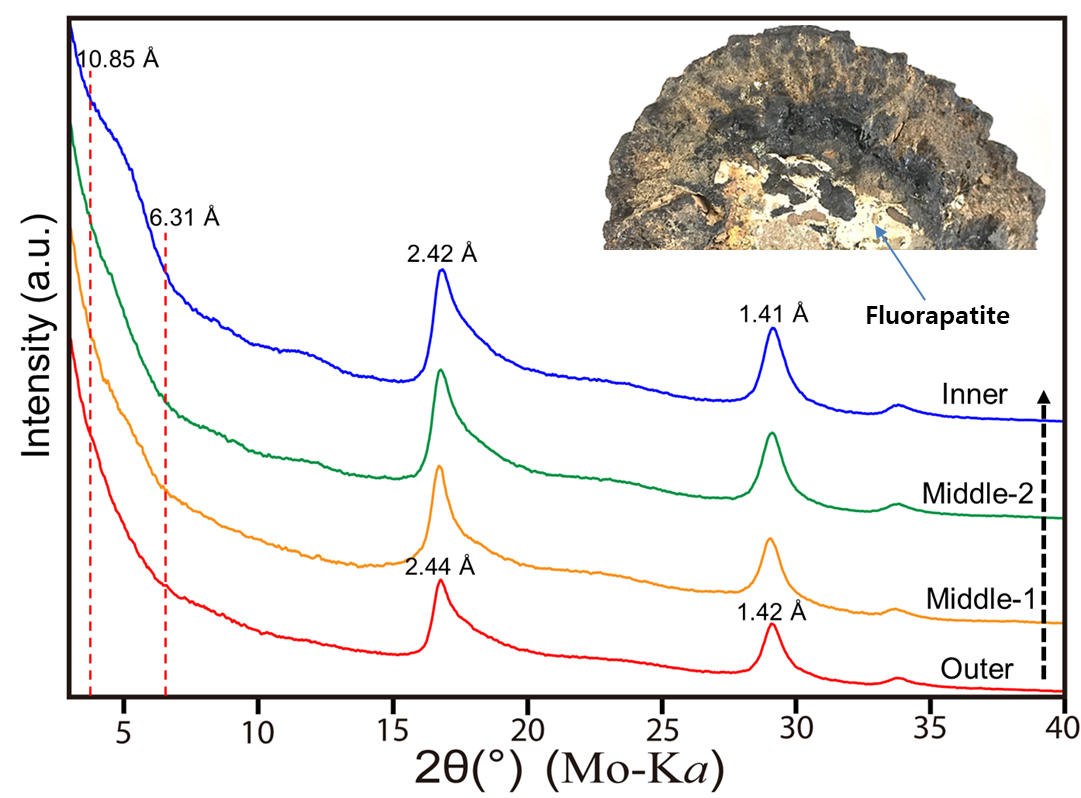
본 연구는 서태평양 마젤란 해산군(Magellan Seamounts)에서 채취된 망간각의 광물학적 및 지화학적 특성을 규명하기 위해 수행되었다. 시료는 수심 1,424m에서 채취되었으며, XRD와 XRF 분석을 통해 조사되었다(Fig. 6). XRD 분석 결과, 본 시료의 주요 광물은 망간 산화물인 vernadite로 확인되었고, 형광인회석이 부수적인 광물로 존재함을 확인하였다. 또한 XRF 분석을 통해 Mn, Fe, Co, Ni, Cu, Zn, Mo, Ti 등이 망간각의 주요 구성 원소임을 알 수 있었다. 서태평양 망간각의 이러한 성분들은 10대 핵심 전략광물이나 6대 전략 광종에 해당하며, 다른 해역—Pacific Crust Zone(PCZ), Clarion Clipperton Zone(CCZ), Peru Basin(PB)—에서 채취된 망간각에서도 확인되지만, 함량에서는 차이를 보였다. 특히 본 연구의 마젤란 해산군 시료는 동일 수심(약 1,400m)에서 채취된 타 해역의 망간각 및 망간단괴에 비해 Mn, Co, Ni, Y, Ti의 함량이 더 높게 나타났다(Table 1). 이러한 시료의 핵심금속 함량은 같은 마젤란 해산군 내에 위치한 Caiwei seamount에서 수집된 망간각 시료에 함유된 Co(5700 ppm), Ni(3700 ppm), Cu(1300 ppm)의 농도에 비해서도 높은 수치이다(Ren et al., 2024). 이러한 결과는 본 시료가 높은 자원 잠재력을 지니고 있음을 시사하며, 향후 망간각의 형성 기작을 규명하고 핵심 원소과 희토류 원소(REE)의 농집 및 인산염화 과정과의 연관성을 보다 심층적으로 분석할 예정이다.
https://cdn.apub.kr/journalsite/sites/ksmer/2025-062-05/N0330620503/images/ksmer_62_05_03_F6.jpg
Fig. 6.

Powder XRD patterns of the HFMC from the Magellan Seamounts in the northwest Pacific Ocean. The analysis was conducted from the outer area to inner part, and the results show characteristic vernadite reflections. Images of the studied ferromanganese crust further indicate the presence of a fluorapatite phase, suggesting phosphatization.

Table 1.

Critical metal compositions of representative Fe-Mn crust and nodule areas formed by hydrogenetic, mixed, and diagenetic processes. The values for the Magellan ferromanganese crusts are from this study. Chemical analyses were performed using X-ray fluorescence. PCZ refers to the Pacific Prime Crust Zone, and the values presented in the table represent the combined contents of ferromanganese crusts and polymetallic nodules (CCZ: Clarion-Clipperton Zone; PB: Peru Basin). Entries without available data are denoted by “–”. The data sources include Hein and Koschinsky (2014), Hein et al. (2013), and the present study

  Element PCZ CCZ PB Magellan Fe-Mn crust (This study)
Upper Middle Lower
Mean Mean Mean Mean Mean Mean
Mn (wt%) 22.8 28.1 34.2 38.3 36.1 29.3
Fe 16.9 5.9 6.1 12.6 12.7 7.1
Co (ppm) 6,662 2,011 475 10,400 5,720 3,740
Ni 4,209 13,159 13,008 13,200 11,000 11,200
Cu 976 10,631 5,988 2,240 1,980 1,500
Zn 668 1,385 1,845 1,230 1,270 1,560
Ce 1,322 255 110 - 8.0 -
La 272 108 68 - 21.9 -
Y 221 92 69 153 386 737
LREE 2,044 571 273 - - -
HREE 425 192 130 - - -
Tl 155 199 129 454 - -
As 393 67 65 - - -
V 641 429 431 743 691 868
W 89 61 75 - - -
Mo 461 587 547 948 720 728
Ti 11,600 2,800 1,600 10,600 9,660 3,950

결 론

본 연구에서는 서태평양 마젤란 해산군(Magellan Seamounts)에서 채취된 망간각의 광물학적 및 지화학적 특성을 규명하였다. Table 2는 앞서 제시한 내용을 바탕으로, 해저 망간각과 망간단괴에서 주요 금속(원소)들의 농축 기원, Fe-Mn 상관성, 그리고 대표적인 농축 메커니즘을 요약한 것이다. 연구 결과, 핵심금속의 농축은 개별 요인이 아닌, 광상의 성장률, 수심, 인산염화 작용과 같은 거시적 환경 요인과 Fe-Mn(산화)수산화물의 전기화학적·구조적 특성과 같은 미시적 요인이 복합적으로 상호작용한 결과임을 규명하였다. 특히, 금속 원소별 고유한 지구화학적 특성에 따라 농축 과정이 뚜렷하게 구분되었으며, 본 연구에서는 이를 다섯 가지 주요 경로로 체계화하였다: 첫째, Ni, Cu, Zn, Li는 망간 산화물 표면과의 직접적인 복합체화를 통해 농축된다. 둘째, Co, Ce, Tl은 산화-치환 반응을 통해 망간 산화물 구조 내에 통합된다. 셋째, REE(Ce 제외), Cd, Mo, W, V는 정전기적 상호작용에 의해 Fe-Mn(산화)수산화물 사이에 분배·흡착된다. 넷째, Pt, Te, As, Sb는 산화 상태에 따라 망간 산화물 또는 비정질 수산화철에 선택적으로 부화되는 이중적 거동을 보인다. 마지막으로, Se와 Ti는 비정질 수산화철에 의해 강하게 수착되는 특성을 나타낸다. 이러한 다양한 농축 경로는 거시적으로는 망간각의 성장률, 수심, 인산염화 작용과 같은 환경 요인에 의해 조절되며, 미시적으로는 광물 표면 전하, 층간 및 터널 구조, 원소 간의 전자적 상호작용에 의해 지배된다. 즉, 거시적 환경이 금속 농축의 전반적인 강도와 시기를 결정한다면, 미시적 메커니즘은 특정 금속이 선택적으로 부화되는 과정을 설명하는 핵심 열쇠이다.

Table 2.

Summary of the genetic types, Fe-Mn correlations, and representative enrichment mechanisms of major metals (elements) in deep-sea ferromanganese crusts and polymetallic nodules

Element Genetic type Fe vs. Mn correlation Key enrichment mechanism
Co Hydrogenetic > Diagenetic Mn > Fe Co2+ is oxidized to Co3+ by Mn3+/Mn4+ and adsorbed at TCS sites, followed by structural incorporation into the Mn layer.
Ni Mixed Mn > Fe Metal ions form inner-sphere complexes at TCS sites, becoming fixed within Mn layers or interlayer spaces.
Cu Diagenetic > Hydrogenetic Mn > Fe Metal ions adsorb at TCS/DES sites, compensating lattice vacancies or occupying tunnel centers and edge-sharing positions.
Zn Diagenetic > Hydrogenetic Mn > Fe Metals adsorbed at TCS sites stabilize within interlayer spaces between Mn sheets.
REE Hydrogenetic > Diagenetic LREE: Mn↑/
HREE: Fe↑
REEs occur as carbonate complexes (CO32⁻) in seawater and form surface complexes via ligand exchange with –OH groups on Mn-Fe oxides.
Y Hydrogenetic Fe > Mn Negatively charged carbonate complexes preferentially adsorb onto positively charged Fe oxyhydroxide surfaces, forming stable complexes.
Pt Hydrogenetic > Diagenetic Mn > Fe Pt2+ is oxidized to Pt4+, forming Mn-O-Pt bonds and undergoing oxidative enrichment.
PGE Hydrogenetic Fe ≈ Mn   Depending on the element, PGEs are enriched via surface complexation or co-precipitation.
Te Hydrogenetic > Diagenetic Fe > Mn   Te(IV/VI) strongly adsorbs onto FeOOH, while Te4+ is oxidized to Te6+ and enriched on MnO2 surfaces.
Tl Hydrogenetic Mn > Fe Tl+ is oxidized to Tl3+ and strongly adsorbed within the TCS sites of Mn oxides; at higher concentrations, Tl+ adsorption becomes dominant.
Se Hydrogenetic Fe > Mn Se(VI) selenate strongly adsorbs on FeOOH, while MnO2 preferentially retains Se(IV).
Cd Diagenetic > Hydrogenetic Mn > Fe Cd2+ and similar ions bind within tunnels or interlayer voids of Mn oxides or form surface complexes.
Li Diagenetic > Hydrogenetic Al-silicate ≫ (Mn, Si) / weak with Fe Li+ adsorbs onto the hydrated outer interlayer surfaces of hydrogenetic MnO2 and binds to tunnel walls in diagenetic Mn oxides.
Mo Mixed Fe ≥ Mn MoO₄2⁻ forms inner interfacial complexes (DCS/DES arrangements) on Mn or Fe oxides.
W Mixed Fe ≥ Mn WO₄2⁻ adsorbs at internal interfaces, forming stable surface complexes.
V Mixed Fe ≈ Mn VO₄3⁻ shares edges with MnO6 or FeO6 octahedra, forming inner interfacial complexes.
Ti Hydrogenetic Fe > Mn Ti co-grows with FeOOH and can be remobilized into residual phases after phosphatization.
Sb Mixed Mn > Fe Sb(III) is oxidized and complexed on MnO2 surfaces, while Sb(V) binds to FeOOH.
As Mixed Fe > Mn As(V) is incorporated and co-precipitated with FeOOH, whereas As(III) adsorbs onto MnO2 surfaces.

본 연구의 의의는 이처럼 복잡하게 얽힌 핵심금속 농축 기작의 통합적 모델을 제시했다는 데 있다. 이러한 지구화학적 이해는 유망 광구를 예측하고 자원 잠재성을 평가하는 데 있어 정량적 지표를 제공할 수 있다. 더 나아가, 금속별 농축 메커니즘의 정밀한 규명은 향후 친환경적이고 선택적인 금속 회수 기술 개발의 기초 자료로 활용될 수 있으며, 심해저 광물자원 개발이 해양 생태계에 미칠 영향을 예측하고 완화하는 지속 가능한 정책 수립에도 기여할 수 있을 것으로 기대된다.


Acknowledgements

이 연구는 정부(과학기술정보통신부) 재원으로 한국연구재단의 지원(No. RS-2024-00342773)과 2024년도 정부(교육부) 재원으로 한국연구재단의 G-LAMP 사업 지원 (No. RS-2024-00445180)을 받아 수행된 연구입니다.

References

1

Asavin, A.M., Anikeev, L.I., Kazakov, V.A., Andreev, S.I., Sapozhnikov, D.A., Roshchina, I.A., and Kogarko, L.N., 2008. Trace element and PGE distribution in layered ferromanganese crusts, Geochemistry International, 46, p.1179-1205.

10.1134/S001670290812001X
2

Atkins, A.L., Shaw, S., and Peacock, C.L., 2016. Release of Ni from birnessite during transformation of birnessite to todorokite: Implications for Ni cycling in marine sediments, Geochimica et Cosmochimica Acta, 189, p.158-183.

10.1016/j.gca.2016.06.007
3

Bai, Y.H., Jefferson, W.A., Liang, J.S., Yang, T.T., and Qu, J.H., 2017. Antimony oxidation and adsorption by in-situ formed biogenic Mn oxide and Fe-Mn oxides, Journal of Environmental Sciences, 54, p.126-134.

10.1016/j.jes.2016.05.026
4

Balistrieri, L.S. and Chao, T.T., 1990. Adsorption of selenium by amorphous iron oxyhydroxide and manganese-dioxide, Geochimica et Cosmochimica Acta, 54, p.739-751.

10.1016/0016-7037(90)90369-V
5

Banakar, V.K., Hein, J.R., Rajan, R.P., and Chodankar, A.R., 2007. Platinum group elements and gold in ferromanganese crusts from Afanasiy-Nikitin seamount, equatorial Indian Ocean: Sources and fractionation, Journal of Earth System Science, 116, p.3-13.

10.1007/s12040-007-0002-x
6

Baturin, G.N., Konopleva, E.V., Dubinchuk, V.T., and Melnikov, M.E., 2005. Platinum and gold in the ferromanganese crusts of the Pacific Ocean, Oceanology, 45, p.269-276.

7

Bau, M., 1999. Scavenging of dissolved yttrium and rare earths by precipitating iron oxyhydroxide: Experimental evidence for Ce oxidation, Y-Ho fractionation, and lanthanide tetrad effect, Geochimica et Cosmochimica Acta, 63, p.67-77.

10.1016/S0016-7037(99)00014-9
8

Bau, M., Koschinsky, A., Dulski, P., and Hein, J.R., 1996. Comparison of the partitioning behaviours of yttrium, rare earth elements, and titanium between hydrogenetic marine ferromanganese crusts and seawater, Geochimica et Cosmochimica Acta, 60, p.1709-1725.

10.1016/0016-7037(96)00063-4
9

Bau, M., Schmidt, K., Koschinsky, A., Hein, J., Kuhn, T., and Usui, A., 2014. Discriminating between different genetic types of marine ferromanganese crusts and nodules based on rare earth elements and yttrium, Chemical Geology, 381, p.1-9.

10.1016/j.chemgeo.2014.05.004
10

Berezhnaya, E.D., Dubinin, A.V., Rimskaya-Korsakova, M.N., and Novikov, A.I., 2018. Accumulation of platinum group elements in hydrogenous Fe-Mn crust and nodules from the Southern Atlantic Ocean, Minerals, 8(7), p.275.

10.3390/min8070275
11

Blöthe, M., Wegorzewski, A., Müller, C., Simon, F., Kuhn, T., and Schippers, A., 2015. Manganese-cycling microbial communities inside deep-sea manganese nodules, Environmental Science and Technology, 49(13), p.7692-7700.

10.1021/es504930v
12

Bodei, S., Manceau, A., Geoffroy, N., Baronnet, A., and Buatier, M. 2007. Formation of todorokite from vernadite in Ni-rich hemipelagic sediments, Geochimica et Cosmochimica Acta, 71, p.5698-5716.

10.1016/j.gca.2007.07.020
13

Bruland, K.W., 1980. Oceanographic distributions of cadmium, zinc, nickel, and copper in the North Pacific, Earth and Planetary Science Letters, 47, p.176-198.

10.1016/0012-821X(80)90035-7
14

Byrne, R.H. and Sholkovitz, E.R., 1996. Chapter 158 Marine chemistry and geochemistry of the lanthanides, In Handbook on the Physics and Chemistry of Rare Earths; Elsevier: Hoboken, Vol. 23, NJ, USA, p.497-593.

10.1016/S0168-1273(96)23009-0
15

Byrne, R.H., 2002. Inorganic speciation of dissolved elements in seawater: The influence of pH on concentration ratios, Geochemical Transactions, 3, p.11.

10.1186/1467-4866-3-1135412769PMC1475612
16

Conrad, T., Hein, J.R., Paytan, A., and Clague, D.A., 2017. Formation of Fe-Mn crusts within a continental margin environment, Ore Geology Reviews, 87, p.25-40.

10.1016/j.oregeorev.2016.09.010
17

Cruz-Hernandez, Y., Villalobos, M., Marcus, M.A., Pi-Puig, T., Zanella, R., and Martinez-Villegas, N., 2019. Tl(I) sorption behavior on birnessite and its implications for mineral structural changes, Geochimica et Cosmochimica Acta, 248, p.356-369.

10.1016/j.gca.2019.01.020
18

Cui, Y.C., Shi, X.F., Liu, J.H., and Ren, X.W., 2008. Effects of phosphatization on the elemental association of cobalt-rich crusts, Geological Science and Technology Information, 27, p.61-67.

19

De Carlo, E.H. and Wen, X.-Y., 1997. The influence of redox reactions on the uptake of dissolved Ce by suspended Fe and Mn Oxide Particles, Aquatic Geochemistry, 3, p.357-389.

10.1023/A:1009664626181
20

Douville, E., Bienvenu, P., Charlou, J.L., Donval, J.P., Fouquet, Y., Appriou, P., and Gamo, T., 1999. Yttrium and rare earth elements in fluids from various deep-sea hydrothermal systems, Geochimica et Cosmochimica Acta, 63, p.627-643.

10.1016/S0016-7037(99)00024-1
21

Elderfield, H., Hawkesworth, C.J., Greaves, M.J., and Calvert, S.E., 1981. Rare-earth element geochemistry of oceanic ferromanganese nodules and associated sediments, Geochimica et Cosmochimica Acta, 45, p.513-528.

10.1016/0016-7037(81)90184-8
22

Feng, Q., Yanagisawa, K., and Yamasaki, N., 1996. Synthesis of Birnessite-Type Lithium Manganese Oxide, Journal of the Ceramic Society of Japan, 104, p.897-899.

10.2109/jcersj.104.897
23

Föllmi, K.B., 1996. The phosphorus cycle, phosphogenesis and marine phosphate-rich deposits, Earth-Science Reviews, 40(1-2), 55-124.

10.1016/0012-8252(95)00049-6
24

Fu, Y.Z. and Wen, H.J., 2020. Variabilities and enrichment mechanisms of the dispersed elements in marine Fe-Mn deposits from the Pacific Ocean, Ore Geology Reviews, 121, p.103470.

10.1016/j.oregeorev.2020.103470
25

Goldberg, E.D., 1987. Heavy metal analyses in the marine environment: Approaches to quality control, Marine Chemistry, 22, p.117-124.

10.1016/0304-4203(87)90003-X
26

Grangeon, S., Fernandez-Martinez, A., Claret, F., Marty, N., Tournassat, C., Warmont, F., and Gloter, A., 2017. In-situ determination of the kinetics and mechanisms of nickel adsorption by nanocrystalline vernadite, Chemical Geology, 459, p.24-31.

10.1016/j.chemgeo.2017.03.035
27

Grangeon, S., Lanson, B., and Lanson, M., 2014. Solid-state transformation of nanocrystalline phyllomanganate into tectomanganate: Influence of initial layer and interlayer structure, Acta Crystallographica Section B: Structural Science, Crystal Engineering and Materials, 70, p.828-838.

10.1107/S2052520614013687
28

Guan, Y., Sun, X.M., Ren, Y.Z., and Jiang, X.D., 2017. Mineralogy, geochemistry and genesis of the polymetallic crusts and nodules from the South China Sea, Ore Geology Reviews, 89, p.206-227.

10.1016/j.oregeorev.2017.06.020
29

Gulley, A. L., Nassar, N.T., and Xun, S., 2018. China, the United States, and competition for resources that enable emerging technologies, Proceedings of the National Academy of Sciences USA, 115(16), p.4111-4115.

10.1073/pnas.171715211529610301PMC5910828
30

Halbach, P. and Marbler, H., 2009. Marine ferromanganese crusts: contents, distribution and enrichment of strategic minor and trace elements, BGR-Report, BGR, Berlin, Germany, p.1-73.

31

Halbach, P. and Puteanus, D., 1984. The influence of the carbonate dissolution rate on the growth and composition of Co-rich ferromanganese crusts from central pacific seamount areas, Earth and Planetary Science Letters, 68, p.73-87.

10.1016/0012-821X(84)90141-9
32

Halbach, P., 1986. Processes controlling the heavy-metal distribution in pacific ferromanganese nodules and crusts, Geol Rundsch, 75, p.235-247.

10.1007/BF01770191
33

Halbach, P., Jahn, A., and Cherkashov, G., 2017. Marine co-rich ferromanganese crust deposits: description and formation, occurrences and distribution, Estimated World-Wide Resources, Springer, Cham, Switzerland, p.65-141.

10.1007/978-3-319-52557-0_3
34

Halbach, P., Kriete, C., Prause, B., and Puteanus, D., 1989. Mechanisms to explain the platinum concentration in ferromanganese seamount crusts, Chemical Geology, 76, p.95-106.

10.1016/0009-2541(89)90130-7
35

Halbach, P., Manheim, F.T., and Otten, P., 1982. Co-rich ferromanganese deposits in the marginal seamount regions of the Central Pacific Basin: results of the Midpac’81, Erzmetall, 6, p.447-453.

36

Halbach, P., Puteanus, D., and Manheim, F.T., 1984. Platinum concentrations in ferromanganese seamount crusts from the central pacific, Naturwissenschaften, 71, p.577-579.

10.1007/BF01189182
37

Halbach, P., Sattler, C.D., Teichmann, F., and Wahsner, M., 1989. Cobalt-rich and platinum-bearing manganese crust deposits on seamounts: Nature, formation, and metal potential, Marine Mining, 8, p.23-39.

38

Halbach, P., Segl, M., Puteanus, D., and Mangini, A., 1983. Co-fluxes and growth-rates in ferromanganese deposits from central pacific seamount areas, Nature, 304, p.716-719.

10.1038/304716a0
39

Hein, J. R., Mizell, K., and Gartman, A., 2022. Deep-ocean polymetallic nodules and cobalt-rich ferromanganese crusts in the global ocean: New sources for critical metals, The United Nations Convention on the Law of the Sea and the Deep Seabed Mining Regime, p.196-230. Brill.

10.1163/9789004507388_013
40

Hein, J.R. and Koschinsky, A., 2014. Deep-Ocean Ferromanganese Crusts and Nodules, Treatise on Geochemistry; Elsevier, Amsterdam, The Netherlands, p.273-291.

10.1016/B978-0-08-095975-7.01111-6
41

Hein, J.R. and Koschinsky, A., 2020. Deep-ocean polymetallic nodules as a resource for critical materials, Nature Reviews Earth & Environment, 1(3), p.158-169.

10.1038/s43017-020-0027-0
42

Hein, J.R., 2003. Cobalt-rich ferromanganese crusts: global distribution, composition, origin and research activities, Marine Georesources and Geotechnology, 21(1-2), p.67-81.

43

Hein, J.R., Conrad, T., Mizell, K., Banakar, V.K., Frey, F.A., and Sager, W.W., 2016. Controls on ferromanganese crust composition and reconnaissance resource potential, Ninetyeast Ridge, Indian Ocean, Deep-Sea Research Part I: Oceanographic Research Papers, 110, p.1-19.

10.1016/j.dsr.2015.11.006
44

Hein, J.R., Konstantinova, N., Mikesell, M., Mizell, K., Fitzsimmons, J.N., Lam, P.J., Jensen, L.T., Xiang, Y., Gartman, A., and Cherkashov, G., 2017. Arctic Deep Water Ferromanganese-Oxide Deposits Reflect the Unique Characteristics of the Arctic Ocean, Geochemistry, Geophysics, Geosystems, 18, p.3771-3800.

10.1002/2017GC007186
45

Hein, J.R., Koschinsky, A., and Halliday, A.N., 2003. Global occurrence of tellurium-rich ferromanganese crusts and a model for the enrichment of tellurium, Geochimica et Cosmochimica Acta, 67, p.1117-1127.

10.1016/S0016-7037(02)01279-6
46

Hein, J.R., Koschinsky, A., and Kuhn, T., 2020. Deep-ocean polymetallic nodules as a resource for critical materials, Nature Reviews Earth and Environment, 1, p.158-169.

10.1038/s43017-020-0027-0
47

Hein, J.R., Koschinsky, A., Bau, M., Manheim, F., Kang, J.-K., and Roberts, L., 2000. Cobalt-Rich Ferromanganese Crusts in the Pacific, Vol. 17, CRC Press: Boca Raton, FL, USA, p.239-279.

10.1201/9780203752760-9
48

Hein, J.R., Mizell, K., Koschinsky, A., and Conrad, T.A., 2013. Deep-ocean mineral deposits as a source of critical metals for high and green-technology applications: Comparison with land-based resources, Ore Geology Reviews, 51, p.1-14.

10.1016/j.oregeorev.2012.12.001
49

Hein, J.R., Yeh, H.W., Gunn, S.H., Sliter, W.V., Benninger, L.M., and Wang, C.H., 1993. Two major Cenozoic episodes of phosphogenesis recorded in equatorial pacific seamount deposits, Paleoceanography, 8, p.293-311.

10.1029/93PA00320
50

Hens, T., Brugger, J., Etschmann, B., Paterson, D., Brand, H.E.A., Whitworth, A., and Frierdich, A.J., 2019. Nickel exchange between aqueous Ni(II) and deep-sea ferromanganese nodules and crusts, Chemical Geology, 528, p.119276.

10.1016/j.chemgeo.2019.119276
51

Hodkinson, R.A. and Cronan, D.S., 1991. Regional and depth variability in the composition of cobalt-rich ferromanganese crusts from the SOPAC area and adjacent parts of the central equatorial Pacific, Marine Geology, 98, p.437-447.

10.1016/0025-3227(91)90115-K
52

Huang, S. and Fu, Y., 2023. Enrichment characteristics and mechanisms of critical metals in marine Fe-Mn crusts and nodules: a review. Minerals, 13, p.1532.

10.3390/min13121532
53

Jiang, X., Lin, X., Yao, D., Zhai, S., and Guo, W., 2007. Geochemistry of lithium in marine ferromanganese oxide deposits, Deep-Sea Research Part I: Oceanographic Research Papers, 54, p.85-98.

10.1016/j.dsr.2006.10.004
54

Jiang, X., Yao, D., and Zhai, S., 2004. Factors controlling the concentration of the transition metals Cu, Co and Ni in the ferromanganese deposits: An overview, Marine Geology and Quaternary Geology, 24, p.41-48.

55

Jiang, X., Yao, D., Lin, X., and Zhai, S., 2007. Geochemistry of Cu, Co, Ni, Ti, and Mg in diagenetic ferromanganese nodules, Marine Geology and Quaternary Geology, 27, p.47-54.

56

Jiang, X.-D., Sun, X.-M., Chou, Y.-M., Hein, J.R., He, G.-W., Fu, Y., Li, D.-f., Liao, J.-L., and Ren, J.-B., 2020. Geochemistry and origins of carbonate fluorapatite in seamount Fe-Mn crusts from the Pacific Ocean, Marine Geology, 423, p.106135.

10.1016/j.margeo.2020.106135
57

Josso, P., Lusty, P., Chenery, S., and Murton, B., 2021. Controls on metal enrichment in ferromanganese crusts: Temporal changes in oceanic metal flux or phosphatisation? Geochimica et Cosmochimica Acta, 308, p.60-74.

10.1016/j.gca.2021.06.002
58

Kashiwabara, T., Oishi, Y., Sakaguchi, A., Sugiyama, T., Usui, A., and Takahashi, Y., 2014. Chemical processes for the extreme enrichment of tellurium into marine ferromanganese oxides, Geochimica et Cosmochimica Acta, 131, p.150-163.

10.1016/j.gca.2014.01.020
59

Kashiwabara, T., Takahashi, Y., Marcus, M.A., Uruga, T., Tanida, H., Terada, Y., and Usui, A., 2013. Tungsten species in natural ferromanganese oxides related to its different behavior from molybdenum in oxic ocean, Geochimica et Cosmochimica Acta, 106, p.364-378.

10.1016/j.gca.2012.12.026
60

Khanchuk, A.I., Mikhailik, P.E., Mikhailik, E.V., Zarubina, N.V., and Blokhin, M.G., 2015. Peculiarities of the distribution of rare-earth elements and yttrium in mineral phases of the ferromanganese crusts from the Detroit guyot (Pacific Ocean), Doklady Earth Sciences, 465, p.1243-1247.

10.1134/S1028334X15120016
61

Kim, J. and Kwon, K.D., 2022. Tunnel cation and water structures of todorokite: Insights into metal partitioning and isotopic fractionation, Geochimica et Cosmochimica Acta, 333, p.153-165.

10.1016/j.gca.2022.07.008
62

Koschinsky, A. and Halbach, P., 1995. Sequential leaching of marine ferromanganese precipitates: Genetic implications, Geochimica et Cosmochimica Acta, 59, p.5113-5132.

10.1016/0016-7037(95)00358-4
63

Koschinsky, A. and Hein, J.R., 2003. Uptake of elements from seawater by ferromanganese crusts: Solid-phase associations and seawater speciation, Marine Geology, 198, p.331-351.

10.1016/S0025-3227(03)00122-1
64

Koschinsky, A., Hein, J.R., Kraemer, D., Foster, A.L., Kuhn, T., and Halbach, P., 2020. Platinum enrichment and phase associations in marine ferromanganese crusts and nodules based on a multi-method approach, Chemical Geology, 539, p.119426.

10.1016/j.chemgeo.2019.119426
65

Koschinsky, A., Stascheit, A., Bau, M., Halbach, P., 1997. Effects of phosphatization on the geochemical and mineralogical composition of marine ferromanganese crusts, Geochimica et Cosmochimica Acta, 61, p.4079-4094.

10.1016/S0016-7037(97)00231-7
66

Kuhn, T., Bostick, B.C., Koschinsky, A., Halbach, P., and Fendorf, S., 2003. Enrichment of Mo in hydrothermal Mn precipitates: Possible Mo sources, formation process and phase associations, Chemical Geology, 199, p.29-43.

10.1016/S0009-2541(03)00054-8
67

Kuhn, T., Wegorzewski, A., Ruehlemann, C., and Vink, A., 2017. Composition, Formation, and Occurrence of Polymetallic Nodules, Springer, Cham, Switzerland, p.23-63.

10.1007/978-3-319-52557-0_2
68

Kuhn,T., Bau, M., Blum, N., and Halbach, P., 1998. Origin of negative Ce anomalies in mixed hydrothermal-hydrogenetic Fe-Mn crusts from the Central Indian Ridge, Earth and Planetary Science Letters, 163, p.207-220.

10.1016/S0012-821X(98)00188-5
69

Kwon, K.D., Refson, K., and Sposito, G., 2013. Understanding the trends in transition metal sorption by vacancy sites in birnessite, Geochimica et Cosmochimica Acta, 101, p.222-232.

10.1016/j.gca.2012.08.038
70

Lee, D.S. and Edmond, J.M., 1985. Tellurium species in seawater, Nature, 313, p.782-785.

10.1038/313782a0
71

Lee, S. and Xu, H. 2016. XRD and TEM studies on nanophase manganese oxides in freshwater ferromanganese nodules from Green Bay, Lake Michigan, Clays and Clay Minerals, 64(5), p.523-536.

10.1346/CCMN.2016.064032
72

Lee, S. and Xu, H. 2024. Millennial-scale paleoclimate changes recorded in Holocene ferromanganese crusts with oscillatory micro-bands: insights from mineralogical and chemical variations in hydrogenetic ferromanganese crusts of the Magellan Seamounts, Clays and Clay Minerals, 72, e21, p.1-12.

10.1017/cmn.2024.17
73

Lee, S., Xu, H.F., Xu, W.Q., and Sun, X.M., 2019. The structure and crystal chemistry of vernadite in ferromanganese crusts, Acta Crystallographica Section B: Structural Science, Crystal Engineering and Materials, 75, p.591-598.

10.1107/S2052520619006528
74

Li, C., Song, W., Sun, Z., Huang, W., Hu, G., Yuan, X., and Kao, S.-J., 2023. High-Resolution Analysis of Fe-Mn Oxyhydroxide in Ferromanganese Nodules from the Northwestern Pacific Ocean and Insights on Element Mobility, Minerals, 13, p.415.

10.3390/min13030415
75

Li, D., Fu, Y., Sun, X., and Wei, Z., 2020. Critical metal enrichment mechanism of deep-sea hydrogenetic nodules: Insights from mineralogy and element mobility, Ore Geology Reviews, 118, p.103371.

10.1016/j.oregeorev.2020.103371
76

Li, Y.H. and Schoonmaker, J.E., 2014. Chemical Composition and Mineralogy of Marine Sediments, In Treatise on Geochemistry (2nd ed.), Holland, H.D., Turekian, K.K., Eds. Elsevier: Oxford, UK, p.1-32.

10.1016/B978-0-08-095975-7.00701-4
77

Little, S.H., Sherman, D.M., Vance, D., and Hein, J.R., 2014. Molecular controls on Cu and Zn isotopic fractionation in Fe-Mn crusts, Earth and Planetary Science Letters, 396, p.213-222.

10.1016/j.epsl.2014.04.021
78

Lusty, P. A. J., Hein, J. R., and Josso, P., 2018. Formation and occurrence of ferromanganese crusts: Earth's storehouse for critical metals, Elements: An International Magazine of Mineralogy, Geochemistry, and Petrology, 14(5), p.313-318.

10.2138/gselements.14.5.313
79

Lusty, P.A.J., Murton, B.J., 2018. Deep-Ocean Mineral Deposits: Metal Resources and Windows into Earth Processes, Elements 2018, 14, p.301-306.

10.2138/gselements.14.5.301
80

Maeno, M.Y., Ohashi, H., Yonezu, K., Miyazaki, A., Okaue, Y., Watanabe, K., Ishida, T., Tokunaga, M., and Yokoyama, T., 2016. Sorption behavior of the Pt(II) complex anion on manganese dioxide (ẟ-MnO2): A model reaction to elucidate the mechanism by which Pt is concentrated into a marine ferromanganese crust, Mineralium Deposita, 51, p.211-218.

10.1007/s00126-015-0599-7
81

Manceau, A. and Steinmann, S.N., 2021. Nature of High and Low-Affinity Metal Surface Sites on Birnessite Nanosheets, ACS Earth and Space Chemistry, 5, p.66-76.

10.1021/acsearthspacechem.0c00278
82

Manceau, A., Drits, V.A., Silvester, E., Bartoli, C., and Lanson, B., 1997. Structural mechanism of Co2+ oxidation by the phyllomanganate buserite, American Mineralogist, 82, p.1150-1175.

10.2138/am-1997-11-1213
83

Manceau, A., Lanson, M., and Takahashi, Y., 2014. Mineralogy and crystal chemistry of Mn, Fe, Co, Ni, and Cu in a deep-sea Pacific polymetallic nodule, American Mineralogist, 99, p.2068-2083.

10.2138/am-2014-4742
84

Marchig, V., Vonstackelberg, U., Hufnagel, H., and Durn, G., 2001. Compositional changes of surface sediments and variability of manganese nodules in the Peru Basin, Deep Sea Research Part II: Topical Studies in Oceanography, 48, p.3523-3547.

10.1016/S0967-0645(01)00055-8
85

Marino, E., Gonzalez, F.J., Lunar, R., Reyes, J., Medialdea, T., Castillo-Carrion, M., Bellido, E., and Somoza, L., 2018. High-Resolution Analysis of Critical Minerals and Elements in Fe-Mn Crusts from the Canary Island Seamount Province (Atlantic Ocean), Minerals, 8, p.285.

10.3390/min8070285
86

Marino, E., González, F.J., Somoza, L., Lunar, R., Ortega, L., Vázquez, J.T., Reyes, J., and Bellido, E., 2017. Strategic and rare elements in Cretaceous-Cenozoic cobalt-rich ferromanganese crusts from seamounts in the Canary Island Seamount Province (northeastern tropical Atlantic), Ore Geology Reviews, 87, p.41-61.

10.1016/j.oregeorev.2016.10.005
87

Mikhailik, P.E., Khanchuk, A.I., Mikhailik, E.V., Rashidov, V.A., Savelyev, D.P., and Zarubina, N.V., 2023. Ferromanganese Crusts of the North Pacific Ocean, Russian Journal of Pacific Geology, 17, p.101-133.

10.1134/S1819714023020045
88

Mikhailik, P.E., Mikhailik, E.V., Zarubina, N.V., and Blokhin, M.G., 2017. Distribution of rare-earth elements and yttrium in hydrothermal sedimentary ferromanganese crusts of the Sea of Japan, Russian Geology and Geophysics, 58, p.1530-1542.

10.1016/j.rgg.2017.11.013
89

Mitsunobu, S., Takahashi, Y., Terada, Y., and Sakata, M., 2010. Antimony(V) incorporation into synthetic ferrihydrite, goethite, and natural Iron oxyhydroxides, Environmental Science & Technology, 44, p.3712-3718.

10.1021/es903901e
90

Mizell, K., Hein, J. R., Au, M., and Gartman, A., 2022. Estimates of metals contained in abyssal manganese nodules and ferromanganese crusts in the global ocean, In Perspectives on Deep-Sea Mining, Springer, p.53-78.

10.1007/978-3-030-87982-2_3
91

Mohwinkel, D., Kleint, C., and Koschinsky, A., 2014. Phase associations and potential selective extraction methods for selected high-tech metals from ferromanganese nodules and crusts with siderophores, Applied Geochemistry, 43, p.13-21.

10.1016/j.apgeochem.2014.01.010
92

Nozaki, Y., 2001. Elemental Distribution: Overview, In Encyclopedia of Ocean ciences (2nd Ed.), Steele, J.H., Ed., Academic Press: Oxford, UK, p.255-260.

10.1016/B978-012374473-9.00402-1
93

Ohta, A. and Kawabe, I., 2001. REE (III) adsorption onto Mn dioxide (ẟ-MnO2) and Fe oxyhydroxide: Ce(III) oxidation by ẟ-MnO2. Geochimica et Cosmochimica Acta, 65, p.695-703.

10.1016/S0016-7037(00)00578-0
94

Oldham, V.E., Jones, M.R., Tebo, B.M., and Luther, G.W., 2017. Oxidative and reductive processes contributing to manganese cycling at oxic-anoxic interfaces, Marine Chemistry, 195, p.122-128.

10.1016/j.marchem.2017.06.002
95

Pan, J., De Carlo, E.H., and Liu, S., 2003. Effect of phosphatization on element concentration of cobalt-rich ferromanganese crusts, In proceedings of the ISOPE Ocean Mining Symposium, Seoul, Republic of Korea, p.20-26.

96

Peacock, C.L. and Sherman, D.M., 2007a. Crystal-chemistry of Ni in marine ferromanganese crusts and nodules, American Mineralogist, 92, p.1087-1092.

10.2138/am.2007.2378
97

Peacock, C.L. and Sherman, D.M., 2007b. Sorption of Ni by birnessite: Equilibrium controls on Ni in seawater, Chemical Geology, 238, p.94-106.

10.1016/j.chemgeo.2006.10.019
98

Post, J.E., McKeown, D.A., and Heaney, P.J., 2021. Raman spectroscopy study of manganese oxides: Layer structures, American Mineralogist, 106, p.351-366.

10.2138/am-2021-7666
99

Puteanus, D. and Halbach, P., 1988. Correlation of co concentration and growth-rate: A method for age-determination of ferromanganese crusts, Chemical Geology, 69, p.73-85.

10.1016/0009-2541(88)90159-3
100

Qin, H., Uesugi, S., Yang, S., Tanaka, M., Kashiwabara, T., Itai, T., Usui, A., and Takahashi, Y., 2019. Enrichment mechanisms of antimony and arsenic in marine ferromanganese oxides: Insights from the structural similarity, Geochimica et Cosmochimica Acta, 257, p.110-130.

10.1016/j.gca.2019.04.018
101

Rajani, P.R., Manoj, R.V., Joshi, R.K., Jishnu, B.K., and Nagasundaram, M., 2022. Base metals and Lithium - rich ferromanganese oxide deposits from the South Andaman Sea, Northeastern Indian Ocean: Mode of occurrence and genesis, Journal of Asian Earth Sciences, 234, p.105272.

10.1016/j.jseaes.2022.105272
102

Randall, S.R., Sherman, D.M., and Ragnarsdottir, K.V., 1988. An extended X-ray absorption fine structure spectroscopy investigation of cadmium sorption on cryptomelane (KMn8O16). Chemical Geology, 151, p.95-106.

10.1016/S0009-2541(98)00073-4
103

Ren, J.B., He, G.W., Deng, X.G., Deng, X.Z., Yang, Y., Yao, H.Q., and Yang, S.X., 2022. Metallogenesis of Co-rich ferromanganese nodules in the northwestern Pacific: Selective enrichment of metallic elements from seawater. Ore Geology Reviews, 143, p.104778.

10.1016/j.oregeorev.2022.104778
104

Ren, X., Hein, J. R., Yang, Z., Xing, N., and Zhu, A., 2024. Controls on cobalt concentrations in ferromanganese crusts from the Magellan seamounts, west Pacific, Frontiers in Marine Science, 11, 1489943.

10.3389/fmars.2024.1489943
105

Ren, X.W., Liu, J.H., Chui, Y.C., Shi, X.F., and Yin, J.W., 2011. Effects of phosphatization on enrichment of cobalt in the Co-rich Fe-Mn crusts from seamount MP2 of the Line islands in the Central Pacific, Advanced Marine Science, 29, p.324-329.

106

Ren, Y., Sun, X., Guan, Y., Xiao, Z., Liu, Y., Liao, J., and Guo, Z., 2019. Distribution of Rare Earth Elements plus Yttrium among Major Mineral Phases of Marine Fe-Mn Crusts from the South China Sea and Western Pacific Ocean: A Comparative Study, Minerals, 9, p.8.

10.3390/min9010008
107

Sharma, M., 2019. Platinum Group Elements and Their Isotopes in the Ocean, In Encyclopedia of Ocean Sciences, (3rd Ed.), Cochran, J.K., Bokuniewicz, H.J., Yager, P.L., Eds., Academic Press, Oxford, UK, p.174-180.

10.1016/B978-0-12-409548-9.11556-8
108

Sherman, D.M. and Peacock, C.L., 2010. Surface complexation of Cu on birnessite (ẟ-MnO2): Controls on Cu in the deep ocean, Geochimica et Cosmochimica Acta, 74, p.6721-6730.

10.1016/j.gca.2010.08.042
109

Simanova, A.A. and Peña, J., 2015. Time-Resolved Investigation of Cobalt Oxidation by Mn(III)-Rich ẟ-MnO2 Using Quick X-ray Absorption Spectroscopy, Environmental Science & Technology, 49, p.10867-10876.

10.1021/acs.est.5b01088
110

Simanova, A.A., Kwon, K.D., Bone, S.E., Bargar, J.R., Refson, K., Sposito, G., and Peña, J., 2015. Probing the sorption reactivity of the edge surfaces in birnessite nanoparticles using nickel(II), Geochimica et Cosmochimica Acta, 164, p.191-204.

10.1016/j.gca.2015.04.050
111

Sorensen, J.V., Gueguen, B., Stewart, B.D., Pena, J., Rouxel, O., and Toner, B.M., 2020. Large nickel isotope fractionation caused by surface complexation reactions with hexagonal birnessite, Chemical Geology, 537, p.119481.

10.1016/j.chemgeo.2020.119481
112

Sovacool, B.K., Ali, S.H., Bazilian, M., Radley, B., Nemery, B., Okatz, J., and Mulvaney, D., 2020. Sustainable minerals and metals for a low-carbon future, Science, 367(6473), p.30-33.

10.1126/science.aaz6003
113

Stoffynegli, P. and Mackenzie, F.T., 1984. Mass balance of dissolved lithium in the oceans, Geochimica et Cosmochimica Acta, 48, p.859-872.

10.1016/0016-7037(84)90107-8
114

Sun, Q., Cui, P.-X., Zhu, M., Fan, T.-T., Ata-Ul-Karim, S.T., Gu, J.-H., Wu, S., Zhou, D.-M., and Wang, Y.-J., 2019. Cd(II) retention and remobilization on ẟ-MnO2 and Mn(III)-rich ẟ-MnO2 affected by Mn(II), Environment International, 130, p.104932.

10.1016/j.envint.2019.104932
115

Surya Prakash, L., Ray, D., Paropkari, A.L., Mudholkar, A.V., Satyanarayanan, M., Sreenivas, B., Chandrasekharam, D., Kota, D., Kamesh Raju, K.A., and Kaisary, S., 2012. Distribution of REEs and yttrium among major geochemical phases of marine Fe-Mn-oxides: Comparative study between hydrogenous and hydrothermal deposits, Chemical Geology, 312-313, p.127-137.

10.1016/j.chemgeo.2012.03.024
116

Sutherland, K.M., Wankel, S.D., Hein, J.R., and Hansel, C.M., 2020. Spectroscopic insights into ferromanganese crust formation and diagenesis, Geochemistry, Geophysics, Geosystems, 21, e2020GC009074.

10.1029/2020GC009074
117

Takahashi, Y., Manceau, A., Geoffroy, N., Marcus, M.A., and Usui, A., 2007. Chemical and structural control of the partitioning of Co, Ce, and Pb in marine ferromanganese oxides, Geochimica et Cosmochimica Acta, 71, p.984-1008.

10.1016/j.gca.2006.11.016
118

Takematsu, N., Sato, Y., and Okabe, S., 1989. Factors controlling the chemical-composition of marine manganese nodules and crusts: A review and synthesis, Marine Chemistry, 26, p.41-56.

10.1016/0304-4203(89)90063-7
119

Toro, N., Robles, P., and Jeldres, R.I., 2020. Seabed mineral resources, an alternative for the future of renewable energy: A critical review, Ore Geology Reviews, 126, p.103699.

10.1016/j.oregeorev.2020.103699
120

Tournassat, C., Charlet, L., Bosbach, D., and Manceau, A., 2002. Arsenic(III) Oxidation by Birnessite and Precipitation of Manganese(II) Arsenate, Environmental Science & Technology, 36, p.493-500.

10.1021/es0109500
121

U.S.G.S., 2023. Mineral Commodity Summaries 2023; U.S. Geological Survey: Reston, VA, USA.

122

Usui, A. and Terashima, S., 1997. Deposition of hydrogenetic and hydrothermal manganese minerals in the Ogasawara (Bonin) Arc Area, Northwest Pacific, Marine Georesources and Geotechnology, 15, p.127-154.

10.1080/10641199709379941
123

Usui, A., 1979. Nickel and copper accumulation as essential elements in 10-Å manganite of deep-sea manganese nodules, Nature, 279, p.411-413.

10.1038/279411a0
124

Usui, A., Nishi, K., Sato, H., Nakasato, Y., Thornton, B., Kashiwabara, T., Tokumaru, A., Sakaguchi, A., Yamaoka, K., and Kato, S., 2017. Continuous growth of hydrogenetic ferromanganese crusts since 17 myr ago on Takuyo-Daigo Seamount, NW Pacific, at water depths of 800-5500 m, Ore Geology Reviews, 87, p.71-87.

10.1016/j.oregeorev.2016.09.032
125

van Genuchten, C.M. and Pena, J., 2016. Sorption selectivity of birnessite particle edges: A d-PDF analysis of Cd(II) and Pb(II) sorption by ẟ-MnO2 and ferrihydrite, Environmental Science: Processes & Impacts, 18, p.1030-1041.

10.1039/C6EM00136J
126

Varghese, S., Ramesh, R.P., Pillai, R. Joseph, S.R., Gopakumar, B., Sathikumar, R., Joshi, R.K., Guha, P.D., Manoj, R.V., and Nagasundaram, M., 2021. Accumulation and enrichment of platinum group elements in hydrogenous Fe-Mn crust and nodules from the Andaman Sea, India. Current Science, 120, p.1740-1748.

10.18520/cs/v120/i11/1740-1748
127

Verlaan, P.A. and Cronan, D.S., 2022. Origin and variability of resource-grade marine ferromanganese nodules and crusts in the Pacific Ocean: A review of biogeochemical and physical controls, Geochemistry, 82, p.125741.

10.1016/j.chemer.2021.125741
128

Verlaan. P.A., Cronan, D.S., and Morgan, C.L., 2004. A comparative anlaysis of compositional variations in and between marine ferromanganese nodules and crusts in the South Pacific and their environmental controls, Progress in Oceanography, 63, p.125-158.

10.1016/j.pocean.2004.11.001
129

Wang, Z., Kwon, K.D., Peacock, C., Mo, X.X., Gou, W.X., Feng, X.H., and Li, W., 2022. Zn stable isotope fractionation during adsorption onto todorokite: A molecular perspective from X-ray absorption spectroscopy and density functional theory, Geochimica et Cosmochimica Acta, 327, p.116-136.

10.1016/j.gca.2022.04.016
130

Wang, Z., Peacock, C., Kwon, K.D., Gu, X., Feng, X., and Li, W., 2023. Site-specific isotope fractionation during Zn adsorption onto birnessite: Insights from X-ray absorption spectroscopy, density functional theory and surface complexation modeling. Geochimica et Cosmochimica Acta, 348, p.68-84.

10.1016/j.gca.2023.03.006
131

Wedepohl, K.H., 1995. The composition of the continental crust, Geochimica et Cosmochimica Acta, 59, p.1217-1232.

10.1016/0016-7037(95)00038-2
132

Wegorzewski, A.V. and Kuhn, T., 2014. The influence of suboxic diagenesis on the formation of manganese nodules in the Clarion Clipperton nodule belt of the Pacific Ocean. Marine Geology, 357, p.123-138.

10.1016/j.margeo.2014.07.004
133

Wegorzewski, A.V., Grangeon, S., Webb, S.M., Heller, C., and Kuhn, T., 2020. Mineralogical transformations in polymetallic nodules and the change of Ni, Cu and Co crystal chemistry upon burial in sediments. Geochimica et Cosmochimica Acta, 282, p.19-37.

10.1016/j.gca.2020.04.012
134

Wegorzewski, A.V., Kuhn, T., Dohrmann, R., Wirth, R., and Grangeon, S., 2015. Mineralogical characterization of individual growth structures of Mn-nodules with different Ni+Cu content from the central Pacific Ocean, American Mineralogist, 100, p.2497-2508.

10.2138/am-2015-5122
135

Yang, P., Lee, S., Post, J.E., Xu, H., Wang, Q., Xu, W., and Zhu, M., 2018. Trivalent manganese on vacancies triggers rapid transformation of layered to tunneled manganese oxides (TMOs): Implications for occurrence of TMOs in low-temperature environment, Geochimica et Cosmochimica Acta, 240, p.173-190.

10.1016/j.gca.2018.08.014
136

Yi, L., Li, Y., Mikhailik, P., Qi, Y., and Deng, C., 2023. Magnetic and geochemical scanning reveals growth history of marine ferromanganese crust on Detroit Seamount, northwest Pacific since the early Miocene, Quaternary International, 671, p.52-61.

10.1016/j.quaint.2023.08.002
137

Yin, H., Wang, X., Qin, Z., Ginder-Vogel, M., Zhang, S., Jiang, S., Liu, F., Li, S., Zhang, J., and Wang, Y., 2018. Coordination geometry of Zn2+ on hexagonal turbostratic birnessites with different Mn average oxidation states and its stability under acid dissolution, Journal of Environmental Sciences, 65, p.282-292.

10.1016/j.jes.2017.02.017
138

Zhang, D., Li, X., Wu, Y., Xu, X., Liu, Y., Shi, B., Peng, Y., Dai, D., and Sha. Z., 2023. Microbe-driven elemental cycling enables microbial adaptation to deep-sea ferromanganese nodule sediment fields, Microbiome, 11, p.87.

10.1186/s40168-023-01601-237491386PMC10367259
139

Zhao, H.Y., Feng, X.H., Lee, S.S., Reinhart, B., and Elzinga, E.J., 2023. Sorption and oxidation of Co(II) at the surface of birnessite: Impacts of aqueous Mn(II), Chemical Geology, 618, p.121281.

10.1016/j.chemgeo.2022.121281
140

Zhao, S.L., Wang, Q., Sun, J.Y., Borkiewicz, O.J., Huang, R.X., Saad, E.M., Fields, B., Chen, S., Zhu, M.Q., and Tang, Y.Z., 2018. Effect of Zn coprecipitation on the structure of layered Mn oxides, Chemical Geology, 493, p.234-245.

10.1016/j.chemgeo.2018.05.044
141

Zhu, H.W., Xiao, X.Y., Guo, Z.H., Peng, C., Wang, X.H., and Yang, A.D., 2020. Characteristics and behaviour of vanadium(V) adsorption on goethite and birnessite, Environmental Earth Sciences, 79, p.240.

10.1007/s12665-020-08992-7
142

Zhu, M., Ginder-Vogel, M., and Sparks, D.L., 2010. Cation effects on the layer structure of biogenic Mn-oxides, Environmental Science & Technology, 44, p.4465-4471.

10.1021/es1009955
페이지 상단으로 이동하기