
General Remarks

Journal of the Korean Society of Mineral and Energy Resources Engineers. 31 August 2025. 492-506
https://doi.org/10.32390/ksmer.2025.62.4.492

ABSTRACT


MAIN

  • 서 론

  • REEs의 지구화학적 특성

  • REEs의 토양 내 존재형태 평가 방법

  • 환경지구화학적 지표로서의 REEs 활용

  • 결 론

서 론

희토류 원소(Rare Earth Elements, REEs)는 일반적으로 란탄족 원소(La, 란타넘; Ce, 세륨; Pr, 프라세오디뮴; Nd, 네오디뮴; Pm, 프로메튬; Sm, 사마륨; Eu, 유로퓸; Gd, 가돌리늄; Tb, 터븀; Dy, 디스프로슘; Ho, 홀뮴; Er, 어븀; Tm, 툴륨; Yb, 이터븀; Lu, 루테튬) 15개와 화학적으로 유사한 이트륨(Y), 경우에 따라 스칸듐(Sc)을 포함하는 17개 원소군을 지칭한다. 이들 원소는 4차 산업과 친환경 에너지 전환의 핵심 원소로 주목받으며, 자원 개발과 환경 관리 양 측면에서 연구가 빠르게 확대되고 있다. REEs는 산업적으로 전자기기, 정보통신기술(ICT), 신재생에너지, 전기차, 하이브리드 배터리, 초강력 영구자석, 태양광 및 풍력 발전소, 촉매, 형광체, MRI 조영제 등 광범위한 고기술 산업 분야에서 핵심 소재로 활용되고 있으며(Table 1), 그 수요는 에너지 효율 향상, 소형화, 고성능화가 요구되는 차세대 기술 발전과 함께 급격히 증가하고 있는 추세이다(Balaram, 2019; Hatje et al., 2024).

Table 1.

Main industrial applications of rare earth elements (Naumov, 2008; Charalampides et al., 2015; Suli et al., 2017)

Applications
La Glasses, ceramics, car catalysts, phosphors, pigments, accumulators, electron microscopy tracers, studio lighting, laptop batteries, camera lenses, hybrid car batteries
Ce Polishing powders, ceramics, phosphors, glasses, catalysts, pigments, mischmetals, UV filters, carbon arc lights, color television screens, fluorescent lighting, catalytic converters
Pr Nickel–metal hydride batteries in hybrid cars, glass goggles for glassblowers and welders, high-intensity carbon arc lights, ceramics, glasses, pigments
Nd Permanent magnets, catalysts, infrared filters, pigments for glass, lasers, specialized goggles for glassblowers
Pm Miniature nuclear batteries for spacecraft, guided missiles, and measuring devices; phosphors
Sm Permanent magnets for headphones, small motors, and electric guitars; microwave filters; nuclear reactor absorbers; cancer treatment
Eu Anti-forgery marks on euro banknotes, nuclear reactor control rods, compact fluorescent bulbs
Gd Microwave, MRI, optical, and magnetic detection; ceramics, glasses, crystal scintillators, color television picture tubes
Tb Magnets for wind turbine and hybrid car motors; speakers; UV light for checking euro bank notes
Dy Speakers, compact discs and hard discs, medium source rare-earth lamps for the film industry
Ho Yellow or red coloring for glass, cubic zirconias, nuclear reactor control rods, solid-state lasers for non-invasive medical procedures for treating cancers and kidney stones
Er Nuclear reactor control rods, coloring agent in glazes and glasses, laser for skin tattoo removal
Tm Lasers, anti-forgery marks on euro banknotes that emit blue fluorescence under UV light
Yb Stress gauges for monitoring ground deformations caused by earthquakes or underground explosions; catalysts; fiber laser amplifiers
Lu Catalysts, detectors in positron emission tomography
Y Capacitors, phosphors, microwave filters, glasses, oxygen sensors, radars, lasers, superconductors (e.g., yttrium–barium–copper–oxygen), red color source in color television tubes
Sc High-strength aluminum–scandium alloys; electron beam tubes; aerospace industry components; sports equipment such as bicycle frames, fishing rods, golf iron shafts, and baseball bats

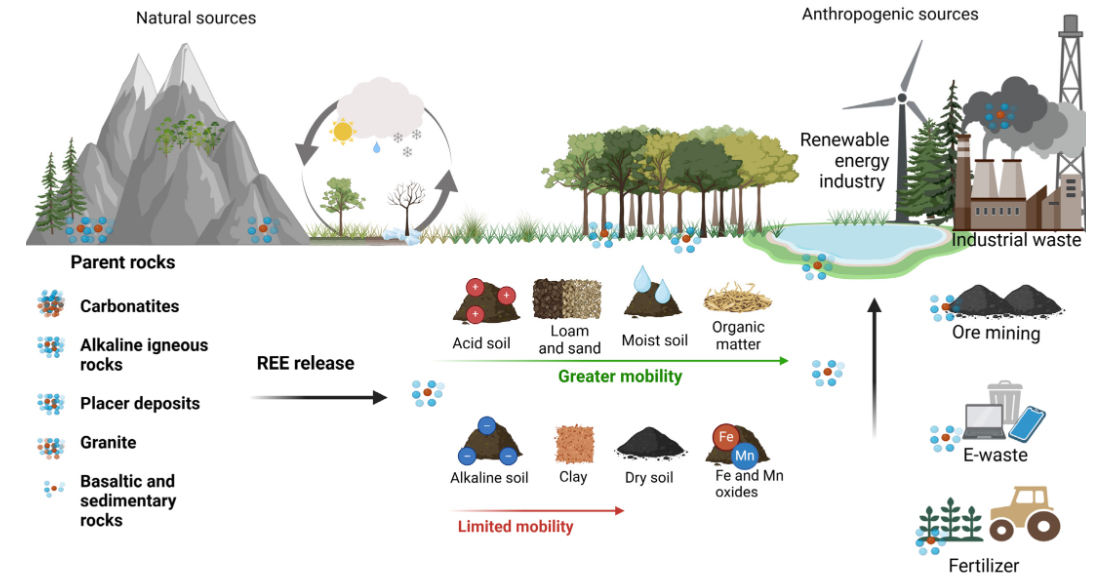
산업적 중요성과 더불어 지질 환경 내에서의 REEs의 지구화학적 거동 특성 또한 점차 주목받고 있다. REEs는 자연적 풍화 및 퇴적 과정, 광산 개발, 도시화, 산업활동 등 다양한 인위적∙자연적 경로를 통해 지질 매체 내에서 축적될 수 있으며(Fig. 1), 이로 인해 최근 신흥 오염물질(emerging contaminants)로 간주되기도 한다(Ribeiro et al., 2024; Yun et al., 2024; Martina et al., 2025). 따라서 토양 내 REEs의 오염 정도, 생물 이용성, 지화학적 거동 특성을 규명하려는 다양한 연구들이 최근 활발히 수행되고 있다(Vural, 2020; Zhang et al., 2023; Forsyth et al., 2025; Wang et al., 2024b; Rasool et al., 2025). 특히, 전통적으로 환경 내에서 화학적 특성이 안정하여(conservative) 용출 및 이동성이 낮다고 여겨져 온 REEs가 pH, 산화환원조건, 광물학적 배경 등 특정 환경 요인에 따라 선택적으로 용출되거나 이동할 수 있음이 여러 연구에서 밝혀지면서, 이들 원소에 대한 기존 인식이 재고되고 있는 실정이다(Hermassi et al., 2022; Wen et al., 2024; Amiel et al., 2024). 아울러 REEs의 정규화 패턴(normalized pattern)과 Ce 및 Eu 이상(anomaly)은 오염원 기원, 퇴적환경 이력, 지질학적 배경을 해석하는 유효한 지표(indicator)로 활용되고 있으며, 이러한 특성 덕분에 REEs는 환경 지구화학 분야에서 점차 중요한 관심 대상으로 자리 잡고 있다(Davranche et al., 2011; Kumar et al., 2019; Liu et al., 2022; Zhang and Shields, 2023; Pipe et al., 2025).
https://cdn.apub.kr/journalsite/sites/ksmer/2025-062-04/N0330620411/images/ksmer_62_04_11_F1.jpg
Fig. 1.

Natural and anthropogenic sources of rare earth elements and their environmental pathways (Martina et al., 2025).

REEs는 다양한 첨단 산업 분야에서 필수적인 원소로 활용될 뿐만 아니라, 환경 지구화학을 포함한 여러 학문 분야에서 화학 지표로서의 활용도가 점차 확대되고 있다. 그럼에도 불구하고 국내에서는 REEs의 존재형태(speciation), 거동 특성, 환경 지표로서의 활용 가능성에 대한 체계적인 연구가 거의 이뤄지지 않은 실정이다. 이에 본 총설에서는 REEs의 지구화학적 특성과 존재형태, 오염원 추적 및 지표적 응용 사례를 종합적으로 정리함으로써 환경 지구화학적 활용 가능성을 조망하고자 한다.

REEs의 지구화학적 특성

최근 산업 전반에 걸쳐 REEs의 활용도가 급증하면서 지질 환경으로의 유입 및 축적 가능성도 높아지고 있으며, 이에 따라 자원 개발뿐만 아니라 환경 내 존재형태와 거동 특성에 대한 지구화학적 관심 또한 확대되고 있다. 전통적으로 환경 지구화학 분야에서는 구리(Cu), 납(Pb), 아연(Zn)과 같은 중금속이 주로 다뤄져 왔는데, 이들은 산업 활동 및 도시화로 인해 고농도로 축적되고 생물독성과 인체 위해성이 명확히 규명되어 있어 관리와 감시에 대한 인식이 높다. 반면, REEs는 산업적 중요성에도 불구하고 환경 내 거동에 대한 연구는 상대적으로 부족했으며, 최근에서야 특정 지구화학적 조건에 따라 다양한 존재 형태로 나타나고 선택적으로 이동할 수 있음이 밝혀지고 있는 실정이다(Hermassi et al., 2022; Wen et al., 2024; Amiel et al., 2024).

일반적으로 REEs는 La에서 Eu(또는 Sm)까지의 경희토류(Light Rare Earth Elements, LREE), Gd에서 Lu까지의 중희토류(Heavy Rare Earth Elements, HREE)로 구분한다(Gupta and Krishnamurthy, 2005; IUPAC, 2019). 이러한 분류는 단순한 원소 번호의 나열이 아니라 각 원소의 전자 구조와 이온 특성의 차이에 기반한 것이며, 두 그룹은 환경 내 이동성, 흡착 특성, 결합 양상 등 지구화학적 거동에서 뚜렷한 차이를 보인다(Jordens et al., 2013; Jha et al., 2016; Goodenough et al., 2016). REEs의 가장 두드러진 특징은 대부분 +3의 산화 상태(REE3+)로 존재하고, 전자가 내부의 4f 오비탈에 위치하며, 란탄 수축(lanthanide contraction) 현상이 발생한다는 것이다. 첫 번째로 REEs는 지질 환경 내에서 대부분 +3의 단일 산화 상태를 가지는데 이는 이들 원소가 유사한 지구화학적 거동을 보이게 한다. 다만 Ce와 Eu는 두 개 이상의 산화수를 가지므로 이들 원소가 퇴적 또는 침전되는 환경을 추론할 수 있는 지표로서 역할을 할 수 있다(Cao et al., 2022a; Katsanou et al., 2022; Fang et al., 2023; Wang et al., 2024a). 두 번째로 REEs는 전자가 내부의 4f 오비탈에 위치하여 전자 교환 반응에 덜 관여하고 화학적으로 안정적이며 반응성이 낮다(Balaram, 2019; Parker et al., 2020; Li et al., 2025). 예를 들면, 전하량 측면에서 Cu2+, Pb2+, Zn2+ 등 일반적인 중금속 이온들은 REE3+와 유사해 보일 수 있으나, 중금속은 최외곽 전자들이 반응성이 높은 오비탈(예: Cu는 3d, Pb는 6p, Zn은 4s/3d 등)에 위치하여 전자 교환 반응이나 리간드 결합에 더 적극적으로 관여하고, 다양한 산화 상태 전이를 통해 높은 반응성과 생물학적 독성을 나타낼 수 있다(Mirica et al., 2004; Krężel and Maret, 2016; Gourlaouen and Piquemal, 2022). 반면에 REEs는 수화 반경이 크고 뚜렷한 양전하를 가지며 전자가 안정한 4f 오비탈에 존재하여 주로 점토광물, 산화망간(Mn-oxide), 산화철(Fe-oxide), 유기물 등의 표면과 선택적으로 결합하며, 이는 토양 환경 내에서 REEs가 일반적으로 비이동성(immobile)으로 거동하도록 만든다. 세 번째로 REEs는 La에서 Lu로 갈수록 이온 반경이 점진적으로 감소하는 ‘란탄 수축’ 현상이 나타나는데, 작아진 이온은 더 높은 전하 밀도를 가지므로 지질 환경에서 더 강하게 흡착되거나 침전되는 경향이 나타난다. 예를 들어, La3+의 이온 반경은 약 103 pm이고, Lu3+는 약 86 pm이며, 이러한 점진적 수축은 LREE와 HREE의 물리화학적 거동 차이를 설명하는 핵심적인 지표로 작용한다(Parker et al., 2002; Balaram, 2019; Hatje et al., 2024). 특히 LREE와 HREE 간의 이온 반경 차이는 특정 흡착 표면에 대한 결합 선호성 차이를 유도하며, 이는 환경 시료 내에서 정규화 패턴의 경사(gradient) 또는 Ce, Eu 이상과 같은 지시 특성으로 나타난다(Pourret and Davranche, 2013; Yanfei et al., 2016; Liu et al., 2018; Liu et al., 2021; Amiel et al., 2022).

REEs는 원소별로 지각 내 존재량이 상이하며, 이러한 존재량의 차이는 자연적 풍부도 및 환경 내 거동 특성을 해석하는 데 중요한 기준이 된다. 특히 환경 시료 내 농도 분포를 해석하거나 Chondrite 정규화를 통해 Ce 및 Eu 이상과 같은 지표를 분석하는 경우, 각 원소의 지각 평균 농도 및 Chondrite 기준 값은 필수적인 비교 지표로 활용된다. Table 2Taylor and McLennan(1985), Wedepohl(1995), Abou El-Anwar(2025) 등의 자료를 기반으로 한 주요 REEs의 지각 내 평균 농도와 Wakita et al.(1971), Pourmand et al.(2012)의 Chondrite 농도를 비교한 표이며, 이러한 기초 데이터는 REEs의 정규화 패턴 해석, 오염원 구분, 퇴적환경 평가 등에서 과학적 기준선으로 기능한다. 결과적으로, 이와 같은 지화학적 특성과 분포 경향은 REEs가 퇴적환경의 변화, 오염원 기원, 지질학적 배경 등을 해석하는 데 있어 매우 유용한 지표로 활용될 수 있는 과학적 기반을 제공하며, 기존의 중금속과는 구별되는 REEs만의 독자적인 지구화학적 응용 가능성을 보여준다.

Table 2.

Average concentrations of rare earth elements in Earth’s crust according to three representative geochemical studies (T.M: Taylor and McLennan; W.P: Wedepohl; A.A: Abu El-Anwar), and their corresponding chondritic abundances (W.K: Wakita et al.; P.M: Pourmand et al.)

Crustal values (mg/kg) Chondritic values (mg/kg)
T.M W.P A.A W.K P.M
La 16 30 11.3 0.34 0.2469
Ce 33 60 15.93 0.91 0.6321
Pr 3.9 6.7 - 0.121 0.0959
Nd 16 27 6.59 0.64 0.4854
Pm - - - - -
Sm 3.5 5.3 2.69 0.195 0.1556
Eu 1.1 1.3 - 0.073 0.0599
Gd 3.3 4 - 0.26 0.2093
Tb 0.6 0.65 - 0.047 0.0378
Dy 3.7 3.8 - 0.3 0.2577
Ho 0.8 0.8 - 0.078 0.0554
Er 2.2 2.1 - 0.2 0.1667
Tm 0.3 0.3 - 0.032 0.0261
Yb 2.2 2 - 0.22 0.1694
Lu 0.3 0.35 - 0.034 0.0256
Y 20 24 4.98 - 1.395
Sc 30 16 31.44 - 5.493

Differences in crustal values reflect variations in sampling sources, geological coverage, and analytical techniques.

REEs의 토양 내 존재형태 평가 방법

토양 및 퇴적물 내 금속의 존재형태는 금속의 이동성, 생물학적 이용 가능성, 독성 및 장기적 환경 영향을 평가하는 데 있어 핵심적인 정보를 제공한다. 이러한 존재형태를 파악하기 위해 가장 널리 사용되어 온 방법 중 하나가 바로 연속추출법(sequential extraction method)이다. 이 방법은 시료 내 금속을 다양한 화학적 결합 형태에 따라 단계적으로 분리하여, 금속이 어떤 지질상(phase)과 결합하고 있는지를 정량화하는 방법이다. 대표적인 연속추출 프로토콜인 Tessier et al.(1979)이 제안한 방법(이하 Tessier 방식)은 교환성, 탄산염 결합, 산화물 결합, 유기물 결합, 잔류 분획 등 다섯 가지 단계로 금속을 분리하며, 중금속(Cu, Zn, Pb 등)의 존재형태를 밝히는 데 효과적으로 활용되어 왔다(Tessier et al., 1979; Ali et al., 2024). 그러나 이러한 연속추출법은 Cu, Pb, Zn 등과 같이 +2의 반응성이 높은 전자 구조를 가진 중금속의 화학적 거동을 기준으로 설계된 것이므로 REEs에는 이론적∙실무적으로 완전히 부합하지 않을 수 있다. 예를 들면, REEs는 점토광물, 망간 산화물, 철 산화물, 유기물 등의 표면에 강하게 결합하는 경향이 있으며, 모암에서 기원한 인산염 광물(모나자이트, 제노타임 등)과 같은 매우 안정적인 광물 형태로도 존재할 수 있다. 이러한 특성으로 인해 실제로는 표면에 흡착된 상태이거나 인산염과 같이 매우 안정적인 형태로 존재함에도 불구하고, 기존 연속추출법으로는 용해되지 않아 잔류 분획(residual fraction)으로 과도하게 분류되는 사례가 보고되기 때문이다(Mihajlovic et al., 2014; Mihajlovic et al., 2017; Mihajlovic and Rinklebe, 2018; Cao et al., 2022b).

환경 지구화학 분야에서는 과거에도 이와 유사한 사례가 있었다. As는 일반적인 중금속과 달리 환경 내에서 음이온 또는 비정형 결합 형태로 존재하기 때문에, 기존의 연속추출법을 그대로 적용할 경우 그 존재형태가 왜곡되거나 과소평가될 수 있다(Keon et al., 2001; Wenzel et al., 2001; Han et al., 2013). 이에 따라 As에 특화된 추출법이 개발되었으며, 다양한 pH 조건, 선택적 리간드 조절, 기기 분석에의 영향 등을 고려하여 As의 여러 결합 형태를 정밀하게 분획하는 방식이 제안되어 왔다(Keon et al., 2001; Wenzel et al., 2001; Ahn et al., 2005; Javed et al., 2013; Wu et al., 2020) 이는 각 원소의 고유한 화학적 특성에 따라 연속추출법이 맞춤형으로 설계되어야 함을 보여주며, REEs 역시 이에 준하는 특화된 접근이 요구된다.

토양 내 REEs의 존재형태와 이를 밝히기 위한 연속추출을 적용하기 위해서는 모암의 조성 및 토양 구성 성분과 REEs의 반응에 대한 이해가 선행되어야 한다. REEs는 자연적으로 모암 내 REEs 함유 광물의 풍화 과정을 통해 토양에 유입되며, 일반적인 1차 공급원으로는 탄산염암(carbonatites), 알칼리성 화성암(alkaline igneous rocks), 중광물인 바스테나사이트(bastnäsite), 모나자이트(monazite), 제노타임(xenotime) 등을 포함하는 사광층(placer deposits) 등이 있다(Table 3)(Dostal, 2017; Martina et al., 2025). 이러한 암석이 풍화되면서 REEs는 1차 광물에서 토양 환경으로 점진적으로 방출되어 2차 광물에 포함되거나 점토광물, 산화물, 유기물과 상호작용하게 된다(Martina et al., 2025). 그러므로 토양 내에서 REEs는 모암의 성질을 지닌 탄산염, 인산염, 규산염 그리고 산화물 계열로 존재 가능하며, 점토광물의 내구 및 외구 착화(inner/outer-sphere complexation)된 형태(Nagasawa et al., 2024), 유기물과 착화(complexation with organic matter)된 형태(Lachaux et al., 2022), 풍화된 철산화물과 강하게 결합된 형태(Wu et al., 2022) 등으로도 존재할 수 있다.

Table 3.

Names and chemical compositions of key rare earth element (REE)-bearing minerals related to REE mineralization

Mineral Formula TREO (wt %)
Allanite (Y,Ln,Ca)2(Al,Fe3+)3(SiO4)3(OH) 39
Apatite (Ca,Ln)5(PO4)3(F,Cl,OH) 19
Bastnäsite (Ln,Y)(CO3)F 75
Eudialyte Na4(Ca,Ln)2(Fe2+,Mn2+,Y)ZrSi8O22(OH,Cl)2 9
Fergusonite (Ln,Y)NbO4 53
Gittinsite CaZrSi2O7 -
Limorite Y2(SiO4)(CO3) 68
Kainosite Ca2(Y,Ln)2Si4O12(CO3)∙H2O 38
Loparite (Ln,Na,Ca)(Ti,Nb)O3 30
Monazite (Ln,Th)PO4 65
Mosandrite (Na,Ca)3Ca3Ln(Ti,Nb,Zr)(Si2O7)2(O,OH,F)4 33
Parisite Ca(Ln)2(CO3)3F2 61
Pyrochlore (Ca,Na,Ln)2Nb2O6(OH,F) -
Rinkite (Ca,Ln)4Na(Na,Ca)2Ti(Si2O7)2(O,F)2 20
Steenstrupine Na14Ln6Mn2Fe2(Zr,Th)(Si6O18)2(PO4)7∙3H2O 31
Synchysite Ca(Ln)(CO3)2F 51
Xenotime YPO4 61
Zircon (Zr,Ln)SiO4 4

Ln = lanthanides; TREO = oxides of lanthanides and yttrium (Y)

REEs의 존재형태를 확인하기 위하여 다양한 연속추출법이 활용되고 있다. 그 중에서도 Tessier 방식과 유럽 표준화 기구(Community Bureau of Reference, BCR)에서 제안한 방법(이하 BCR 방식)은 오래된 방법임에도 여전히 널리 사용되고 있다(Rauret et al., 1999). Cao et al.(2000)은 Tessier 방식을 이용해 토양 내 REEs의 존재형태를 분석하고, 생물학적 이용 가능성이 높은 분획이 식물로 전이된 REE 함량과 어떻게 관련되는지 평가했다. 이 연구에서는 대부분의 REEs가 잔류상(60~90%)으로 존재했지만, 이동성 분획과 식물 전이 사이에 유의한 상관관계가 관찰되었다. Liu et al.(2019a)는 석탄회(fly ash)의 XRD, SEM-EDX, μXRF, μXANE 등 광물학적 분석과 연속추출법 결과를 비교했으나, 연속 추출법(Tessier 방식)은 REEs의 실제 분획과 일치하는 정밀한 분리가 어려움을 보였다. 이는 Tessier 방식 등 중금속 기반 추출법이 REEs의 특성을 충분히 반영하지 못함을 시사한다. Chen et al.(2023)도 논토양 내 REEs의 존재형태를 Tessier 방식을 이용하여 확인하였으나, 이동성이 높은 수용성 및 이온교환형은 약 2% 수준으로 나타난 반면에 잔류형은 50~80% 정도로 확인되었다. BCR 방식을 이용하여 REEs의 존재형태를 확인한 연구도 다수 수행되었다. Forsyth et al.(2025)은 BCR 방식으로 토양 내 존재하는 REEs를 교환성, 환원성 분획, 산화성 분획, 잔류형 등으로 구분하였으며, 이들 분획 중 식물로 전이되는 REEs를 규명하고자 하였다. 연구 결과 이동성이 높은 형태만 식물로 전이되는 것이 아니라, 교환성부터 잔류형까지 전체 분획이 식물로 전이되는 REEs 함량에 영향을 미치는 것으로 확인되었다. 잔류형으로 분류된 REEs가 식물로 전이되었다는 것은 식물의 대사작용에 의하여 잔류형이 용해되었다고 볼 수도 있으나, 실제로 잔류형을 더 세분화할 수 있음에도 하나의 분획으로 구분한 것으로 보는 것이 합리적일 것이다.

Tessier 방식과 BCR 방식은 세계적으로 가장 널리 이용되고 있는 방법이며, 다양한 연구 분야에서 유의미한 연구결과를 내고 있다. 그러나 전술한 것과 같이 연속추출법은 실제 토양 내 REEs의 화학적 결합 상태를 정확히 반영하는 데 한계가 있으며, 이는 실제 존재형태를 확인하는 XPS, EXAFS 등과 같은 기기분석 결과와 유의미한 연결성을 갖지 못하는 주요 원인이 된다. 더욱이, 대부분의 REEs가 잔류형으로 분류되어 실제 환경에서 식물로 전이되거나 용출될 수 있는 비잔류형 REEs에 대한 세분화된 정보를 얻지 못한다는 단점도 가지고 있다. 이에 Park et al.(2021)은 석탄회의 재활용을 목적으로 석탄회 내 존재하는 REEs의 존재형태를 확인하는데 Tessier 방식과 BCR 방식을 모두 이용하여 상호보완적인 연구를 수행하기도 하였다. 이 연구에서도 Tessier 방식에서는 REEs가 대부분 잔류형태(85%)로 나타나 정보 손실이 컸으나, BCR 방식에서는 잔류형 비율이 60~70%로 감소하였다. 이는 Tessier 방식에서 잔류형으로 분류되었던 REEs의 일부가 BCR 방식의 효과적인 용출제에 의해 산화형 및 유기물 결합형과 같은 비잔류형 분획으로 재분류되었음을 의미한다. 따라서, BCR 방식은 비록 단계 수는 적지만 REEs의 잠재적 이동성을 예측하는 데 더 세분화된 정보를 제공하였다. Sanematsu et al.(2011)은 알칼리 현무암 기원 라테라이트 내 REEs의 존재형태를 그들이 고안한 방법을 이용하여 확인하기도 하였으며(Table 4), Mittermüller et al.(2016)은 이온교환 형태, 탄산염 결합 형태, 환원성 결합 형태, 산 용해성 형태로 REEs를 구분∙추출한 후 BCR 방식과 결과를 비교하기도 하였으며, 그들이 개발한 방법이 REEs 중 생물이용 형태(bioavailable fraction)와 인산염 결합 형태(REEs-phosphates fraction)에 대하여 더 정밀한 정보를 제공할 수 있다고 주장하였다. 이외에도 토양 및 퇴적물 내 REEs의 존재형태 확인을 위한 다양한 연속추출 방법들이 다양하게 제시되었으며, 용출제나 대상 분획이 명확하게 다른 연속추출 방법을 정리하였다(Table 4). 그러나 Bauer et al.(2022)이 제시한 8단계(잔류형태 포함)의 연속추출 방법은 Lin et al.(2018)이 제시한 방법을 일부 수정하여 적용한 방법이며, Lin et al.(2018)Jegadeesan et al.(2008)의 방법을 변형하여 적용한 것이다. 더하여 Jegadeesan et al.(2008)은 Tessier 방식에 3개의 연속추출법을 취합하여 하나의 연속추출 방법을 설계하였는데, 3개의 연속추출법은 As(Al-Abed et al., 2007), Co&Ni(Sočo and kalembkiewicz, 2007a), Cu&Zn(Sočo and kalembkiewicz, 2007b)을 대상으로 제작된 방법이다. 동일하게 Table 4에 있는 Wang et al.(2021) 방법도 Tessier 방식과 Novikov et al.(2009)의 방법을 취합하여 만든 방법이며, 실험에 이용되는 용출제나 반응 시간이 중금속을 대상으로 하는 Tessier 방식과 매우 유사하다.

Table 4.

Sequential extraction methods for identifying the speciation of rare earth elements

Bauer et al., 2022Wang et al., 2021Sanematsu et al., 2011
Speciation Lixiviant Condition Speciation Lixiviant Condition Speciation Lixiviant Condition
Water
soluble
D/W
(pH 5.8)
24 h, 25°C Ion exchangeable 1 M MgCl2 (pH 7) 24 h, 25°C Ion adsorption and exchangeable 1 M CH3COONa∙3H2O
(pH 5)
1 h
Clay 1 M (NH4)2SO4
(pH 6)
24 h, 25°C
Carbonates 1 M CH3COONa∙3H2O
(pH 4)
24 h, 25°C Carbonates 1 M NH4 acetate + 
acetic acid
(pH 5)
12 h, 25°C Organic matter 0.1 M Na4P2O7
(pH 10)
1 h
Amorphous Mn oxides 0.1 M

NH2OH∙HCl (pH 3.5)
0.5 h, 25°C Fe and
Mn oxides
0.04 M NH2OH∙HCl + acetic acid (pH 2) 12 h, 95°C Amorphous Fe and crystalline Mn 1.24 M NH2OH
(pH 1)
2 h
Mn oxide and amorphous Fe 0.2 M (NH4)2C2O4 +
oxalic acid (pH 3)
4 h, 25°C
Fe and Mn oxides NH2OH (pH 1) 2 h, 60°C
Fe oxides 0.2 M (NH4)2C2O4 +
oxalic acid (pH 3) +
ascorbic acid (pH 2.3)
0.5 h, 80°C
Organic matter H2O2+CH3COONH4
(pH 2)
19 h, 25–85°C Organic matter HNO3 + H2O2 5.5 h, 85°C Clays Aqua regia 2 h, digestion
Residue LiBO2 Digestion Residue Microwave NaOH + HNO3 Digestion Residue HNO3, HF, HClO4, HCl 19 h, digestion

REEs는 중금속과 전자 구조나 화학적 거동 특성 면에서 본질적으로 다르기 때문에 중금속 기반 연속추출법(Tessier, BCR 등)을 그대로 적용하는 것은 한계가 뚜렷하다. 기존 방법들은 REEs의 주요 광물학적 형태나 결합 방식(예: 인산염, 흡착형 산화물 등)을 충분히 구분하지 못하고, 특히 생물학적 이용 가능성과의 연결성에 있어 과소평가되는 경우가 많다. 그럼에도 불구하고 이러한 전통적 연속추출법은 토양 및 퇴적물 내 REEs의 거동을 상대적으로 구분된 화학적 분획으로 파악할 수 있는 기초적 도구로서 여전히 가치가 있으며, 특히 상대적인 이동성이나 환경 중의 안정성, 식물 전이 경향성 등에 대한 전반적인 이해를 제공하는 데 유용하다. 또한 다양한 원소 간의 존재형태 차이를 비교하거나, 특정 환경 조건에 따른 REEs의 변화 경향성을 파악하는 데에도 효과적으로 활용될 수 있다. 궁극적으로는 REEs의 전자 구조 및 광물 결합 특성을 반영한 전용 연속추출 프로토콜을 개발하고 표준화함으로써, 보다 정밀한 분획 구분과 신뢰도 높은 환경거동 평가, 그리고 식물 전이 연구가 가능해질 것으로 기대된다.

환경지구화학적 지표로서의 REEs 활용

REEs는 원자량에 따라 LREE와 HREE로 나뉘며, 이들 간의 상대적인 분포 특성이나 특정 원소(예: Ce, Eu)의 이상은 기원물질의 특성이나 환경 조건에 따라 뚜렷한 차이를 보인다. 예를 들어, 산화 조건에서는 Ce3+가 Ce4+로 산화되어 불용성 침전물로 제거되며, 이에 따라 용존상 Ce의 상대적 고갈(음의 Ce 이상; negative Ce anomaly)이 발생한다. 반면에 환원 조건에서는 Ce3+ 상태가 유지되므로 Ce의 이상성이 뚜렷하게 나타나지 않거나 정상적인 패턴을 보이게 된다(Liu et al., 2019b; Liu et al., 2021; Cao et al., 2022a). 이와 유사하게 Eu도 Eu2+/Eu3+로 존재하는데 환원 조건이나 고온 환경에서 Eu2+로 환원되어 광물 내 다른 원소(예를 들면, Ca2+)를 치환할 수 있다. 즉, 토양, 퇴적물, 암석 등의 광물을 포함한 고체 물질에서 Ce가 양의 이상(positive Ce anomaly)을 보이는 경우 산화 환경에서 광물이 생성되었음을 추론할 수 있고, Eu가 양의 이상(positive Eu anomaly)을 보인다면 환원 환경이나 고온 조건(예를 들면, 마그마 등)에서 광물이 생성되었음을 예측할 수 있다. 이러한 Ce 및 Eu 이상은 현대 해양의 용존산소 농도 정량화(Cao et al., 2022a), 암석의 생성 환경 추론(Katsanou et al., 2022), 퇴적물의 생성 환경 및 지질학적 기원 추적(Fang et al., 2023; Wang et al., 2024a) 등에 이용된 바 있다.

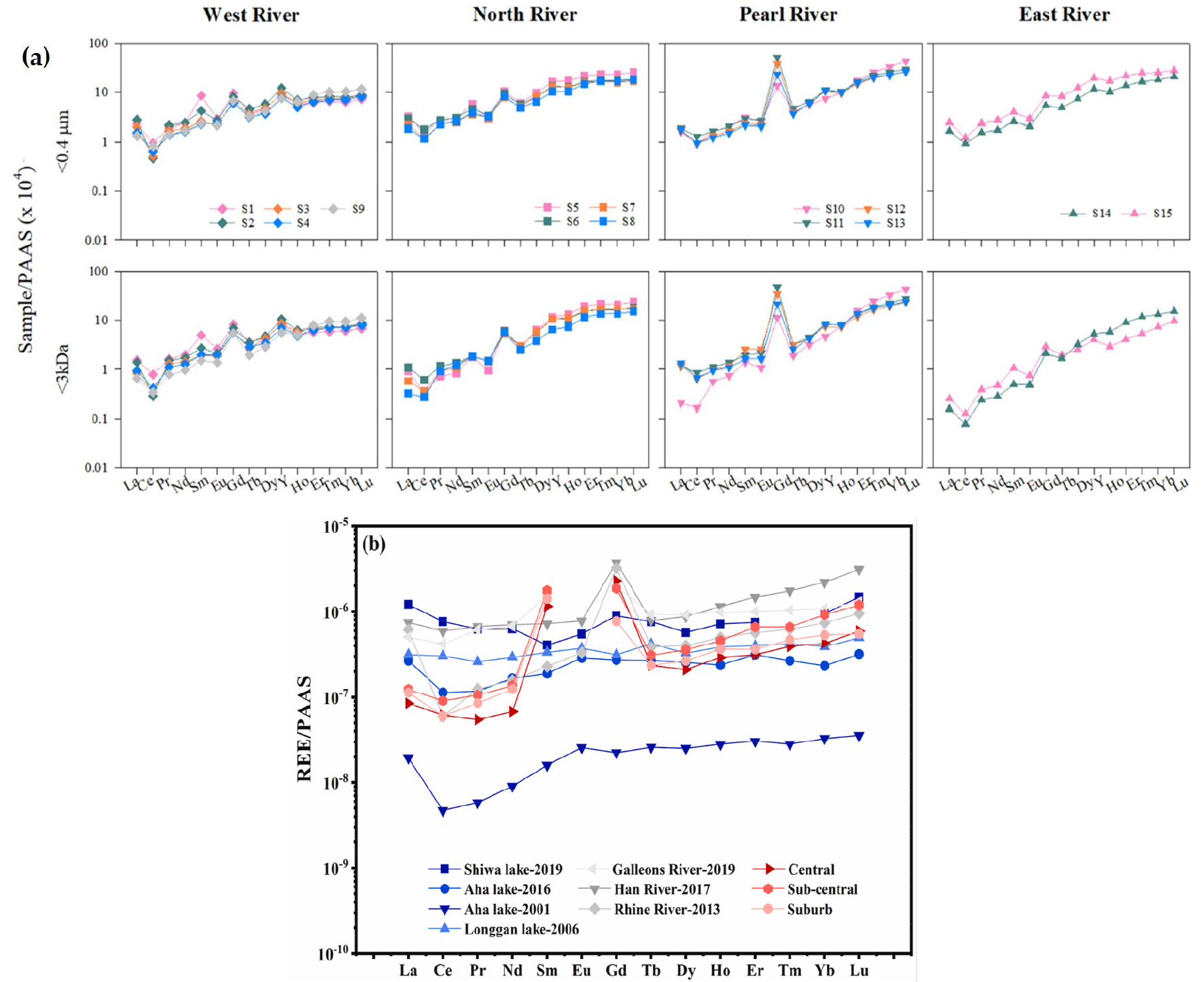
자연적으로 기원한 REEs는 일반적으로 LREEs에서 HREEs로 갈수록 점차 농도가 감소하는 완만한 패턴을 보인다. 여기에 Post-Archean Australian Shale(PAAS) 또는 Chondrite 정규화를 실시하면 비교적 평탄하거나 선형적인 곡선을 형성하게 되며, 이는 REE의 환경 내 거동 해석에 있어 기준선 역할을 한다. 그러나 Fig. 2와 같이 정규화 이후 특정 REEs(Gd, Sm 등)에서 주변 원소에 비해 불균형적으로 상승하는 패턴이 발생할 경우, 인위적 오염원 유입을 시사하는 지표로 해석될 수 있다.
https://cdn.apub.kr/journalsite/sites/ksmer/2025-062-04/N0330620411/images/ksmer_62_04_11_F2.jpg
Fig. 2.

Post-Archean Australian Shale (PAAS)-normalized rare earth element (REE) patterns in river water from different sites within the Pearl River Basin (a) and in Wuhan lakes compared with lakes from other regions worldwide (b). Data sources: (a) Ma and Wang, 2023; (b) Liu et al., 2022.

Fig. 2(a)는 중국 남부의 Pearl River에서 표층수를 채취하여 REEs 농도를 분석하고 이를 PAAS로 정규화한 결과이다(Ma and Wang, 2023). West, North, East River의 REEs 패턴은 우측으로 점차 증가하고 있는 반면에 Pearl River 시료는 Gd 이상이 뚜렷하게 나타난다. 이러한 특이적 패턴은 대표적인 인위적 기원의 예로 볼 수 있으며, Ma and Wang(2023)의 연구에서는 주변 토양 이용 현황 등을 참고하여 의료영상 조영제 등에 포함된 Gd가 하수처리 과정을 거쳐 자연 환경으로 유입된 결과로 추정하였다. Fig. 2(b)에서도 Sm과 Gd 이상이 뚜렷하게 나타나는데, 이는 앞선 연구와 동일하게 중국 중부의 Wuhan lake에서 표층수를 채취하고 PAAS로 정규화한 결과이다(Liu et al., 2022). 이 연구에서는 다양한 인간활동 요인들과 REEs 간의 Spearman 상관분석을 수행하였으며, 그 결과 Sm은 경작지 비율과 Gd는 인구밀도 및 병원밀도와 유의한 양의 상관관계를 보였다. 이러한 결과로부터 통계적으로 유의한 상관관계를 가진 요인은 REEs의 잠재적 기원으로 간주할 수도 있다고 주장하였다. 이처럼 REEs의 정규화 패턴에서 나타나는 특정 원소의 이상은 기존 중금속 지표만으로는 파악하기 어려운 새로운 오염원의 유입을 효과적으로 추적할 수 있는 중요한 환경지표로 활용될 수 있음을 보여준다.

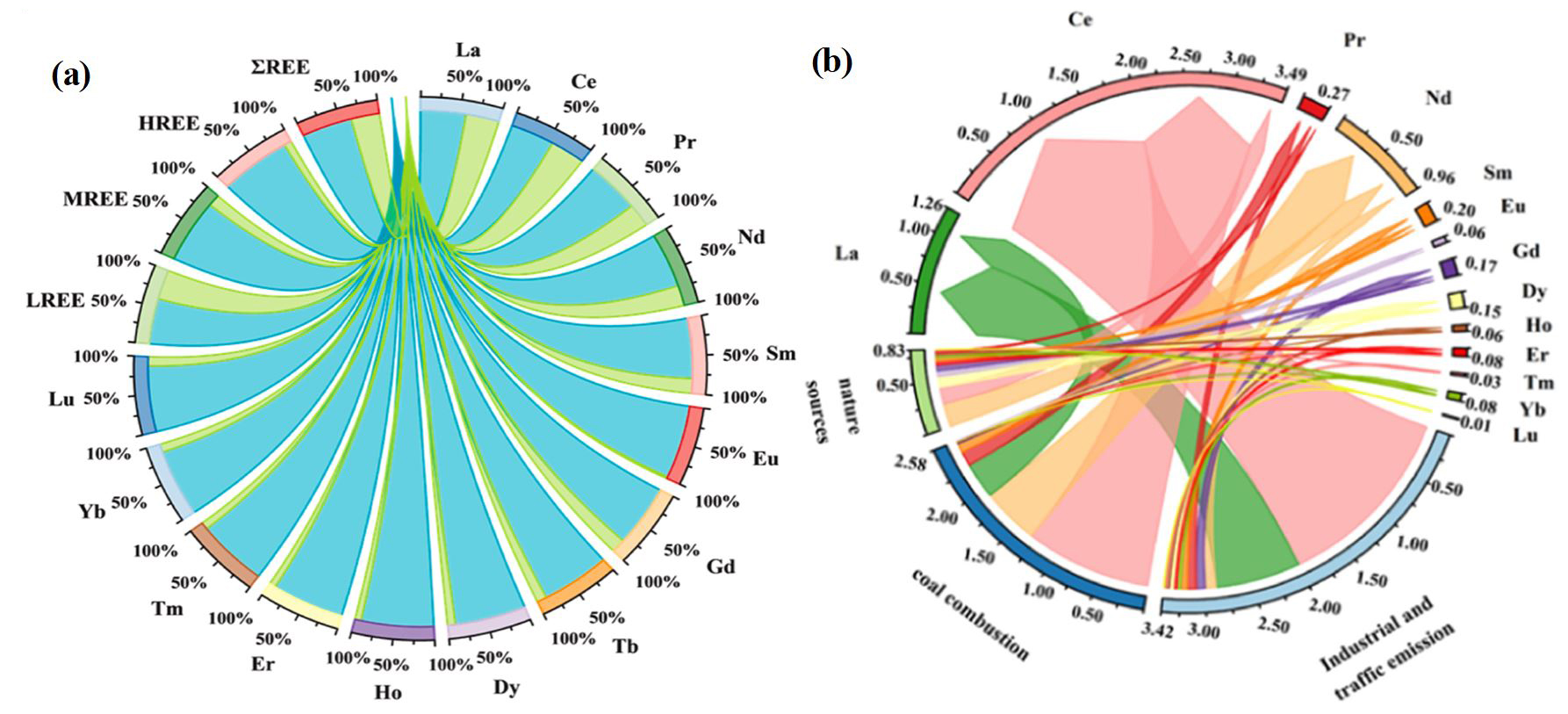
최근 환경지구화학 분야에서는 복잡한 오염원의 기원을 정량적으로 규명하기 위한 도구로 미국 환경보호청(U.S. EPA)에서 제공하는 Positive Matrix Factorization(PMF) 모델이 널리 활용되고 있다. PMF 모델은 관측된 시료 내 오염물질 농도와 불확실성(uncertainty) 데이터를 바탕으로 잠재적인 오염원의 조성 특성(profile)과 각 시료에 대한 기여도(contribution)를 동시에 도출하는 통계 기반 기법이며, 그동안 As, Cd, Pb 등 중금속이나 영양염류(NO3, PO43–), 유기오염물질 등이 주요 분석 인자로 사용되어 왔다. 그러나 최근에는 기존 오염물질 외에 REEs를 변수로 포함한 PMF 모델의 적용 사례가 보고되면서(Rabha et al., 2022; Ma and Han, 2024; Shen et al., 2024), REEs가 새로운 오염 추적 지표로 주목받고 있다. Ma and Han(2024)은 REEs를 이용하여 PMF 모델을 생성하였으며, 퇴적물 오염이 지질기원(63.9%)과 인위기원(36.1%)으로부터 유래한 것을 확인하였다(Fig. 3(a)). Shen et al.(2024)는 PMF 모델을 활용하여 미세먼지(PM 2.5) 내 REEs의 기원을 세 가지 요인(산업 및 교통 배출, 석탄 연소, 자연 기원)으로 분리하였다(Fig. 3(b)). 분석 결과, 산업 및 교통 배출원이 거의 모든 REEs에 대하여 가장 큰 기여를 하였으며, 석탄 연소 기원은 감소 추세, 자연 기원은 점진적 증가하는 것으로 추론하였다.
https://cdn.apub.kr/journalsite/sites/ksmer/2025-062-04/N0330620411/images/ksmer_62_04_11_F3.jpg
Fig. 3.

Examples of source contribution assessments of rare earth elements (REEs) using the positive matrix factorization model: (a) in sediments (Ma and Han, 2024) and (b) in PM 2.5 (Shen et al., 2024).

과거부터 환경지구화학 분야에서는 중금속 오염이 발생했을 때, 지질부하지수(geoaccumulation index)나 부화지수(enrichment factor)와 같은 지표를 활용하여 인위적 기원이 오염에 미친 영향을 대략적으로 평가하는 연구가 주로 수행되어 왔다. 인위적 기원을 보다 정밀하게 구분하기 위하여 Pb 등의 안정 동위원소 분석을 활용한 기원 추적 연구도 병행되어 왔으며, 이러한 동위원소 기술의 발전은 환경 오염원 추적 분야에 큰 진전을 가져왔다. 이러한 가운데, Shen et al.(2024)의 연구는 동위원소 분석 없이도 PMF 모델을 활용하여 인위적 REEs 오염원을 교통 배출, 석탄 연소, 자연기원 등으로 정량적 분류한 사례로 주목할 만하다. PMF 모델은 희토류뿐 아니라 중금속, 영양염, 유기물 등 다양한 변수들을 통합할 수 있다는 점에서 향후 활용 가능성이 매우 크며, 특히 REEs는 오염원에 따라 농도 분포 특성이나 PAAS 및 Chondrite 정규화 분획 패턴이 상이하게 나타나므로 PMF 모델에 REEs를 포함시킬 경우 전자폐기물, 광촉매 물질, 의료 폐수 등 기존 중금속만으로는 식별이 어려웠던 신종 오염원을 효과적으로 추적할 수 있는 가능성을 보여준다. 즉, 석탄∙석유∙자동차 등 전통 산업에서 유래한 오염원과 Nd, Dy 등 특정 REEs를 활용하는 첨단 산업 기반 오염원을 정량적으로 구분할 수 있는 잠재력을 제시하며, REEs는 중금속 분석을 보완하는 고해상도 지시 원소로 기능할 수 있다. 향후 PMF 모델에 REEs를 체계적으로 통합한다면, 다양한 산업 오염원이 중첩된 복합 환경에서도 더욱 정밀한 오염원 규명이 가능해질 것이며, 이는 첨단 산업 오염에 대한 정책적 대응 및 맞춤형 환경관리 전략 수립을 위한 핵심 기초자료로 활용될 수 있을 것이다. 결국, REEs는 환경 반응성, 분별 특성, 광범위한 산업적 활용을 바탕으로, 향후 환경지구화학 연구 전반에서의 적용성과 학술적 중요성이 더욱 커질 것으로 기대된다.

결 론

본 총설은 REEs의 지구화학적 거동과 환경에서의 응용 가능성을 종합적으로 고찰하여, 이들 원소가 기존 중금속 지표의 한계를 보완하는 강력한 오염원 추적 지표임을 확인하였다. 특히, REEs의 독특한 Ce 및 Eu 이상과 정규화 패턴은 오염원 기원 및 환경 조건을 해석하는 데 실질적인 정보를 제공하는 핵심 지표로 분석되었다.

본 총설은 REEs의 존재형태 평가에 있어 전통적인 연속추출법이 갖는 한계를 명확히 제시하고, BCR 방식과 같은 대안적 추출법이 상대적으로 더 유의미한 정보를 제공함을 확인하였다. 하지만 이 또한 완벽한 해결책이 아니며, 추출법에 따라 REEs의 분획 결과가 상이하게 나타날 수 있음을 강조하였다. 또한, PMF 모델에 REEs를 통합하여 복합 오염원을 정량적으로 구분한 최신 연구 동향을 분석함으로써, REEs가 기존 지표로는 식별이 어려운 첨단 산업 오염원을 정밀하게 추적하는 데 효과적인 도구임을 입증하였다.

결론적으로, 본 총설은 REEs에 대한 기초 이론부터 환경지구화학적 응용 사례까지 체계적으로 정리하여, 국내 관련 연구가 부족한 현 상황에서 향후 연구를 위한 핵심 자료로 활용될 수 있는 기반을 마련하였다. REEs의 환경 관리 및 오염원 추적 도구로서의 잠재력을 극대화하기 위해서는 REEs의 특성을 반영한 전용 연속추출 프로토콜의 개발 및 표준화가 필수적이며, 국내 환경에 특화된 REEs 배경 농도 데이터베이스 구축과 같은 후속 연구가 중요하다. 이러한 노력을 통해 REEs는 미래 환경 모니터링 및 정책 수립에 있어 중요한 역할을 수행할 수 있을 것으로 기대한다.


Acknowledgements

이 연구는 한국지질자원연구원 기본사업(25-3414) 및 환경부와 한국환경산업기술원의 환경기술개발사업(과제번호 RS-2024-00337326)의 지원을 받아 수행하였습니다.

References

1

Abou El-Anwar, E.A., 2025. Geochemical evaluation of the rare earth and trace elements in the Upper Eocene carbonate of Abu Rimth Formation, Southern Galala Plateau, Eastern Desert, Egypt, Journal of Umm Al-Qura University for Applied Science, 5, p.1-11.

10.1007/s43994-025-00228-3
2

Ahn, J.S., Park, Y.S., Kim, J.Y., and Kim, K.Y., 2005. Mineralogical and geochemical characterization of arsenic in an abandoned mine tailings of Korea, Environmental Geochemistry and Health, 27, p.147-157.

10.1007/s10653-005-0121-8
3

Al-Abed, S.R., Jegadeesan, G., Purandare, J., and Allen, D., 2007. Arsenic release from iron rich mineral processing waste: influence of pH and redox potential, Chemosphere, 66, p.775-782.

10.1016/j.chemosphere.2006.07.045
4

Ali, J., Tuzen, M., Shaikh, Q., Jatoi, W.B., Feng, X., Sun, G., and Saleh, T.A., 2024. A review of sequential extraction methods for fractionation analysis of toxic metals in solid environmental matrices, TrAC Trends in Analytical Chemistry, 173, 117639.

10.1016/j.trac.2024.117639
5

Amiel, N., Dror, I., and Berkowitz, B., 2022. Mobility and retention of rare earth elements in porous media, ACS Omega, 7(23), p.19491-19501.

10.1021/acsomega.2c0118035722013PMC9202298
6

Amiel, N., Dror, I., and Berkowitz, B., 2024. Mobility of rare earth elements in coastal aquifer materials under fresh and brackish water conditions, ACS Environmental Au, 4(4), p.186-195.

10.1021/acsenvironau.4c0000139035866PMC11258752
7

Balaram, V., 2019. Rare earth elements: A review of applications, occurrence, exploration, analysis, recycling, and environmental impact, Geoscience Frontiers, 10(4), p.1285-1303.

10.1016/j.gsf.2018.12.005
8

Bauer, S., Yang, J., Stuckman, M., and Verba, C., 2022. Rare earth element (REE) and critical mineral fractions of central appalachian coal-related strata determined by 7-Step sequential extraction, Minerals, 12(11), 1350.

10.3390/min12111350
9

Cao, C., Liu, X.M., and Chen, J., 2022a. Cerium anomaly as a tracer for paleo-oceanic redox conditions: A thermodynamics-based Ce oxidation modeling approach, Frontiers in Earth Science, 10, 927826.

10.3389/feart.2022.927826
10

Cao, Y.W., Liu, X.M., Wang, C., Bai, E., and Wu, N., 2022b. Rare earth element geochemistry in soils along arid and semiarid grasslands in northern China, Ecological Processes, 11, 29.

10.1186/s13717-022-00375-z
11

Cao, X., Wang, X., and Zhao, G., 2000. Assessment of the bioavailability of rare earth elements in soils by chemical fractionation and multiple regression analysis, Chemosphere, 40(1), p.23-28,

10.1016/S0045-6535(99)00225-8
12

Charalampides, G., Vatalis, K.I., Apostoplos, B., and Ploutarch- Nikolas, B., 2015. Rare earth elements: industrial applications and economic dependency of Europe, Procedia Economics and Finance, 24, p.126-135.

10.1016/S2212-5671(15)00630-9
13

Chen, M., Chen, J., Wang, H., Lu, X., Luo, X., and Wang, M., 2023. Bioaccumulation of selenium, heavy metals and rare earth elements with different rice cultivars grown on seleniferous soils in Lianchen county, Fujian province, China, Environments, 10(7), 114.

10.3390/environments10070114
14

Davranche, M., Grybos, M., Gruau, G., Pédrot, M., Dia, A., and Marsac, R., 2011. Rare earth element patterns: A tool for identifying trace metal sources during wetland soil reduction, Chemical Geology, 284(1-2), p.127-137.

10.1016/j.chemgeo.2011.02.014
15

Dostal, J., 2017. Rare earth element deposits of alkaline igneous rocks, Resources, 6(3), 34.

10.3390/resources6030034
16

Fang, X., Peng, B., Guo, X., Wu, S., Xie, S., Wu, J., Yang, X., Chen, H., and Dai, Y., 2023. Distribution, source and contamination of rare earth elements in sediments from lower reaches of the Xiangjiang River, China, Environmental Pollution, 336, 122384.

10.1016/j.envpol.2023.122384
17

Forsyth, K., Dia, A., Marques, R., Prudêncio, M.I., Obregón-Castro, C., Diamantino, C., Carvalho, E., Pattier, M., Davranche, M., and Pédrot, M., 2025. Relationship between the distribution of rare earth elements in soil pools with plant uptake: a sequential extraction study, Plant and Soil, 512, p.1137-1152.

10.1007/s11104-024-07135-2
18

Goodenough, K.M., Schilling, J., Jonsson, E., Kalvig, P., Charles, N., Tuduri, J., Deady, E.A., Sadeghi, M., Schiellerup, H., Müller, A., Bertrand, G., Arvanitidis, N., Eliopoulos, D.G., Shaw, R.A., Thrane, K., and Keulen, N., 2016. Europe's rare earth element resource potential: An overview of REE metallogenetic provinces and their geodynamic setting, Ore Geology Reviews, 72(1), p.838-856.

10.1016/j.oregeorev.2015.09.019
19

Gourlaouen, C. and Piquemal, J.-P., 2022. On the quantum chemical nature of lead(II) “Lone Pair”, Molecules, 27(1), 27.

10.3390/molecules2701002735011259PMC8746439
20

Gupta, C.K. and Krishnamurthy, N., 2005. Extractive Metallurgy of Rare Earths, CRC Press, Boca Raton, Florida.

10.1201/9780203413029
21

Han, H.J., Kim, J.Y., Lee, B.T., Kim, K.W., Kim, Y.S., and Lee, J.S., 2013. Comparative study on the characteristics of two sequential extraction methods for arsenic fractionations in the soil, Journal of the Korean Society of Mineral and Energy Resources Engineers, 50(1), p.35-43.

10.12972/ksmer.2013.50.1.035
22

Hatje, V., Schijf, J., Johannesson, K.H., Andrade, R., Caetano, M., Brito, P., Haley, B.A., Lagarde, M., and Jeandel, C., 2024. The global biogeochemical cycle of the rare earth elements, Global Biogeochemical Cycles, 38(6), e2024GB008125.

10.1029/2024GB008125
23

Hermassi, M., Granados, M., Valderrama, C., Ayora, C., and Cortina, J.L., 2022. Recovery of rare earth elements from acidic mine waters: An unknown secondary resource, Science of The Total Environment, 810, 152258.

10.1016/j.scitotenv.2021.152258
24

IUPAC, 2019. Compendium of Chemical Terminology (“Gold Book”), Online version, International Union of Pure and Applied Chemistry, https://goldbook.iupac.org

25

Javed, M.B., Kachanoski, G., and Siddique, T., 2013. A modified sequential extraction method for arsenic fractionation in sediments, Analytica Chimica Acta, 787, p.102-110.

10.1016/j.aca.2013.05.050
26

Jegadeesan, G., Al-Abed, S.R., and Pinto, P., 2008. Influence of trace metal distribution on its leachability from coal fly ash, Fuel, 87, p.1887-1893.

10.1016/j.fuel.2007.12.007
27

Jha, M.K., Kumari, A., Panda, R., Kumar, J.R., Yoo, K., and Lee, J.Y., 2016. Review on hydrometallurgical recovery of rare earth metals, Hydrometallurgy, 165(1), p.2-26.

10.1016/j.hydromet.2016.01.035
28

Jordens, A., Cheng, Y.P., and Waters, K.E., 2013. A review of the beneficiation of rare earth element bearing minerals, Minerals Engineering, 41, p.97-114.

10.1016/j.mineng.2012.10.017
29

Katsanou, K., Siavalas, G., Panagopoulos, G., and Lambrakis, N., 2022. Rare earth element patterns in a rapidly changing karst environment, Applied Geochemistry, 146, 105462.

10.1016/j.apgeochem.2022.105462
30

Keon, N.E., Swartz, C.H., Brabander, D.J., Harvey, C., and Hemond, H.F., 2001. Validation of an arsenic sequential extraction method for evaluating mobility in sediments, Environmental Science & Technology, 35(13), p.2778-2784.

10.1021/es001511o
31

Krężel, A. and Maret, W., 2016. The biological inorganic chemistry of zinc ions, Archives of Biochemistry and Biophysics, 611, p.3-19.

10.1016/j.abb.2016.04.01027117234PMC5120989
32

Kumar, M., Goswami, R., Awasthi, N., and Das, R., 2019. Provenance and fate of trace and rare earth elements in the sediment-aquifers systems of Majuli River Island, India. Chemosphere, 237, 124477.

10.1016/j.chemosphere.2019.124477
33

Lachaux, N., Catrouillet, C., Marsac, R., Poirier, L., Pain-Devin, S., Gross, E.M., Giamberini, L., 2022. Implications of speciation on rare earth element toxicity: a focus on organic matter influence in Daphnia magna standard test, Environmental Pollution, 307, 119554.

10.1016/j.envpol.2022.119554
34

Li, J., Zhao, Y., Yu, D., and Zhan, C., 2025. Recent advances in d-f transition lanthanide complexes for organic light-emitting diodes: insights into structure-luminescence relationships, Laser & Photonics Reviews, 19(13), 2402198.

10.1002/lpor.202402198
35

Lin, R., Stuckman, M., Howard, B.H., Bank, T.L., Roth, E.A., Macala, M.K., Lopano, C., Soong, Y., and Granite, E.J., 2018. Application of sequential extraction and hydrothermal treatment for characterization and enrichment of rare earth elements from coal fly ash, Fuel, 232, p.124-133.

10.1016/j.fuel.2018.05.141
36

Liu, H., Pourret, O., Guo, H., Martinez, R.E., and Zouhri, L., 2018. Impact of hydrous manganese and ferric oxides on the behavior of aqueous rare earth elements (REE): Evidence from a modeling approach and implication for the sink of REE, International Journal of Environmental Research and Public Health, 15(12), 2837.

10.3390/ijerph1512283730545162PMC6313485
37

Liu, P., Huang, R., and Tang, Y., 2019a. Comprehensive understandings of rare earth element (REE) speciation in coal fly ashes and implication for REE extractability, Environmental Science & Technology, 53(9), p.5369-5377.

10.1021/acs.est.9b00005
38

Liu, X.M., Hardisty, D.S., Lyons, T.W., and Swart, P.K., 2019b. Evaluating the fidelity of the cerium paleoredox tracer during variable carbonate diagenesis on the Great Bahamas Bank, Geochimica Cosmochimica Acta, 248, p.25-42.

10.1016/j.gca.2018.12.028
39

Liu, X.M., Kah, L.C., Knoll, A.H., Cui, H., Wang, C., Bekker, A., and Hazen, R.M., 2021. A persistently low level of atmospheric oxygen in Earth’s middle age, Nature Communications, 12, 351.

10.1038/s41467-020-20484-733441548PMC7806885
40

Liu, Y., Wu, Q., Jia, H., Wang, Z., Gao, S., and Zeng, J., 2022. Anthropogenic rare earth elements in urban lakes: Their spatial distributions and tracing application, Chemosphere, 300, 134534.

10.1016/j.chemosphere.2022.134534
41

Ma, L. and Wang, W.X., 2023. Dissolved rare earth elements in the Pearl River Delta: Using Gd as a tracer of anthropogenic activity from river towards the sea, Science of The Total Environment, 856, 159241.

10.1016/j.scitotenv.2022.159241
42

Ma, S. and Han, G., 2024. Rare earth elements reveal the human health and environmental concerns in the largest tributary of the Mekong river, Northeastern Thailand, Environmental Research, 252(3), 118968.

10.1016/j.envres.2024.118968
43

Martina, A., Ferroni, L., and Marrocchino, E., 2025. The soil-plant continuity of rare earth elements: Insights into an enigmatic class of xenobiotics and their interactions with plant structures and processes, Journal of Xenobiotics, 15(2), 46.

10.3390/jox1502004640126264PMC11932217
44

Mihajlovic, J. and Rinklebe, J., 2018. Rare earth elements in German soils - A review, Chemosphere, 205, p.514-523.

10.1016/j.chemosphere.2018.04.059
45

Mihajlovic, J., Giani, L., Stärk, H.J., and Rinklebe, J., 2014. Concentrations and geochemical fractions of rare earth elements in two different marsh soil profiles at the North Sea, Germany, Journal of Soils and Sediments, 14, p.1417-1433.

10.1007/s11368-014-0895-3
46

Mihajlovic, J., Stärk, H.J., and Rinklebe, J., 2017. Rare earth elements and their release dynamics under pre-definite redox conditions in a floodplain soil, Chemosphere, 181, p.313-319.

10.1016/j.chemosphere.2017.04.036
47

Mirica, L.M., Ottenwaelder, X., and Stack, T.D.P., 2004. Structure and spectroscopy of copper−dioxygen complexes, Chemical Reviews, 104(2), p.1013-1046.

10.1021/cr020632z
48

Mittermüller, M., Saatz, J., and Daus, B., 2016. A sequential extraction procedure to evaluate the mobilization behavior of rare earth elements in soils and tailings materials, Chemosphere, 147, p.155-162.

10.1016/j.chemosphere.2015.12.101
49

Nagasawa, M., Shimizu, Y., Yamaguchi, A., Tokunag, K., Mukai, H., Aoyagi, N., Mei, H., and Takahashi, Y., 2024. Interpretation of vertical migration and enrichment processes of rare earth elements (REEs) in ion-adsorption-type mineralization in Japan based on REE speciation analyses, Chemical Geology, 670, 122431.

10.1016/j.chemgeo.2024.122431
50

Naumov, A.V., 2008. Review of the world market of rare-earth metals, Russian Journal of Non-Ferrous Metals, 49, p.14-22.

10.1007/s11981-008-1004-6
51

Novikov, A.P., Kalmykov, S.N., Kuzovkina, E.V., Myasoedov, B.F., Fujiwara, K., and Fujiwara, A., 2009. Evolution of actinide partitioning with colloidal matter collected at PA “Mayak” site as studied by sequential extraction, Journal of Radioanalytical and Nuclear Chemistry, 280(3), p.629-634.

10.1007/s10967-008-7397-y
52

Park, S., Kim, M., Lim, Y., Yu, J., Chen, S., Woo, S.W., Yoon, S., Bae, S., and Kim, H., 2021. Characterization of rare earth elements present in coal ash by sequential extraction, Journal of Hazardous Materials, 402, 123760.

10.1016/j.jhazmat.2020.123760
53

Parker, D., Dickins, R.S., Puschmann, H., Crossland, C., and Howard, J.A.K., 2002. Being excited by lanthanide coordination complexes: aqua species, chirality, excited-state chemistry, and exchange dynamics, Chemical Reviews, 102(6), p.1977-2010.

10.1021/cr010452+
54

Parker, D., Suturina, E.A., Kuprov, I., and Chilton, N.F., 2020. How the ligand field in lanthanide coordination complexes determines magnetic susceptibility anisotropy, paramagnetic NMR shift, and relaxation behavior, Accounts of Chemical Research, 53(8), p.1520-1534.

10.1021/acs.accounts.0c0027532667187PMC7467575
55

Pipe, A.B., Leybourne, M.I., Johannesson, K.H., Hannigan, R.E., and Layton-Matthews, D., 2025. Trace and rare earth element geochemistry of black shales from the Upper Ordovician Utica Shale magnafacies, Chemical Geology, 672, 122507.

10.1016/j.chemgeo.2024.122507
56

Pourmand, A., Dauphas, N., and Ireland, T.J., 2012. A novel extraction chromatography and MC-ICP-MS technique for rapid analysis of REE, Sc and Y: Revising CI chondrite and Post-Archean Australian Shale (PAAS) abundances, Chemical Geology, 291, p.38-54.

10.1016/j.chemgeo.2011.08.011
57

Pourret, O. and Davranche, M., 2013. Rare earth element sorption onto hydrous manganese oxide: A modeling study, Journal of Colloid and Interface Science, 395, p.18-23.

10.1016/j.jcis.2012.11.054
58

Rabha, S., Subramanyam, K.S.V., Sawant, S.S., and Saikia, B.K., 2022. Rare-Earth Elements and Heavy Metals in Atmospheric Particulate Matter in an Urban Area, ACS Earth and Space Chemistry, 6(7), p.1725-1732.

10.1021/acsearthspacechem.2c00009
59

Rasool, M. H., Ridha, S., Ahmad, M., Shamsuddun, R.A.B., Zahoor, M.K., and Khan, A., 2025. A mineralogical perspective on rare earth elements (REEs) extraction from drill cuttings: A Review, Minerals, 15(5), 533.

10.3390/min15050533
60

Rauret, G., López-Sánchez, J.F., Sahuquillo, A., Rubio, R., Davidson, C., Ure, A., and Quevauviller, P., 1999. Improvement of the BCR three step sequential extraction procedure prior to the certification of new sediment and soil reference materials, Journal of Environmental Monitoring, 1, p.57-61.

10.1039/a807854h
61

Ribeiro, P.G., de Oliveira, C., Guerra, M.B.B., de Carvalho, T.S., Martins, G.C., da Silveira Pereira, W.V., Ramos, S.J., and Guilherme, L.R.G., 2024. Rare earths as emerging trace element contaminants in the soil, Current Pollution Reports, 10, p.443-458.

10.1007/s40726-024-00312-y
62

Sanematsu, K., Moriyama, T., Sotouky, L., and Watanabe, Y., 2011. Mobility of rare earth elements in basalt-derived laterite at the bolaven plateau, southern Laos, Resources Geology, 61(2), p.140-158.

10.1111/j.1751-3928.2011.00155.x
63

Shen, Y.W., Zhao, C.X., Zhao, H., Dong, S.F., Guo, Q., Xie, J.J., Lv, ML., Yuan, C.G., 2024. Insight study of rare earth elements in PM2.5 during five years in a Chinese inland city: Composition variations, sources, and exposure assessment, Journal of Environmental Science, 138, p.439-449.

10.1016/j.jes.2023.04.015
64

Sočo, E. and Kalembkiewicz, J., 2007a. Investigations of chemical fraction of Co and Ni in industrial fly ash and mobility of metals in environmental conditions, Chemosphere, 67, p.359-364.

10.1016/j.chemosphere.2006.09.077
65

Sočo, E. and Kalembkiewicz, J., 2007b. Investigations of sequential leaching behaviour of Cu and Zn from coal fly ash and their mobility in environmental conditions, Journal of Hazardous Materials, 145, p.482-487.

10.1016/j.jhazmat.2006.11.046
66

Suli, L.M., Ibrahim, W.H.W., Aziz, B.A., Deraman, M.R., and Ismail, N.A., 2017. A review of rare earth mineral processing technology, Chemical Engineering Research Bulletin, 19, p.20-35.

10.3329/cerb.v19i0.33773
67

Taylor, S.R. and McLennan, S.M., 1985. The continental crust: Its composition and evolution, Blackwell Scientific Publication, Oxford, UK

68

Tessier, A., Campbell, P.G.C., and Bisson, M., 1979. Sequential extraction procedure for the speciation of particulate trace metals, Analytical Chemistry, 51(7), p.844-851.

10.1021/ac50043a017
69

Vural, A., 2020. Investigation of the relationship between rare earth elements, trace elements, and major oxides in soil geochemistry, Environmental Monitoring and Assessment, 192, 124.

10.1007/s10661-020-8069-9
70

Wakita, H., Rey, P., and Schmitt, R.A., 1971. Abundances of the 14 Rare Earth Elements and 12 Other Elements in Apollo 12 Samples, Proceedings of the Second Lunar Science Conference, 2, p.1319-1329.

71

Wang, S., Wang, Z., Gao, S., Zhang, X., Zeng, J., Wu, Q., 2024a. Rare earth elements in lake sediments record historic environmental influences from anthropogenic activities, Ecological Indicators, 159, 111680.

10.1016/j.ecolind.2024.111680
72

Wang, X., Li, B., Zhu, M., Tang, J., Liu, G., Wang, J., Wang, Y., and Hu, J., 2024b. Geochemical behavior of rare earth elements in mining-affected waters, southwest China, Science of the Total Environment, 957, 177747.

10.1016/j.scitotenv.2024.177747
73

Wang, Y., Noble, A., Vass, C., and Ziemkiewicz, P., 2021. Speciation of rare earth elements in acid mine drainage precipitates by sequential extraction, Minerals Engineering, 168, 106827.

10.1016/j.mineng.2021.106827
74

Wedepohl, K.H., 1995. The composition of the continental crust, Geochimica et Cosmochimica Acta, 59, p.1217-1232.

10.1016/0016-7037(95)00038-2
75

Wen, Y., Liu, P., Wang, Q., Zhao, S., and Tang, Y., 2024. Organic ligand-mediated dissolution and fractionation of rare-earth elements (REEs) from carbonate and phosphate minerals, ACS Earth and Space Chemistry, 8(5), p.1048-1061.

10.1021/acsearthspacechem.4c0000938774356PMC11103772
76

Wenzel, W.W., Kirchbaumer, N., Prohaska, T., Stingeder, G., Lombi, E., and Adriano, D.C., 2001. Arsenic fractionation in soils using an improved sequential extraction procedure, Analytica Chimica Acta, 436(2), p.309-323.

10.1016/S0003-2670(01)00924-2
77

Wu, C.Y., Chu, M.F., Huang, K.F., and Hseu, Z.Y., 2022. Rare earth elements associated with pedogenic iron oxides in humid and tropical soils from different parent materials, Geoderma, 423, 115966.

10.1016/j.geoderma.2022.115966
78

Wu, D., Yang, S., Li, F., Zhu, T., and Chen, H., 2020. Online sequential fractionation analysis of arsenic adsorbed onto ferrihydrite by ICP-MS, Analytical Chemistry, 92(1), p.14309-14313.

10.1021/acs.analchem.0c03516
79

Yanfei, X., Li, H., Zhiqi, L., Feng, Z., and Wang, L., 2016. Adsorption ability of rare earth elements on clay minerals and its practical performance, Journal of Rare Earths, 34(5), p.543-548.

10.1016/S1002-0721(16)60060-1
80

Yun, J., Yang, Q., Zhao, C., Chen, C., and Liu, G., 2024. Atmospheric emissions of fine particle matter bound rare earth elements from industry, Nature Communications, 15, 9338.

10.1038/s41467-024-53684-639472427PMC11522377
81

Zhang, K. and Shields, G.A., 2023. Early diagenetic mobilization of rare earth elements and implications for the Ce anomaly as a redox proxy, Chemical Geology, 635, 121619.

10.1016/j.chemgeo.2023.121619
82

Zhang, Y., Su, B., Shao, S., Li, N. Jiao, H., Dan, Y., Zhang, H., and Gao, C. 2023. Geochemical behavior and source analysis of rare earth elements in intensive agriculture soils through high-resolution sampling, Science of the Total Environment, 905, 167777.

10.1016/j.scitotenv.2023.167777
페이지 상단으로 이동하기